




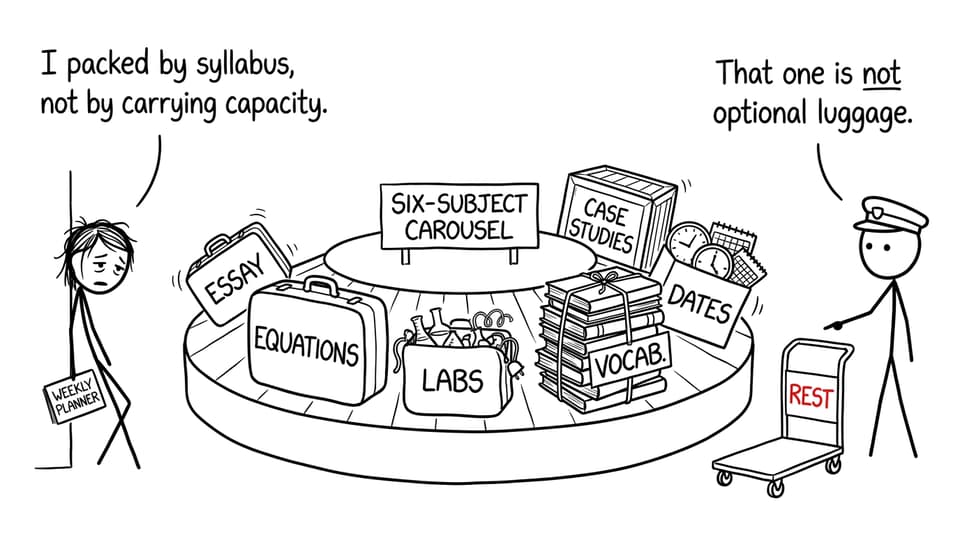
Six subjects create a peculiar kind of pressure. Even when you have studied for three hours, the untouched subjects can make the day feel unfinished.
The answer is not to divide every evening into six equal pieces. To balance revision across six subjects, give every subject regular contact while directing extra time toward the exams, topics, and skills that need it most. From September to November, that means using a weekly rotation, measuring progress through questions rather than hours, and treating recovery as part of the plan.
For students sitting the November 2026 session, the published examination window runs from 23 October to 13 November. Check the IB November 2026 exam schedule and study plan, then work backward from your own papers. Searches for an “IB novexam fall term” plan often describe this same period, although it is spring rather than fall in many November-session regions.
Your September-to-November checklist
Before building a timetable, make these decisions:
- Copy every examination into one calendar.
- Label each subject as high, medium, or maintenance priority.
- Give every subject at least two contacts per week.
- Reserve deeper blocks for weak HL topics and early exams.
- Complete one timed session each week, then increase gradually.
- Keep one evening or half-day free from formal revision.
- Review the plan every Sunday using evidence from completed work.
This is the foundation of a balanced IB study schedule. The schedule should respond to your performance. It should not become another assignment you are afraid to change.
Balance revision across six subjects by weighting them
Equal time feels fair, but it is rarely useful. One subject may have an early paper, another may contain a persistent conceptual gap, and a third may already be secure enough to maintain with short recall sessions.
Start each week by giving every subject a priority score:
- High priority: weak performance, an early examination, or a major skill gap
- Medium priority: reasonable understanding but inconsistent application
- Maintenance priority: currently secure, requiring brief retrieval and occasional timed work
If you have 12 study blocks available, a sensible starting allocation could be four blocks across two high-priority subjects, one block for each remaining subject, and four flexible blocks for timed work, corrections, or changing deadlines. This is not a permanent ranking. A subject should move down once the evidence improves.
Use a rolling two-week view to prevent quiet neglect. A maintenance subject may receive less time this week, but it should return for deeper practice the next. The RevisionDojo Study Planner can place subject tasks around real deadlines and let you move unfinished work without rebuilding the whole system.
Use three phases instead of one endless revision season
September and early November should not look identical. The closer the examination gets, the more your work should shift from learning content to performing under constraints.
September: diagnose and repair
September is for finding gaps while there is still time to repair them. Complete short diagnostic sets in all six subjects, then classify each mistake as a knowledge gap, application error, command-term problem, or timing issue.
Use Study Notes to clarify only the topics exposed by that diagnosis. Follow immediately with Questionbank practice, then turn definitions, formulas, quotations, or recurring misconceptions into Flashcards. The goal is a closed loop: understand, retrieve, apply, correct.
A useful weekday pattern is one 45-60 minute priority block followed by one 25-40 minute maintenance block. This lets you advance a difficult subject without allowing another to disappear. The realistic week-by-week plan for six IB subjects offers a fuller version of this rhythm.
October: add timing and feedback
During October, continue targeted practice but introduce timed sections. Start with one or two per week. Review them slowly enough to understand why marks were lost.
A productive timed session has three parts:
- Attempt the task under its time limit.
- Review the response with the mark criteria or Grading tools.
- Redo the weakest part without looking at the original answer.
This final step matters. Reading feedback can feel productive while leaving the underlying skill untouched. Rewriting an analytical paragraph, resolving a calculation, or rebuilding an essay plan makes the correction active.
Use AI Chat when a mistake remains unclear, not as a substitute for attempting the question. If the same issue survives several correction cycles, a targeted session with a Tutor may save more energy than another week of guessing.
Late October and November: rehearse, then reduce
As the examination window begins, move toward realistic sequencing. Use Mock Exams or Predicted Papers to practise pacing, unfamiliar phrasing, and the experience of continuing after a difficult question. Predicted Papers are simulations, not promises about what will appear.
Match practice to your actual timetable. If two demanding papers occur close together, rehearse that combination once or twice. You are testing recovery and decision-making, not merely content knowledge.
During the final days before each paper, reduce volume. Review error patterns, essential recall, and a small number of representative questions. The month-by-month IB revision plan explains how this shift from foundation to performance should unfold.
Make every study block produce evidence
Burnout grows quickly when work feels endless and progress remains invisible. Replace vague tasks such as “revise biology” with outputs you can finish:
- Answer 12 cell-respiration questions and correct every error.
- Build three essay plans from memory.
- Review 20 vocabulary cards and retest missed items.
- Complete one timed data-response section.
- Explain one difficult concept aloud without notes.
At the end of a block, record accuracy, timing, and the next action. This small trail of evidence decides what deserves time next week.
RevisionDojo keeps this process connected. You can identify a gap in the Questionbank, repair it with Study Notes, retain it through Flashcards, and use AI Chat or Grading tools to understand the correction. Browse the IB resources hub to check the tools available for your subjects and levels.
Protect energy before it becomes an emergency
A timetable that depends on feeling energetic every day is not a timetable. It is a wish.
Create three versions of your routine:
- Full day: one deep block, one lighter block, and brief recall
- Busy day: one focused 30-minute task and 10 minutes of Flashcards
- Recovery day: light recall, planning, and no demanding timed work
This removes the all-or-nothing decision that turns one tired evening into a lost week. The low-stress daily IB study schedule can help you define these smaller routines.
Protect a consistent sleep opportunity, meal breaks, movement, and at least one real weekly break. Sleep supports memory and attention; sacrificing it to create extra study time can weaken the quality of the hours that remain. If exhaustion, anxiety, low mood, or disrupted sleep persists, speak with a parent, school counsellor, teacher, coordinator, or healthcare professional. A revision system should support your health, not ask you to trade it away.
Run a ten-minute Sunday reset
Every Sunday, answer five questions:
- Which subject produced the weakest evidence?
- Which mistake appeared more than once?
- What examination is now closest?
- Which subject received too little contact?
- Where will recovery happen next week?
Then choose two priority subjects, place their hardest blocks when your energy is usually highest, and distribute lighter recall across the remaining four. Leave one flexible block empty. Unplanned schoolwork, illness, and fatigue are normal, so a plan without spare capacity is already behind.
The deeper lesson is simple. Balance does not mean giving every subject the same attention today. It means ensuring that no subject is forgotten, no weakness is ignored, and no week consumes the energy required for the next one.
RevisionDojo is the ultimate IB resource for running that system in one place. Its Questionbank, Study Notes, Flashcards, AI Chat, Grading tools, Predicted Papers, Mock Exams, Coursework Library, and Tutors support the full journey from uncertainty to controlled practice. Start with one diagnostic set today. Let the result, rather than the anxiety, decide what you study tomorrow.