
Average IB student vs 45 student: what's the difference?
The most uncomfortable truth in the IB is that the gap between "average" and "45" rarely looks like genius.
It looks like Tuesday.
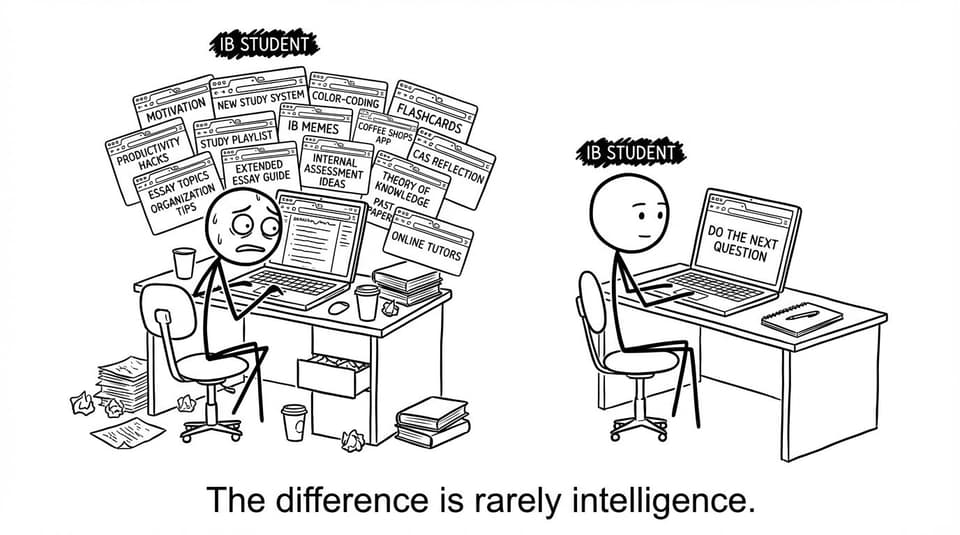
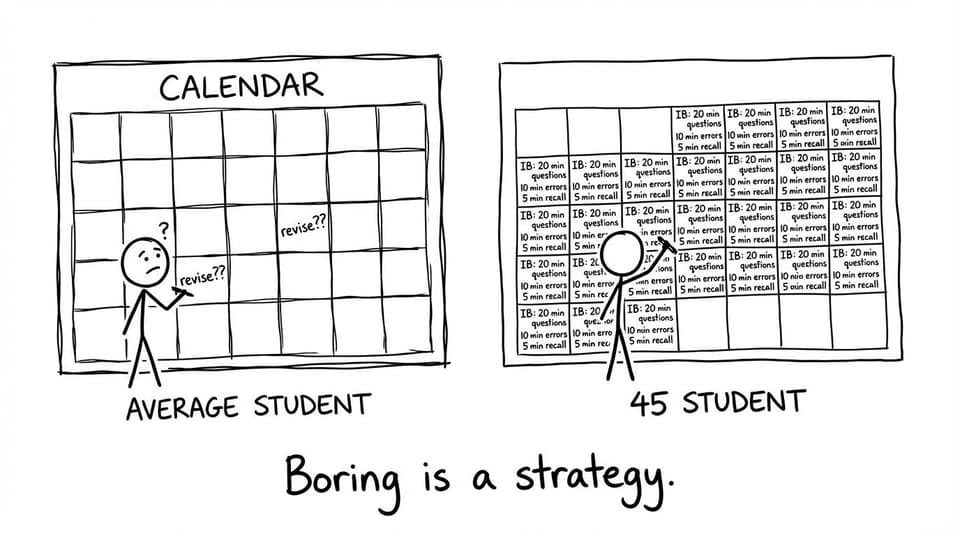
Two students sit down after school. Same syllabus. Same deadlines. Same exam timetable creeping closer. The average IB student searches for motivation like it's a missing ingredient. The 45 student searches for the next small action like it's a door handle.
Neither student feels ready. Both feel busy. But one of them is building a system that keeps working even when they don't feel like it.
That's the real difference.
If you're an IB student preparing for exams, this article is a map: not to perfection, but to repeatable decisions. And if you want a single place to run those decisions, RevisionDojo for IB is built exactly for that.
A quick checklist: what 45 students do differently in IB
Use this as your diagnostic. You don't need to do all of it at once. Pick one, make it normal, then add another.
- They treat the IB like skill training, not content collecting
- They practice with feedback loops (not just "study") using a question bank and markscheme logic
- They do short, frequent recall (flashcards) instead of long, rare review sessions
- They track errors and repeat them until they disappear
- They simulate pressure with mock exams and predicted papers early enough to learn from them
- They ask for help quickly (AI chat, tutors, peers) instead of "later"
- They protect energy: sleep, simple planning, fewer dramatic study plans
A good place to see how this becomes a workflow is RevisionDojo App: The Smarter Way to Prep for IB Exams.
The biggest difference: average IB effort is emotional, 45 effort is mechanical
Most average IB students are not lazy. They're reactive.
Their studying depends on mood. If they feel confident, they study. If they feel overwhelmed, they reorganize. If they feel anxious, they watch another "perfect study routine" video.
The 45 student still has moods. They just don't negotiate with them as often.
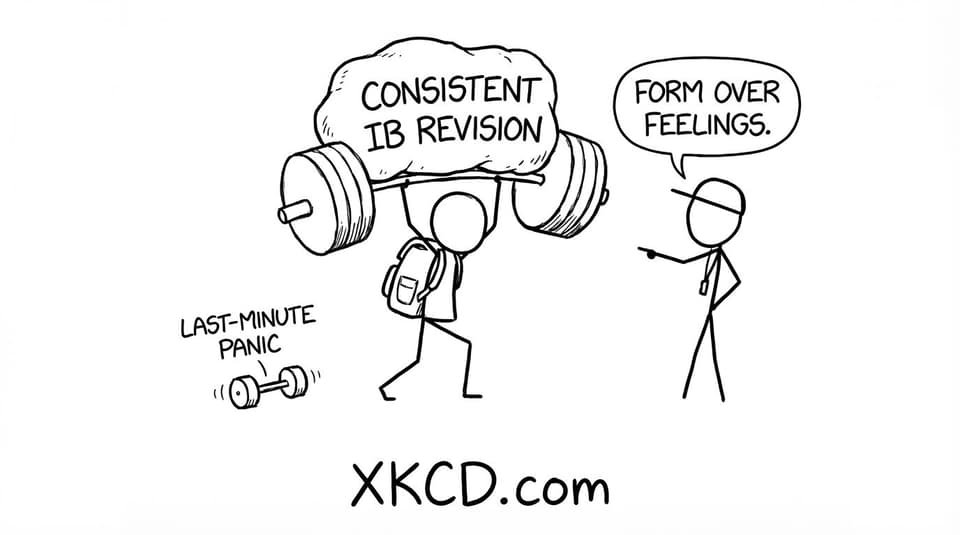
They build mechanical habits:
- "After dinner, I do 25 minutes of IB questions."
- "Every wrong answer becomes a tagged mistake."
- "Every week has one timed paper block."
It's not inspiring. It's dependable.
To make that mechanical loop easier, a tool like the RevisionDojo Questionbank matters because it reduces friction: you open it, filter, answer, get feedback, tag, repeat. That's a system, not a vibe.
How average IB students revise (and why it stalls)
Average revision tends to be heavy on preparation and light on exposure.
They over-invest in "input"
Input feels safe: notes, highlighting, rewatching lessons, rewriting definitions. In the IB, input is necessary, but it doesn't guarantee you can produce marks under time.
They under-invest in "output"
Output is where marks live: answering questions, writing explanations, structuring essays, showing working, using command terms correctly.
If you recognize this pattern, pivot gently: keep input small, and attach it to output.
One practical bridge is pairing notes with immediate practice. For example, read a short section in Study Notes, then prove you can use it by doing a mini set from the Questionbank.
How 45 students revise in IB: they build a feedback loop
A 45 student's secret is boring: they shorten the distance between "I studied" and "I improved."
They do it with a loop:
Learn, recall, apply, correct, repeat
- Learn: syllabus-aligned explanations, not endless rewriting
- Recall: quick daily flashcards
- Apply: exam-style questions
- Correct: markscheme-aligned feedback, error logs, retesting
RevisionDojo is designed to keep that loop in one place: Study Notes, Flashcards, AI Chat, Grading tools, Mock Exams, Predicted Papers, plus a Coursework Library and Tutors when life gets more complicated than a checklist.
For flashcards specifically, use either Interactive IB Flashcards: Engaging Memory Practice or the deeper breakdown in IB Flashcard System: Active Recall for Better Memory.
The exam technique gap: 45 students practice the way the IB rewards
A lot of IB stress comes from a misunderstanding: students think exams are a memory test.
They're not. They're a performance test.
The IB rewards students who can:
- interpret command terms consistently
- select relevant knowledge quickly
- structure answers under time
- avoid common traps in mark allocations
Average students often "know" the topic, but lose marks on:
- vague phrasing
- missing steps
- skipping justification
- not linking to the question wording
That's why exam-style practice matters. If you want a practical guide to official-style practice routines, read IB Questions: Official Exam Practice.
The time-management difference: average IB students cram, 45 students cycle
Cramming in IB is seductive because it creates the illusion of speed. But it's unstable. You remember today, forget next week, then panic again.
45 students cycle instead:
- Day 1: learn a small slice
- Day 2: recall it (flashcards)
- Day 3: apply it (questions)
- Day 5: revisit mistakes
- Week 2: retest under time
This is also where mock exams matter. Not because they predict the future, but because they reveal your present.
A strong starting point is Online IB Mock Exams: Practice Anywhere, Anytime. If you want a structured way to build realistic exams, IB Test Templates: Pre-Made Exams for Quick Practice is a helpful guide.
The "resources" difference: average IB students collect, 45 students commit
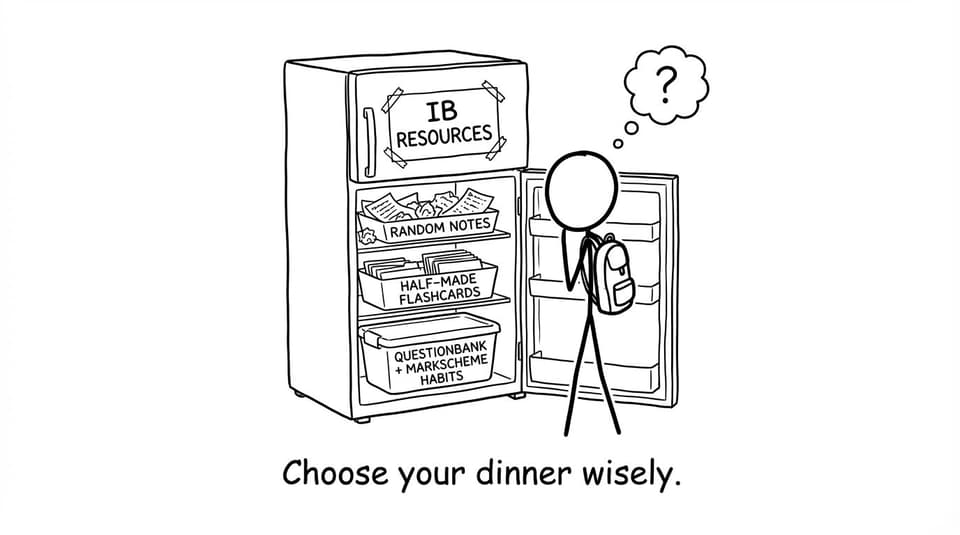
Average students are often surrounded by resources. PDFs, group chats, folders called "final final," and a growing feeling that they're behind.
45 students pick fewer tools and use them more deeply.
That's why "all-in-one" isn't a buzzword for IB. It's relief.
When your Questionbank links to your Study Notes, which create Flashcards, which feed back into Mock Exams, the cognitive load drops. You stop spending your best hours deciding what to do.
If you want a clean overview of what's available in one system, start with Notes + Flashcards + Question Bank (Free), and keep the International Baccalaureate (IB) hub bookmarked for subject navigation.
A practical 7-day plan to move from average to 45 behaviors (IB edition)
This is not a "new life." It's a one-week experiment.
Day 1: Build the loop (30-45 minutes)
- Pick one topic you're weak at in IB.
- Read one small section in Study Notes.
- Do 10-15 targeted questions in the Questionbank.
- Write down the 3 most common errors you made.
Day 2: Lock recall (15 minutes)
- Do a short flashcard session.
- If you're stuck building cards, use a flashcard workflow from Digital IB Study Notes: Access Anywhere, Anytime.
Day 3: Repeat mistakes on purpose (30 minutes)
- Reattempt the exact question types you got wrong.
- Tag them for review and don't let them vanish into yesterday.
Day 4: Add one timed block (45-60 minutes)
- Simulate pressure with an online exam block.
- Review pacing, not just accuracy.
Day 5: Use help early (20 minutes)
- Ask AI Chat to explain one confusion in your own words.
- If the issue is deeper, book a short session with Tutors.
Day 6: Written response tightening (30 minutes)
- Use Grading tools on a short response, essay paragraph, or structured answer.
- Focus on markscheme language and structure.
Day 7: Reflection (10 minutes)
- Decide what to keep next week.
- Keep it small: one daily recall, three practice sessions, one timed block.
That's already what many 45 students do. Quietly. Repeatedly.
Closing: the 45 student isn't a different species; they're a different system
In the IB, the student who scores 45 isn't usually the one with the most dramatic study days. They're the one with the least dramatic weeks.
They do the next question.
They review the mistake.
They repeat what hurts until it stops hurting.
If you want to make that kind of progress feel simpler, build your IB routine inside RevisionDojo: use the Questionbank for repetition, Study Notes for clarity, Flashcards for daily recall, AI Chat for frictionless help, Grading tools to tighten writing, Predicted Papers and Mock Exams for pressure training, and the Coursework Library plus Tutors when you need support that's human.
Start here: RevisionDojo for IB. Then do the next small action. That's how 45s are made.