
Autosomal traits are controlled by genes on autosomes, the non-sex chromosomes. Sex-linked traits are controlled by genes on a sex chromosome, usually the X chromosome in IB Biology. Their chromosome location changes how alleles move through families, so the two patterns produce different Punnett-grid probabilities and pedigree clues.
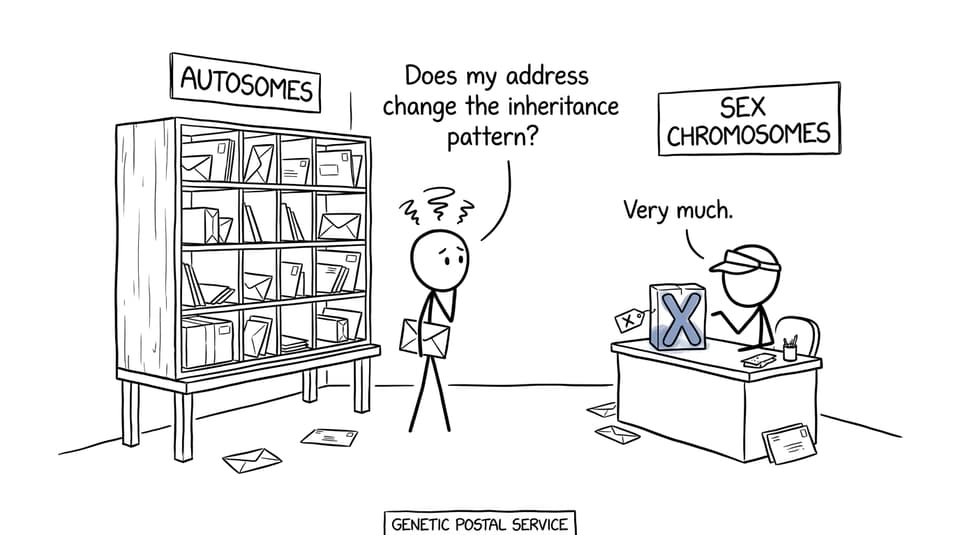
That is the essential distinction. Yet it contains one of genetics’ most useful lessons: an allele’s effect depends partly on its address. The same words, dominant and recessive, still matter, but the chromosome carrying the allele changes who can inherit it and how an examiner expects you to represent it.
The current IB Biology course places this within D3.2 Inheritance, including human sex determination, genes on sex chromosomes, haemophilia, and pedigree interpretation. You can explore the full sequence in RevisionDojo’s D3.2 Inheritance notes.
Autosomal vs sex linked at a glance
Before attempting a genetic cross, ask four questions:
- Is the gene located on an autosome or a sex chromosome?
- Is the relevant allele dominant or recessive?
- What notation should represent the parental genotypes?
- Is the probability being asked about all offspring, sons only, or daughters only?
| Feature | Autosomal inheritance | Sex-linked inheritance |
|---|---|---|
| Gene location | An autosome | A sex chromosome, usually X in IB examples |
| Typical notation | A, a, AA, Aa, aa | Xᴴ, Xʰ, and Y |
| Alleles in the standard human model | Usually two copies of the gene in each individual | Two X-linked copies in XX individuals; one in XY individuals |
| Father-to-son transmission | Possible | Not possible for an X-linked allele |
| Effect of offspring sex | Usually does not change the basic probability | Often changes genotype and phenotype probabilities |
| IB example | An autosomal dominant or recessive disorder | Haemophilia as an X-linked disorder |
What does autosomal inheritance mean?
Humans have 22 pairs of autosomes and one pair of sex chromosomes. An autosomal gene is located on one of those non-sex chromosomes. In a basic Mendelian model, each person possesses two alleles for the gene, one inherited from each parent.
Autosomal does not mean dominant. This is the first distinction to protect in your memory. Chromosome location and allele expression describe different things:
- Autosomal dominant: one copy of the dominant allele is sufficient for the associated phenotype.
- Autosomal recessive: two copies of the recessive allele are normally required for the associated phenotype.
For example, suppose A produces a dominant phenotype and a is recessive. A cross between two heterozygous parents, Aa × Aa, predicts genotype probabilities of 25% AA, 50% Aa, and 25% aa. Under complete dominance, the predicted phenotype ratio is 3 dominant to 1 recessive.
Because the gene is autosomal, you do not attach the alleles to X or Y chromosomes. The predicted probabilities also apply without first separating sons and daughters in the simplified cross. Review the underlying vocabulary and Mendelian logic through RevisionDojo’s guide to Mendel’s laws.
What does sex-linked inheritance mean?
A sex-linked gene is located on a sex chromosome. In IB questions, the focus is normally X-linked inheritance, with haemophilia used as a key example. Y-linked inheritance exists, but it follows a different father-to-son pattern and should not be confused with X linkage.
In the standard XX/XY model used for these crosses, an XX individual has two copies of an X-linked gene. An XY individual has only one X chromosome and therefore one copy of most X-linked genes. This single-copy state is called hemizygous.
For an X-linked recessive allele, one recessive copy can produce the phenotype in an XY individual because there is no corresponding allele at that locus on the Y chromosome to mask it. An XX individual generally needs two recessive copies to express the same simplified Mendelian phenotype. An individual with one dominant and one recessive copy is commonly described as a carrier in an X-linked recessive question, although real genetic conditions can be more complex than classroom models.
The most reliable directional rule is simple: a father gives his X chromosome to every daughter and his Y chromosome to every son. Therefore, a father cannot pass an X-linked allele directly to a son. This rule is often more useful than memorizing a list of ratios.
Worked X-linked recessive example
Consider haemophilia in a simplified IB cross. Let:
Xᴴrepresent the allele for typical blood clottingXʰrepresent the recessive haemophilia allele- the mother be a carrier:
XᴴXʰ - the father be unaffected:
XᴴY
The mother can produce eggs carrying Xᴴ or Xʰ. The father can produce sperm carrying Xᴴ or Y.
Xᴴ from father | Y from father | |
|---|---|---|
Xᴴ from mother | XᴴXᴴ, unaffected daughter | XᴴY, unaffected son |
Xʰ from mother | XᴴXʰ, carrier daughter | XʰY, son with haemophilia |
The outcomes are each predicted to have a 25% probability among all offspring:
- 25% unaffected, non-carrier daughters
- 25% carrier daughters
- 25% unaffected sons
- 25% sons with haemophilia
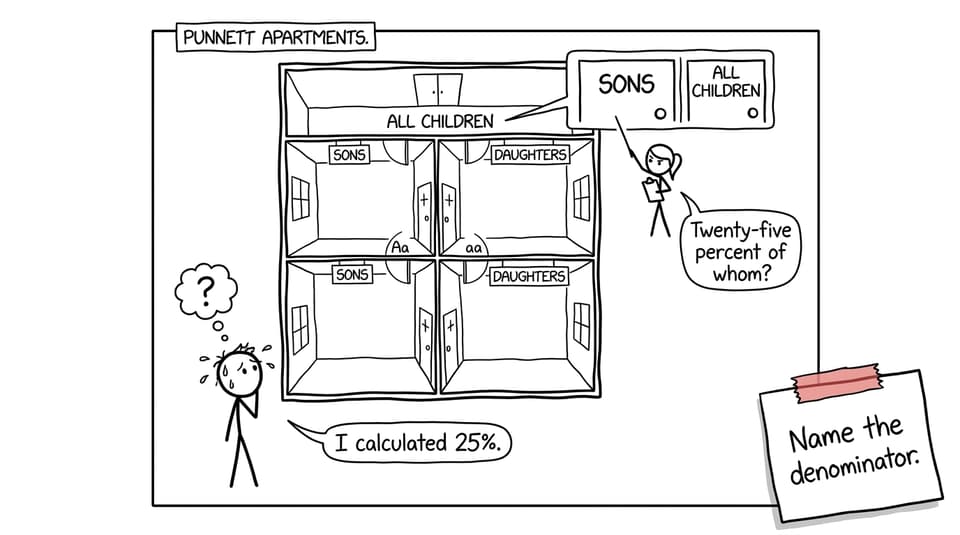
But notice what happens when the denominator changes. Among sons specifically, 50% are predicted to have haemophilia. Among all offspring, the prediction is 25%. Both statements are correct because they answer different questions.
A Punnett grid predicts probabilities, not a guaranteed sequence of births. Each fertilization is a separate event. Four children need not reproduce all four boxes, just as four coin tosses need not produce exactly two heads.
How autosomal vs sex linked appears in IB exams
IB questions may test this distinction through a direct definition, a Punnett grid, an unfamiliar pedigree, or genetic data. The official assessment structure can include multiple-choice, data-based, short-answer, and extended-response tasks, so recognizing the pattern is only the beginning. You must also communicate the reasoning.
Constructing a genetic cross
A complete answer should usually include:
- a key defining every symbol
- parental phenotypes and genotypes
- possible gametes
- a correctly completed Punnett grid
- offspring genotypes and phenotypes
- a probability or ratio with the relevant group clearly identified
Do not write Hh for an X-linked haemophilia cross. That notation hides the chromosome carrying each allele. Instead, attach each allele as a superscript to X and write Y without a corresponding allele unless the question explicitly defines one.
Interpreting a pedigree
Start by tracking transmission rather than counting affected people. Useful clues include:
- father-to-son transmission rules out simple X-linked inheritance
- X-linked recessive traits often appear more frequently in males
- an affected father passes his X-linked allele to all daughters
- autosomal traits can pass from father to son
- recessive traits may appear in children whose parents do not express the phenotype
These are clues, not permission to guess from one feature alone. Small pedigrees can sometimes fit more than one model. Use every relationship provided and state the evidence supporting your conclusion. RevisionDojo’s pedigree chart resources let you practise this reasoning in context.
Turning understanding into marks
Once the explanation feels clear, move quickly into retrieval and application. Use D3.2 Inheritance flashcards to recall notation and definitions, then solve targeted problems in the D3.2 Inheritance Questionbank.
The progression matters. Study Notes build the model; Flashcards make the language retrievable; the Questionbank reveals whether you can use it. RevisionDojo’s AI Chat and Grading tools can then help diagnose why an answer lost precision, while Biology Predicted Papers and Mock Exams test whether the skill survives time pressure.
Common mistakes to avoid
Treating sex-linked as another word for recessive
A sex-linked allele can be dominant or recessive. “Sex-linked” identifies chromosome location; “dominant” and “recessive” describe expression in a particular genetic model.
Giving every male the recessive phenotype
An XY individual expresses an X-linked recessive phenotype only if his X chromosome carries that allele. Having one X chromosome does not automatically make every X-linked trait recessive or harmful.
Claiming that a father gives his X chromosome to a son
A son receives the Y chromosome from his father in the standard XX/XY model. His X chromosome comes from his mother. This is why direct father-to-son transmission cannot occur for an X-linked allele.
Reporting 25% without naming the group
Write “25% of all offspring” or “50% of sons,” not merely “25%.” Genetics questions often test whether you understand the sample space as much as the arithmetic.
Calling a carrier homozygous
For a standard X-linked recessive example, a carrier XX individual is heterozygous. One X carries the usual allele and the other carries the recessive allele.
A quick revision routine
When a question compares autosomal vs sex linked inheritance, use this sequence:
- Locate the gene: autosome, X chromosome, or Y chromosome.
- Identify whether the allele is dominant or recessive.
- Define notation before drawing the cross.
- Write the parents’ genotypes and possible gametes.
- Complete the grid carefully.
- Separate sons and daughters when sex changes the outcome.
- State the denominator alongside every probability.
- Check whether the proposed transmission is biologically possible.
Genetics becomes easier when you stop treating ratios as isolated facts. The deeper rule is movement: which chromosome can travel from which parent to which child?
RevisionDojo brings that rule into a complete revision system. Start with IB Biology Study Notes, retrieve the details with Flashcards, apply them in the Questionbank, and finish with Predicted Papers or Mock Exams. When a misconception persists, AI Chat, Grading tools, the Coursework Library, and Tutors provide the next layer of support. The goal is not merely to recognize a familiar cross. It is to reason correctly when the exam changes the family, the symbols, or the wording.