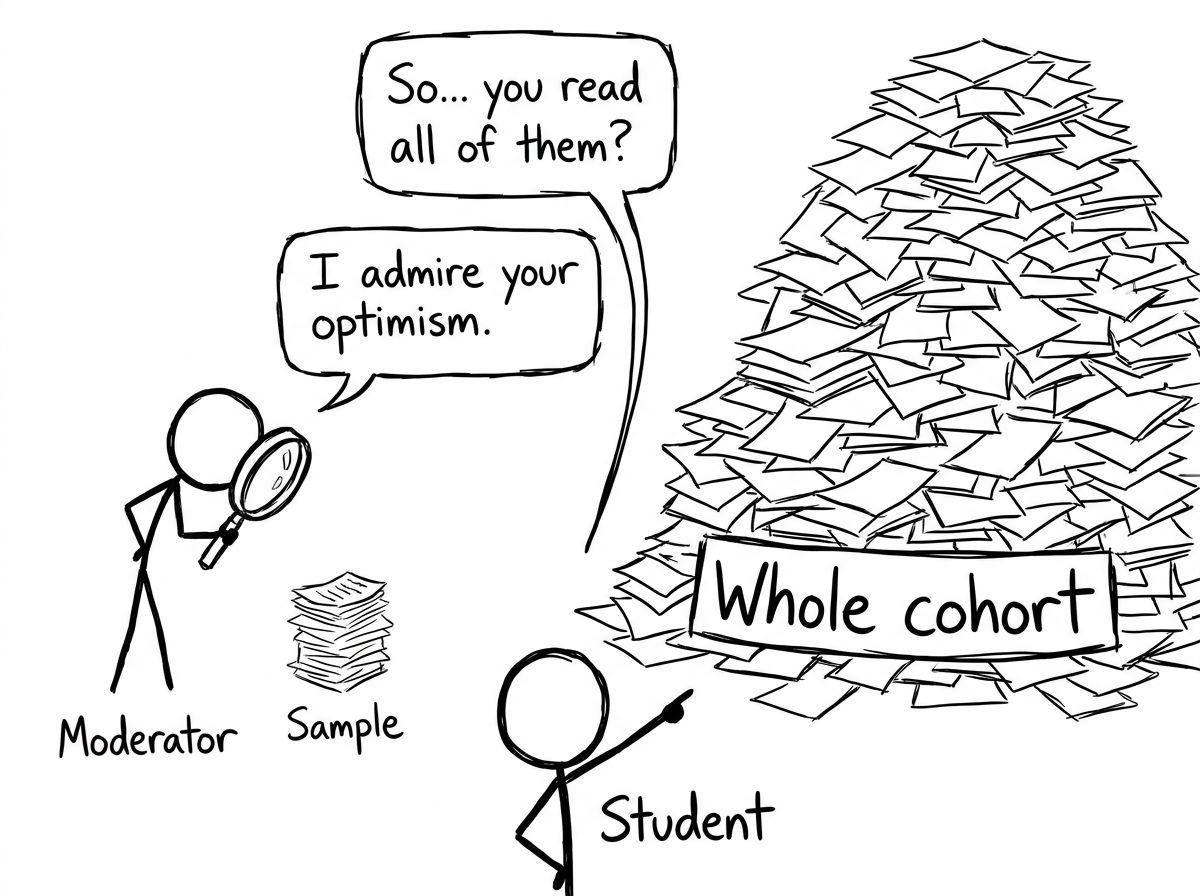
If you have ever stared at your IA at 1:12 a.m. and thought, Someone at the IB is going to read every word of this, you are not alone.
That belief is oddly comforting. It makes the work feel meaningful. It also explains why so many students obsess over polishing sentences that will never change the mark.
So, are IAs externally moderated?
Yes--in most subjects, your IA is marked by your teacher and then externally moderated by the IB. But external moderation does not usually mean a moderator carefully reads every student's full IA in your school. It is closer to quality control: the IB checks a sample, compares it to your teacher's marks, and adjusts if needed.
This post breaks down what that means in real life, why it matters for your final grade, and how to make your IA strong enough to survive both internal marking and external moderation.
IA external moderation: the fast checklist
Use this as a quick anchor before we go deeper:
- Your IA is internally assessed (your teacher awards the marks using IB criteria).
- The IB externally moderates IAs (typically by checking a sample of work from your school).
- If the IB thinks marking is too generous or too harsh, they can adjust marks for the cohort.
- External moderation rewards clear evidence: criterion alignment, transparent method, honest evaluation.
- Your best defense is to write an IA that is easy to mark: signposted, criterion-focused, and well evidenced.
If you want a clean workflow for that, RevisionDojo's IB Internal Assessment Guides are a good starting point, especially when you need to translate vague rubric language into concrete writing choices.
What "externally moderated" actually means for an IA
In the IB, "internal assessment" is a slightly misleading phrase. The IA is internal because your teacher marks it first. But the IB still cares deeply about standardization, so they apply external moderation to make sure different schools are applying the criteria consistently.
Here's the mental model that helps:
- Your teacher is the first marker for your IA.
- The IB moderator is the quality controller who checks whether your teacher's marking matches the global standard.
That second step is why the phrase "IA externally moderated" exists at all.
Some RevisionDojo subject guides say this plainly, for example in guides like SEHS and ESS where the language is direct: the component is internally assessed and externally moderated (see an example in Essentials of the Internal Assessment (SEHS)).
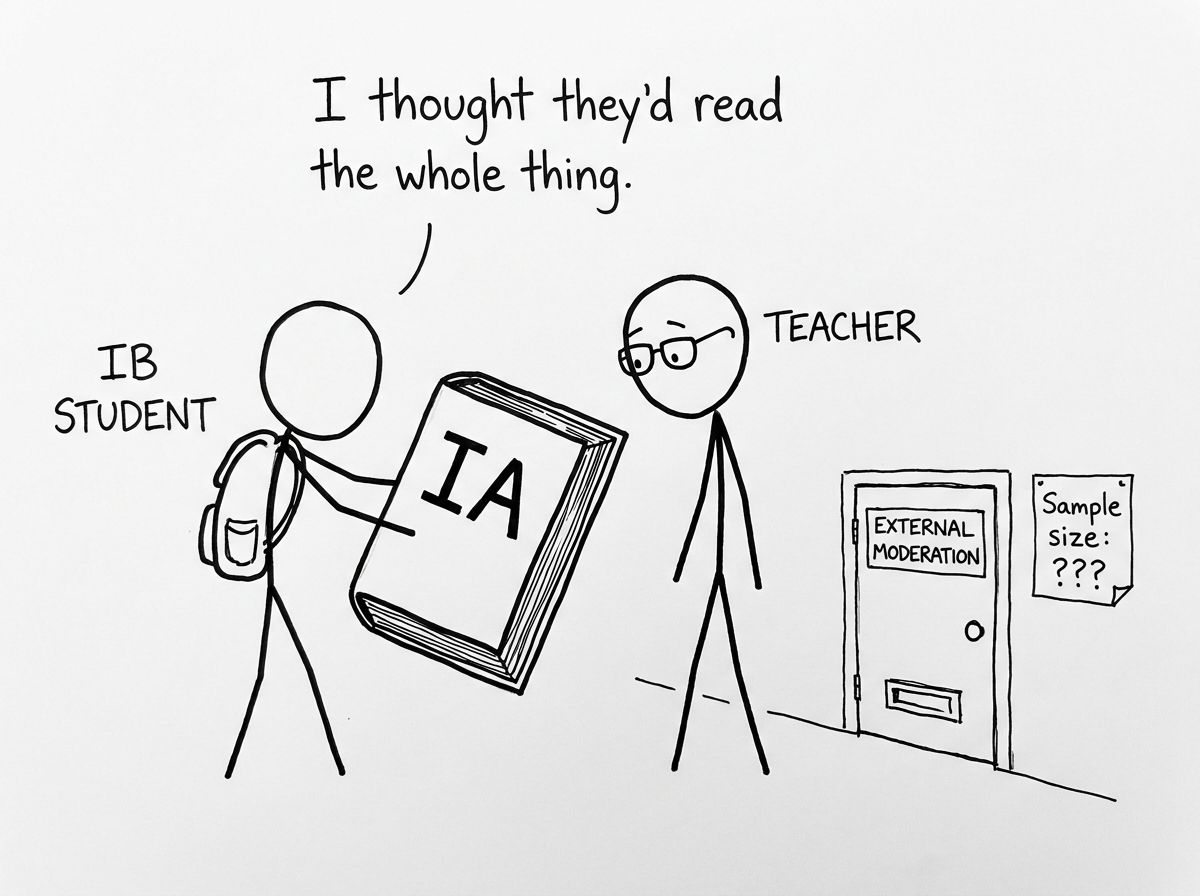
Does the IB read every IA?
Usually, no.
External moderation commonly involves selecting a sample of IAs from your school. The moderator reviews those, compares the marking to the teacher's awarded marks, and then decides whether the school's marking is accurate.
That detail matters because it changes how you should think about "writing for the IB." You are still writing to IB criteria, but your first audience is your teacher and your school's internal standardization.
Why the IA moderation process can change your mark
There is a specific fear students have: What if my teacher likes my IA, but the IB hates it?
That's not paranoia. It is the exact reason moderation exists.
Moderation is designed to prevent two common problems:
- A school where teachers mark too generously (everyone gets unusually high IA marks).
- A school where teachers mark too harshly (students are unfairly penalized compared to global standards).
When the IB moderator sees a mismatch, they can apply an adjustment so the cohort aligns with the standard. In other words, your IA mark is not only about the quality of your work--it is also about the reliability of your school's marking.
This is why schools run internal standardization meetings, and why students should care about writing an IA that is easy to justify with evidence.
If you want to understand how rubric-aligned feedback should sound, look at how RevisionDojo frames criterion-based marking in tools like the IB IA Grader, which emphasizes strand-by-strand evidence and next steps.
The hidden lesson: a moderated IA rewards clarity more than beauty
A strange thing happens when students prepare an IA.
At first, you chase "impressive." A complex topic. Fancy graphs. Big words. You build a cathedral.
Then you see how marks are actually awarded.
The IA is not a creativity contest. It is a criteria contest.
External moderation pushes that even harder. A moderator who has limited time and a strict rubric is not looking to be dazzled. They are looking for proof:
- proof you did what you claim
- proof your method makes sense
- proof your analysis connects to your data
- proof your evaluation is honest and specific
This is why students with a "simple" topic can score very well. Their IA is legible. Their thinking is traceable.
RevisionDojo's content on grading often makes this point in subject-specific terms. For example, the IB Design Technology IA grading explanation highlights that the assessment is not about how impressive a final product looks, but about evidence of thinking and justified decisions.
How to write an IA that survives external moderation
Think of your IA as a courtroom argument. The rubric is the law. Your writing is your evidence.
Below are practical moves that help your IA hold up under moderation.
Build your IA around "marker-friendly" structure
Moderators (and teachers) reward work that reduces ambiguity. Do not make them hunt.
- Use clear headings that map to criteria (where appropriate).
- Label tables and figures properly.
- Keep variables, method choices, and calculations transparent.
- Write conclusions that explicitly answer your aim or research question.
If you are unsure what "transparent" looks like in your subject, start with RevisionDojo's What Is an IA? Understanding the Internal Assessment in IB and then jump into the subject-specific IA guide.
Write evaluation like a scientist, not a lawyer
Many students treat evaluation as defense: "Everything went well, limitations were small, results were valid."
Moderation often punishes that tone.
A strong IA evaluation is specific:
- Which limitation affected which data trend?
- What would you change exactly next time?
- How would that change likely shift uncertainty or reliability?
Honesty reads like competence.
Protect academic honesty (because moderation can spotlight it)
An IA is vulnerable to academic honesty issues because it is long, researched, and often messy.
Even if moderation is sample-based, it is still a formal review process. The safest approach:
- Cite every non-original idea, dataset, image, method, or model.
- Keep your referencing consistent.
- Avoid "template copying" where everyone's structure and phrasing looks identical.
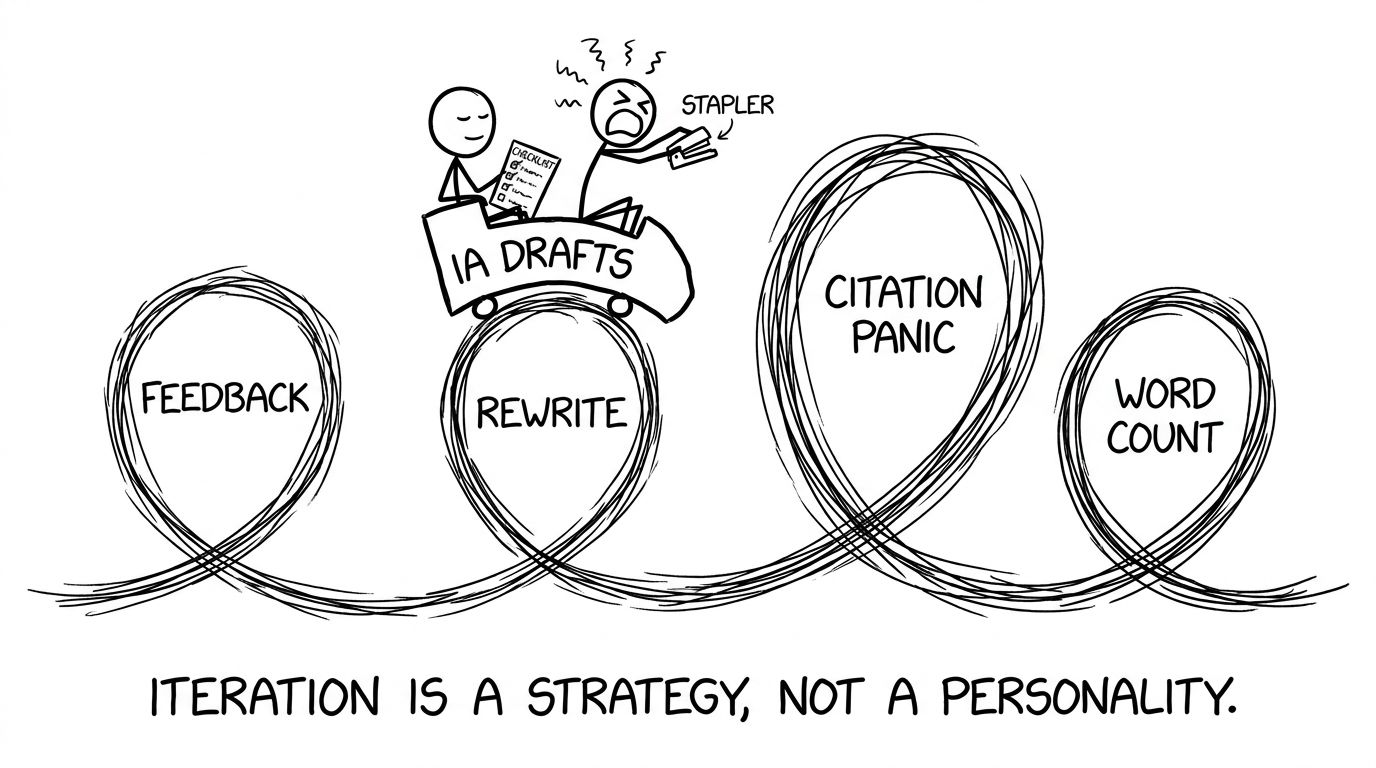
Use feedback loops, not one big rewrite
The best students do not write the IA once. They iterate.
Small cycles work better:
- Draft one section.
- Get feedback.
- Fix it.
- Repeat.
RevisionDojo is built for that kind of iteration: use rubric-aligned feedback via the IB IA Grader, ask follow-up questions in AI Chat, and then strengthen weak skills with Study Notes and targeted practice.
How your IA connects to exam prep (and why that matters now)
IB students often treat the IA as a separate life. Coursework life, then exam life.
But moderation makes the connection obvious: the IA is also a test of whether you understand the course's way of thinking.
If your exams are coming, the smartest move is to use your IA experience as a training ground:
- Are you good at justifying choices?
- Can you interpret data and link it to theory?
- Do you know what the command terms really demand?
This is where RevisionDojo's exam stack becomes useful:
- Use the Questionbank to practice the analysis and evaluation moves your IA requires.
- Use Flashcards to make key definitions, uncertainties, and method logic automatic.
- Use IB-style timed practice through tools highlighted in RevisionDojo App: The Smarter Way to Prep for IB Exams.
- If you need a calm structure, follow How to Study for IB Exams: Step-by-Step Guide.
The point is not to do "more." It is to make your IA and exam prep reinforce each other.
What RevisionDojo helps you do differently for an IA
A moderated IA punishes vague effort. RevisionDojo helps you make your effort visible.
Here is a practical way to use the platform without turning it into another procrastination tool:
- Start with subject-specific expectations in the IB Internal Assessment Guides.
- Draft, then upload to the IB IA Grader to get criterion-aligned annotations.
- Use AI Chat to ask targeted questions like: "Which criterion is my analysis failing, and what evidence would fix it?"
- Use Study Notes to repair missing theory, then lock it in with Flashcards.
- When exams approach, use Mock Exams and Predicted Papers inside RevisionDojo's exam workflow (see How 45-Point IB Students Prepare for Exams for how high scorers keep the loop tight).
FAQ: IA external moderation, answered properly
Are all IAs externally moderated?
In the IB, many subjects use an IA model where the work is internally assessed and then externally moderated. That means the IB has a mechanism to check whether your teacher's marks align with global standards, rather than leaving it entirely to the school. However, "externally moderated" does not always mean the same thing in every subject component, and it can vary by syllabus and assessment model. The most important practical takeaway is that your IA should be written to the official criteria and be easy for a marker to justify with evidence. If your teacher is strict about criterion alignment, that is usually a good sign, not a bad one. When you are unsure what applies to your specific subject, use a subject guide in the IB Internal Assessment Guides to confirm the exact language and expectations.
If moderation is sample-based, why should I care so much about my IA?
Because your IA is still a significant portion of your final grade, and it is the part you can improve through iteration rather than exam-day performance. Even if a moderator does not personally read your IA, your work sits inside your school's overall marking pattern. If your teacher's marking gets adjusted during moderation, that adjustment can affect the cohort, which includes you. More importantly, a strong IA is usually strong for the same reasons a strong exam answer is strong: clear reasoning, correct method, justified choices, and honest evaluation. Treating your IA seriously also reduces stress later, because it is one major grade component that can be stabilized before exam season peaks. Tools like the IB IA Grader are useful here because they shorten the feedback cycle and force your draft to face the rubric directly.
Can RevisionDojo tell me my final moderated IA mark?
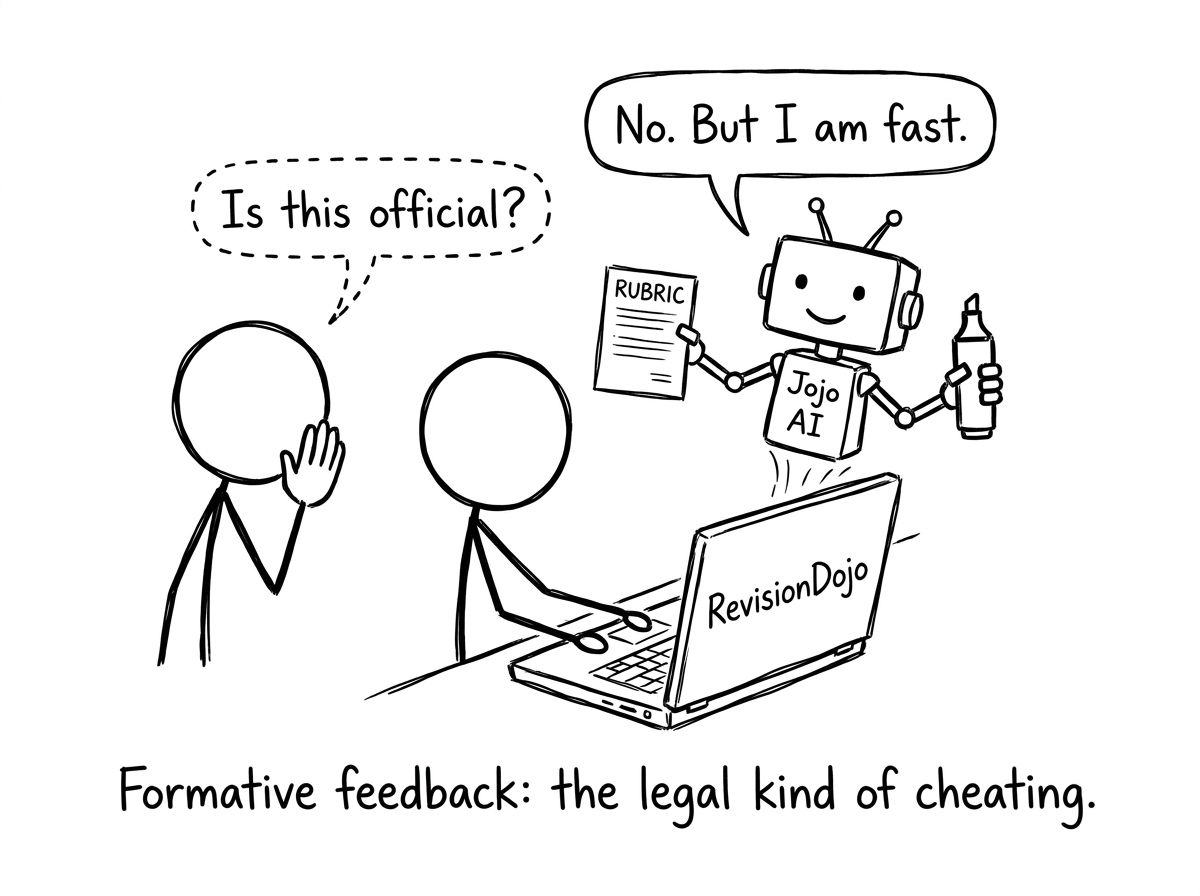
No, and you should be suspicious of any tool that claims it can. Your final IA mark is set through your teacher's marking and the IB's moderation process, and that system involves professional judgment and cohort-level adjustments that no external platform can guarantee. What RevisionDojo can do is help you improve the parts that moderation actually rewards: criterion alignment, evidence clarity, and the completeness of analysis and evaluation. In practice, that means using rubric-based feedback from the grader, building clarity through Study Notes, and removing weak habits through targeted practice in the Questionbank. If you want a healthy mindset, treat AI feedback as formative coaching: fast, structured, and actionable, but not "official." Then combine it with teacher feedback and your subject guide so your IA becomes defensible from multiple angles.
What are the biggest moderation-proofing mistakes students make in an IA?
The biggest mistake is writing an IA that feels impressive but is hard to mark. Moderation is not kind to ambiguity: if your method is unclear, your variables are not controlled, or your conclusion does not directly answer your aim, marks disappear quickly. Another common issue is weak evaluation that lists generic limitations without explaining impact and improvements, because it signals you do not understand your own method. Students also lose marks by hiding the thinking process, for example by skipping intermediate steps in calculations or presenting graphs without interpretation. Finally, academic honesty problems can derail everything, especially when citations are inconsistent or when multiple students submit near-identical phrasing and structure. A simple defense is to make your IA readable: signpost sections, label everything, and show your reasoning like you are teaching it. If you need a reference model for how IB-aligned feedback should sound, compare your draft against rubric language and use the iterative loop in RevisionDojo to tighten weak areas.
The calm truth: external moderation is not your enemy
External moderation exists because the IB wants fairness. The irony is that it often helps the students who do the right things quietly: clear method, honest evaluation, criterion-aligned writing.
If you take one idea from this: treat your IA as a piece of evidence, not a piece of art.
And when you need a system that keeps you moving--from draft to feedback to revision to exam readiness--RevisionDojo is built to be that home base: Questionbank, Study Notes, Flashcards, AI Chat, Grading tools, Predicted Papers, Mock Exams, Coursework Library, and Tutors when you want human help.
Start by opening the IB Internal Assessment Guides, confirm what external moderation means in your subject, and then run one small improvement loop on your IA today. Small iterations compound faster than late-night panic.