

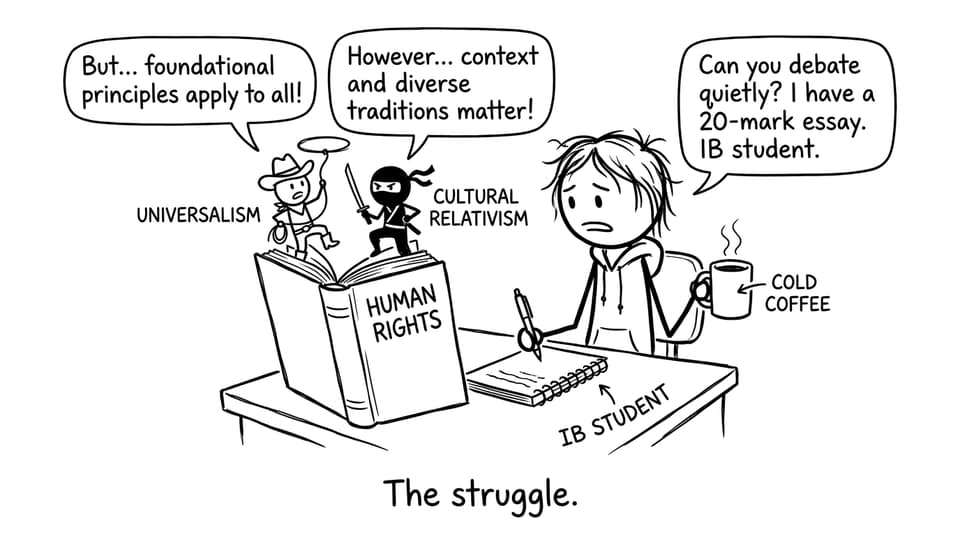
Human rights can sound like the simplest idea in politics: treat people with dignity. Then you open an IB Global Politics essay question and realise the argument is not about dignity at all. It is about who gets to define it, whose history becomes the default, and why enforcement feels uneven.
So, are human rights dominated by Western values? In IB Global Politics, the best answers do not pick a team. They show how Western origins matter, how non-Western actors reshaped the agenda, and how power determines which “universal” claims get amplified.
Quick exam checklist (keep it tight)
-
Define the debate: universalism vs cultural relativism.
-
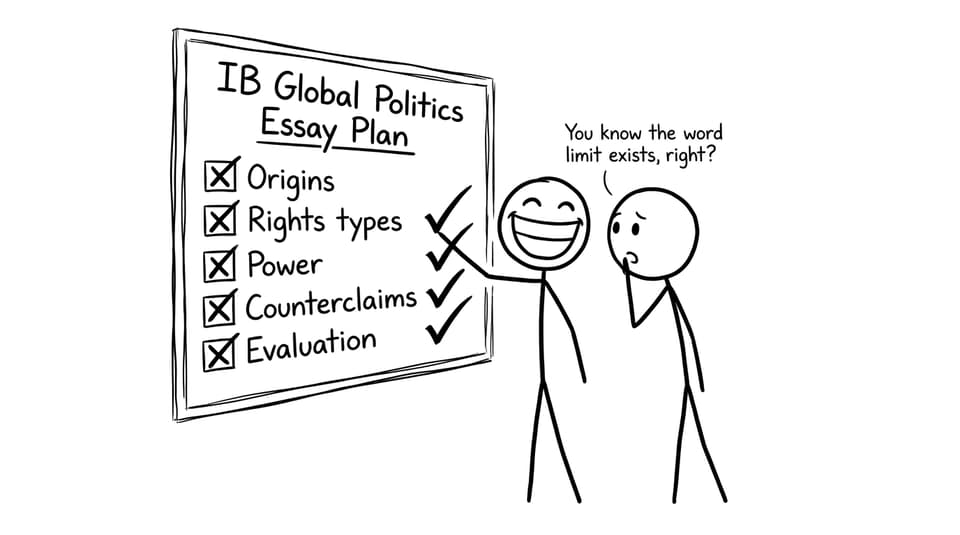
Explain origins: Enlightenment ideas and post-WWII institutions.
-
Compare types of rights: civil/political vs economic/social/cultural and collective rights.
-
Evaluate practice: power, selectivity, legitimacy.
-
Finish with a balanced judgement (and a clear reason why).
If you need clean definitions for essays, the IB Global Politics Glossary saves time.
Why some argue human rights are Western-dominated
In IB Global Politics, the “Western dominance” claim usually begins with history. Modern human rights language is strongly associated with European Enlightenment thinking: individual liberty, legal equality, freedom of expression. Those ideas later fed into global institutions and treaties, meaning the starting template often looked liberal and individualistic.
A second strand is prioritisation. Critics argue that global attention often falls first on civil and political rights (speech, voting, due process), while economic, social, and cultural rights can be treated as slower, optional, or “development goals.” That imbalance can feel like Western liberal ideology wearing a universal badge.
For a strong content foundation, see Understanding Human Rights (topic hub) and the deeper Understanding Human Rights Notes.
Why others say human rights are not “Western property”
The strongest counterclaim in IB Global Politics is simple: the origins of a framework are not the same thing as the ownership of a principle. Ideas like human dignity, protection from violence, and justice appear across philosophical and religious traditions worldwide. The language differs, but the moral core often rhymes.
Also, human rights have not stayed frozen. Non-Western states and Global South coalitions have pushed to expand recognition of economic, social, and collective rights over time. Many regional charters and perspectives reflect community, duty, and solidarity alongside individual freedom.
To build that nuance, connect this debate to Competing Global Perspectives on Human Rights Notes and the broader framing in What Are Human Rights in Global Politics?.
The deeper issue: power and enforcement
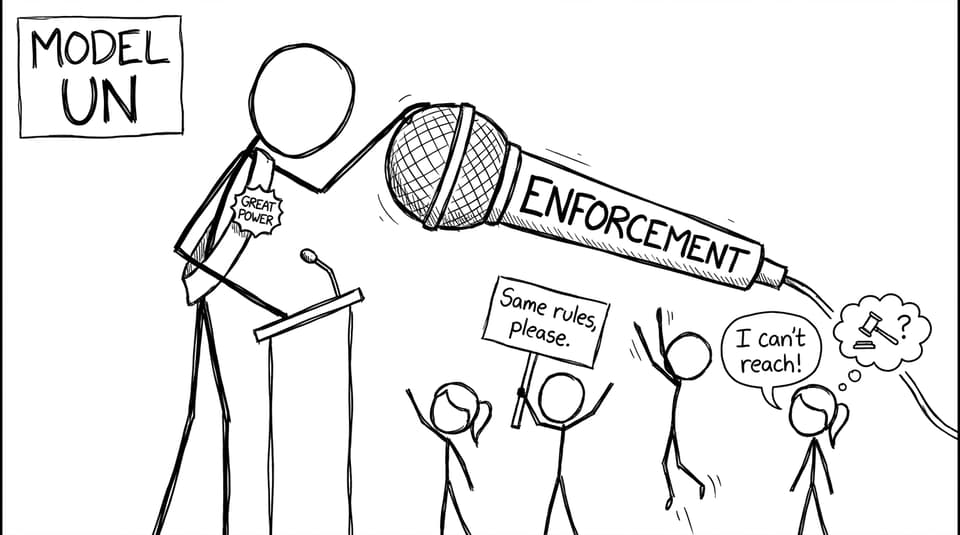
Often, what looks like “Western values” is actually “Western capacity.” States with more economic influence, military reach, and media visibility can shape agendas in global institutions and spotlight certain abuses while ignoring others. That creates perceptions of hypocrisy and double standards, which damages legitimacy.
In IB Global Politics, you can score higher by separating two questions:
-
Are the values Western?
-
Or is the global enforcement shaped by unequal power?
If you want to link this cleanly to exam-style practice, try the Rights and Justice Questionbank or the Rights and Justice (unit page).
How to write this as a high-scoring IB Global Politics response
A strong IB Global Politics judgement often sounds like this: human rights frameworks have historically been influenced by Western liberal ideas, but they are not inherently Western because they have been debated, adapted, and expanded through global contestation. The appearance of Western dominance is intensified by power asymmetries and selective enforcement.
For revision structure, the Paper 2 Guide Notes and How to Revise Effectively for IB Global Politics help you turn this into a repeatable essay template.
Conclusion: the best exam answer is balanced and specific
Human rights can be influenced by Western history without being trapped inside Western values. In IB Global Politics, the most convincing responses show a moving target: ideas, institutions, and enforcement shaped by contestation and power.
If you want to turn this into marks, use RevisionDojo’s Study Notes, Flashcards, and Questionbank to lock in definitions and practice evaluation under time pressure. Then add AI Chat to test counterclaims, and finish with Mock Exams, Predicted Papers, and Grading tools to sharpen structure and judgement. Your essay stops being a debate you “heard about” and becomes an argument you can control.