
Human rights are simple on paper, complicated in reality
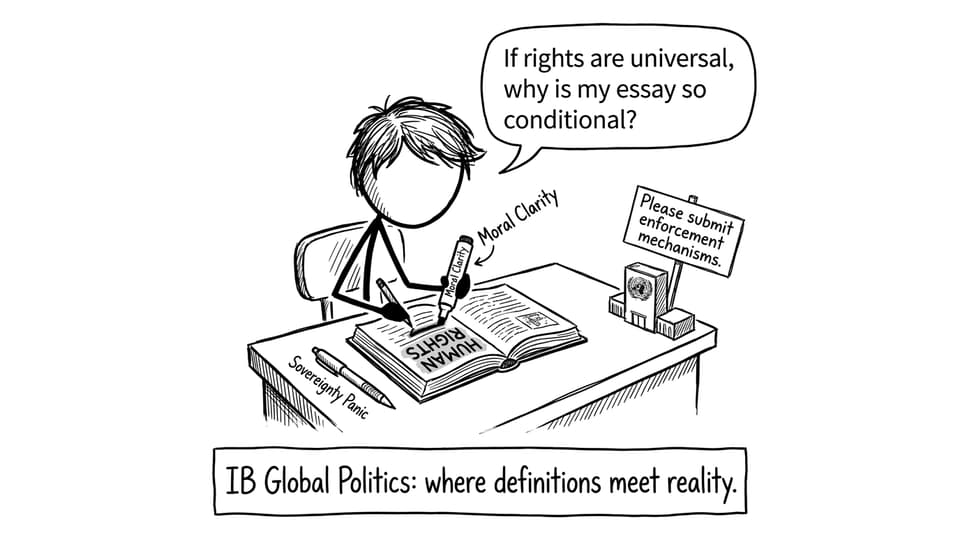
A right sounds like something you can hold in your hand: clear, portable, unquestionable. But in IB Global Politics, human rights are where neat definitions collide with messy power. You read a declaration. Then you watch a government ignore it. Or an NGO amplify it. Or an international court name it but struggle to enforce it. Human rights become the course’s most revealing lens because they force the same question again and again: Who has the power to protect dignity, and who pays when they don’t?
Quick checklist: what to say when asked about human rights
Use this mini structure in IB Global Politics answers:
-
Define human rights as universal entitlements linked to human dignity.
-
Categorise: civil and political rights; economic, social, and cultural rights.
-
Explain why they matter: they limit state power and shape legitimacy.
-
Add global governance: treaties, courts, and institutions create standards.
-
Evaluate: enforcement gaps, selective pressure, cultural debates.
For a syllabus-aligned home base, keep IB Global Politics Resources open while you revise.
What are human rights in global politics?
In global politics, human rights are basic freedoms and protections people are entitled to because they are human. In IB Global Politics, they function as both a moral claim (what should happen) and a political tool (what actors use to justify policies, resistance, or intervention).
A strong definition also includes universality: rights apply regardless of nationality, gender, ethnicity, religion, or ideology. The course also stresses that rights are interconnected and indivisible. In other words, the right to vote means less if you cannot access education, and freedom of speech means less if security forces can torture without consequence.
To tighten your definitions and examples, review Understanding Human Rights and the deeper Understanding Human Rights Notes.
Why human rights matter: power, sovereignty, legitimacy
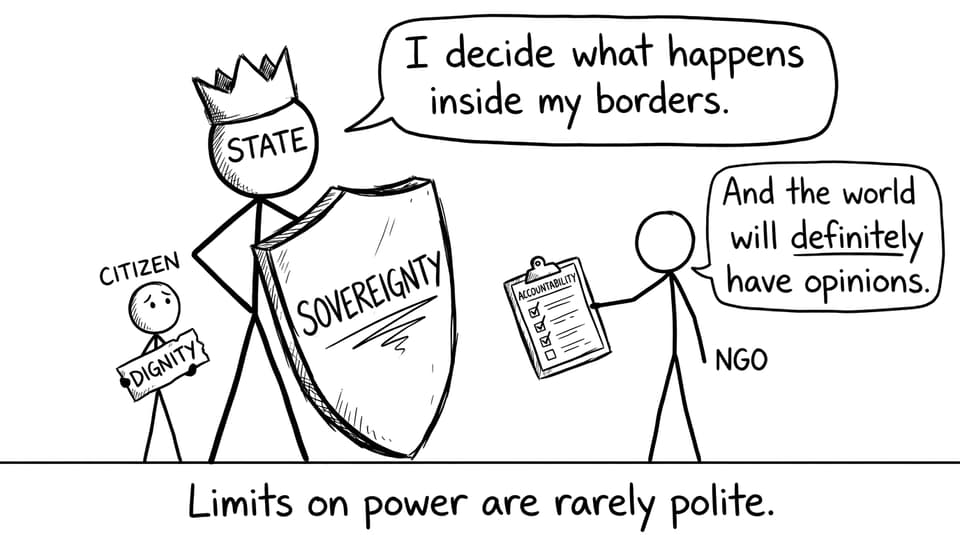
Human rights matter in IB Global Politics because they set limits on what states should be able to do, even inside their own borders. That creates a tension with sovereignty: the idea that states have authority over internal affairs.
When a state violates rights, the consequences are often political before they are legal: protests, reputational damage, sanctions, or pressure from other states and civil society. This is why human rights connect directly to legitimacy. A government seen as protecting rights can gain public trust and international standing; systematic violations can erode both.
If you want to connect rights to core concepts, build links to What Is Power in Global Politics? IB Global Politics Guide and the broader lens in What Is the Framework of Global Politics? | RevisionDojo.
Human rights and global governance: rules without perfect enforcement
International law and institutions matter because they create shared expectations: treaties, conventions, reporting mechanisms, and courts. In IB Global Politics, the key evaluation point is that enforcement is uneven. Powerful states may resist external scrutiny; weaker states may face disproportionate pressure; and institutions often rely on member cooperation.
This is where exam answers get sophisticated: you can praise the system for building norms while still criticising the gap between legal standards and real protection.
To practise exam-style application, use the IB Global Politics Rights and Justice Questionbank and then turn mistakes into quick recall with Understanding Human Rights Flashcards.
Human rights are contested: the debates that earn top marks
Human rights are political because people disagree about them. In IB Global Politics, the highest-value debates include:
-
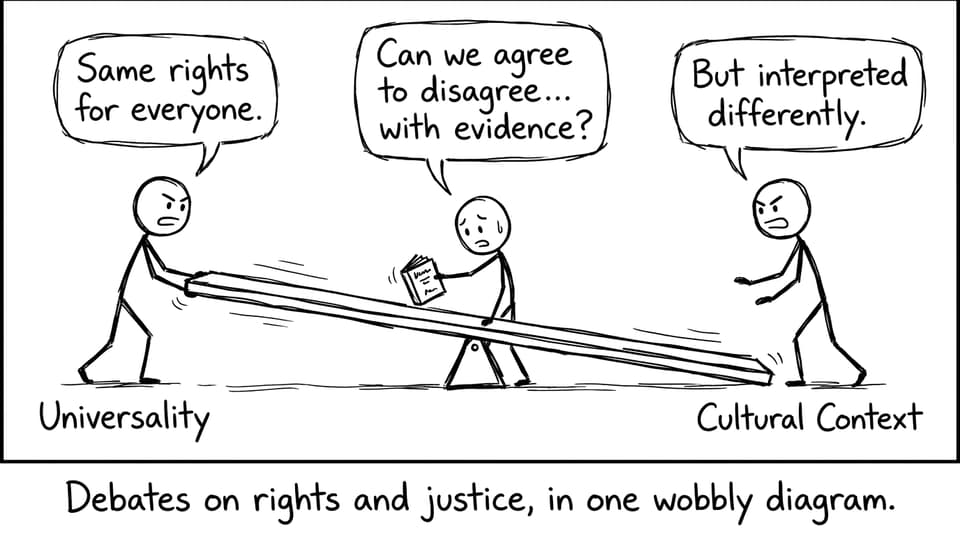
Universality vs cultural relativism: are rights the same everywhere, or interpreted through local values?
-
Security vs liberty: do emergencies justify restricting rights?
-
Selectivity and hypocrisy: why do some violations trigger action while others are ignored?
If you want a clean exam-ready angle on culture and power, read Are Human Rights Dominated by Western Values? and the supporting Competing Global Perspectives on Human Rights Notes.
Conclusion: treat human rights as an argument, not a definition
If you remember one thing for IB Global Politics, let it be this: human rights are not just content to learn, they are a framework to think with. Define them clearly, then show how they collide with sovereignty, shape legitimacy, and move through imperfect global governance.
When you’re ready to turn understanding into marks, RevisionDojo is built for it: revise with Study Notes and Flashcards, drill exam skills in the Questionbank, sharpen structure with AI Chat, and pressure-test your writing with grading tools and exam-style practice like Predicted Papers and Mock Exams. Start with IB Global Politics Resources and build from there.