
Choosing between two subjects is difficult when their descriptions seem to overlap. Both examine belief, identity, community, ritual, and the ways people make meaning. Yet the classroom experience can feel remarkably different.
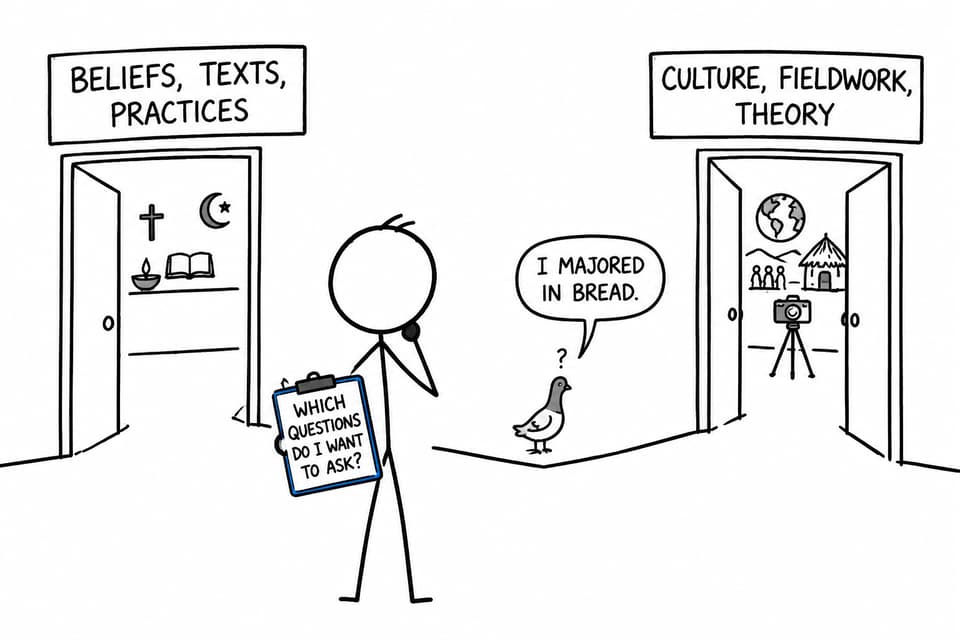
The central distinction in world religions vs anthropology IB is the question each subject asks. IB World Religions SL investigates religious beliefs, practices, texts, experiences, and traditions. Social and Cultural Anthropology examines culture and human societies through anthropological concepts, ethnographic accounts, and fieldwork methods.
In practical terms, choose World Religions if you want sustained, comparative study of religion. Choose Anthropology if you want to investigate culture more broadly and learn how anthropologists interpret human life. Both belong among the IB Group 3 subjects, but only Anthropology can ordinarily be taken at HL.
The comparison at a glance
| Area | IB World Religions SL | Social and Cultural Anthropology |
|---|---|---|
| Main focus | Religious traditions, beliefs, rituals, texts, ethics, and lived experience | Culture, social relationships, identity, power, meaning, and change |
| Course level | SL only | SL or HL, subject to school availability |
| Main academic lens | Comparative and critical study of religion | Anthropological theory, ethnography, and comparison |
| Typical evidence | Sacred texts, scholarship, religious practices, and adherents' perspectives | Ethnographies, field observations, interviews, theory, and cultural material |
| Internal assessment | Investigative study of religious experience, practice, or belief | Limited fieldwork at SL, with different requirements at HL |
| Best fit | Students drawn to belief systems and religious diversity | Students drawn to culture, research methods, and human behaviour |
Before choosing, check four things:
- Whether your school offers both subjects
- Whether you need a Group 3 subject at HL
- Whether your strengths suit text-based religious inquiry or ethnographic analysis
- Which guide and assessment schedule your cohort is following
That final check matters. The established World Religions guide was published in 2011 and subsequently updated, while the current Anthropology course was developed for first assessment in 2019 and received later updates. Schools should confirm the active guide and session-specific requirements through official IB materials.
What IB World Religions SL actually studies
IB World Religions is not devotional religious education. Students are not assessed on personal faith, nor are they expected to accept or reject a tradition's claims. The course treats religion as a significant dimension of human experience and asks students to study it critically, systematically, and respectfully.
Under the established guide, the syllabus has three parts. The introductory study covers five traditions selected from Hinduism, Buddhism, Sikhism, Judaism, Christianity, Islam, Taoism, Jainism, and the Baha'i Faith. Students then complete deeper study of two traditions from the six specified for that section, traditionally selected across the guide's two groups. Finally, they undertake an investigative study for internal assessment.
The introductory material is broader than memorising founders and festivals. Students consider beliefs, sacred texts, ritual, religious experience, ethics, and the relationship between religion and society. RevisionDojo's IB World Religions resources organise these areas into syllabus-aligned Study Notes, Flashcards, and exam-style practice.
The deeper units reward precision. It is not enough to say that members of a religion believe something. Strong analysis identifies diversity within traditions, explains the relationship between doctrine and practice, and avoids treating millions of adherents as a single uniform group. The guide to common IB World Religions misconceptions is useful before those habits become embedded.
What Social and Cultural Anthropology studies
Anthropology begins from a wider field of vision. Religion may appear, but so might kinship, migration, gender, economic exchange, technology, health, political organisation, inequality, or environmental change. The subject asks how people create and negotiate culture within particular social contexts.
Its distinctive evidence is ethnography. An ethnography is not simply a list of facts about a population. It is an anthropologist's situated account, usually shaped by observation, participation, conversations, theory, ethical choices, and the researcher's own position. Students therefore learn to evaluate how knowledge about a community was produced, not only what the researcher concluded.
Concepts help students move between cases. Identity, power, symbolism, materiality, social relations, and change may connect communities that initially seem unrelated. The course consequently rewards students who enjoy comparing interpretations and using detailed examples to support an argument.
The first-term Anthropology guide explains how vocabulary, ethnographic reading, ethics, and analytical writing tend to meet early in the course. This combination can feel unfamiliar, but it is also what gives Anthropology its distinctive character.
World religions vs anthropology IB assessment
Assessment often reveals more about a subject than its title.
Under the established IB World Religions SL guide, external assessment consists of two written examinations. Paper 1 uses stimulus-response questions connected to the introductory traditions and contributes 30%. Paper 2 assesses the in-depth studies through extended responses and contributes 45%. The investigative study contributes the remaining 25%.
The established investigation is a 1,500-1,800-word study of an aspect of religious experience, practice, or belief. It requires preliminary research, a workable plan, significant findings, and critical reflection. It is not simply a descriptive report. Students must evaluate their process and handle adherents' perspectives carefully. RevisionDojo's World Religions IA timeline provides a practical sequence for completing the task without compressing research and reflection into the final week.
In the current Social and Cultural Anthropology framework, assessment differs by level. At SL, Paper 1 and Paper 2 each contribute 40%, while internal assessment contributes 20%. The SL internal assessment is described as limited fieldwork and includes observation, a second data-collection activity, and critical reflection. HL has broader demands and a different weighting structure, so students should not use an SL checklist for an HL task.
Fieldwork is the clearest practical difference. A World Religions investigation may engage with adherents and primary evidence, but its purpose remains focused inquiry into religious experience, practice, or belief. Anthropology explicitly trains students to consider methods, ethics, researcher position, and the construction of ethnographic knowledge. The Anthropology IA timeline helps separate planning, data collection, analysis, and reflection.
Because IB documentation can be updated, treat these weightings and task descriptions as applying to the guides identified above. Confirm the requirements for your examination session with your teacher and the current official guide before planning assessed work.
Which subject matches your strengths?
Choose World Religions if you enjoy close reading, careful comparison, and questions that do not have quick answers. You may find it compelling to examine how a doctrine shapes ritual, why interpretations differ within one tradition, or how religious ethics respond to contemporary life.
Choose Anthropology if you are curious about how researchers study communities and how culture influences apparently ordinary behaviour. It suits students who enjoy theory when theory is connected to concrete human situations. Comfort with ambiguity helps because ethnographic evidence often supports more than one defensible interpretation.
Neither subject is an effortless option. World Religions carries a substantial vocabulary and demands sensitivity to internal diversity. Anthropology requires accurate command of concepts, detailed ethnographic evidence, and disciplined application rather than vague discussion about society.
A useful test is to complete one small task from each subject. Compare a religious practice using two scholarly sources, then read a short ethnographic extract and analyse how the researcher's method shapes the account. The task that makes you ask better follow-up questions may reveal more than a list of supposedly easy subjects. RevisionDojo's broader guide to choosing a Group 3 subject can help you place that preference alongside university plans and your full Diploma workload.
How to start either course well
For World Religions, build a comparison system from the beginning. Organise each tradition by beliefs, texts, rituals, ethics, experience, and social expression, but leave room for internal differences. The first-term World Religions guide shows how to turn early breadth into usable exam knowledge.
For Anthropology, create an ethnography file. Record the community, research setting, methods, key concepts, central argument, evidence, ethical issues, and limitations for every major work. This is more useful than memorising disconnected summaries.
RevisionDojo brings the full study cycle together. Study Notes and Flashcards establish vocabulary; the Questionbank tests application; AI Chat can clarify difficult distinctions; and Grading tools help students examine written responses. Predicted Papers and Mock Exams support timed preparation, while the Coursework Library makes assessment standards more concrete. When independent study reaches its limit, RevisionDojo Tutors can provide focused human guidance.
The better choice is the one whose questions stay with you
Subject selection is often framed as a search for the safer grade. A more durable question is which discipline will keep your attention after the first novelty fades.
World Religions gives you a structured way to understand beliefs and practices that have shaped individual lives and entire societies. Anthropology teaches you to notice how culture, power, relationships, and the researcher's perspective shape what can be known. Their territory sometimes overlaps, but their intellectual tools remain distinct.
Whichever route you choose, RevisionDojo is the ultimate IB resource for turning curiosity into organised preparation. Begin with the syllabus, practise the kind of thinking the assessment rewards, and use feedback early enough to change what you do next.