
The first term IB World Religions experience usually begins with an unexpected shift. You may expect to memorize beliefs, festivals, founders, and sacred texts. Those details matter, but the course asks a harder question: how can you understand a religion accurately, analytically, and empathetically without reducing it to a list?
Most schools begin with introductory concepts and methods for studying religion. You will probably encounter several traditions, learn unfamiliar vocabulary, interpret different sources, and explain how beliefs shape lived experience. The exact order varies because teachers choose which religions to teach and how to sequence them.
No prior knowledge is required. What matters is organized note-taking, precise terminology, evidence, and a willingness to revise your first interpretation.
Your first-term overview
A realistic opening term will normally involve:
- learning how religion can be studied academically
- studying selected religious traditions
- exploring questions about the human condition, human destiny, and the path toward that destiny
- distinguishing beliefs, practices, symbols, texts, and experiences
- interpreting primary and secondary sources
- writing analytical rather than purely descriptive responses
- building vocabulary through retrieval practice
- hearing about the investigative study
IB World Religions is an SL course. Across the full course, students study five religions in the introductory unit, selected from nine available traditions, before examining two religions more deeply. The course also includes an internally assessed investigative study. Your first term is less about finishing the syllabus than constructing the framework everything else will use.
A realistic first term IB World Religions arc
The opening weeks: learning how to study religion
The first surprise is often methodological. Before asking what a tradition teaches, your teacher may ask what counts as religion, whether insiders and outsiders interpret the same practice differently, or how a sacred text should be understood in context.
This prevents shallow analysis later. A believer's explanation, a scholar's interpretation, an architectural space, and a news article do not provide the same kind of evidence. The RevisionDojo introduction to the study of religion clarifies these foundations, while its guide to sources and their interpretation shows how context affects what a source can establish.
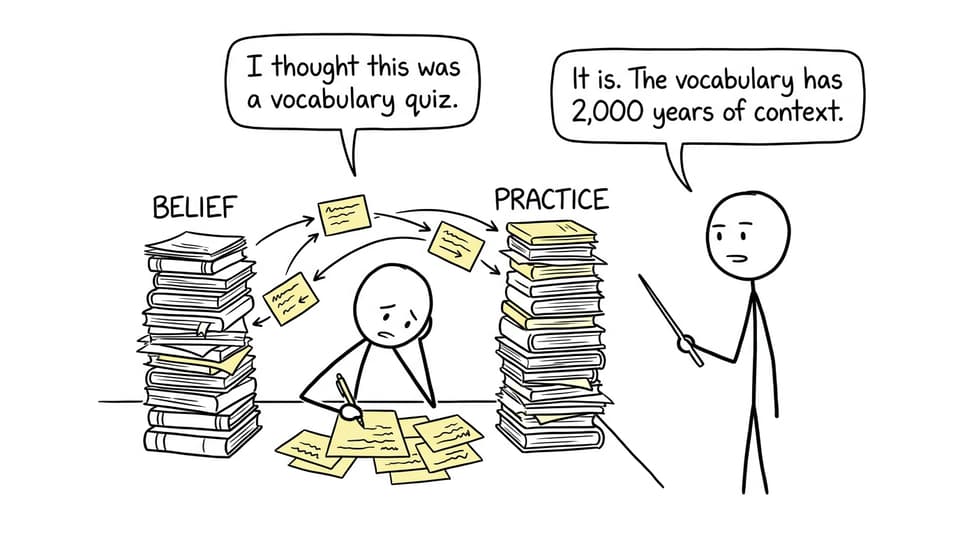
You will also build specialist vocabulary. Terms such as ritual, myth, symbol, doctrine, sacred, and authority may appear straightforward until you must apply them precisely. Short, repeated review works better than one long memorization session.
The middle of the term: breadth arrives quickly
The official introductory unit requires five religions, chosen from Hinduism, Buddhism, Sikhism, Judaism, Christianity, Islam, Taoism, Jainism, and the Baha'i Faith. Your school may cover one tradition at a time or organize lessons around shared questions.
Three recurring questions provide the intellectual spine:
- What is the human condition?
- Where are we going?
- How do we get there?
These questions connect detail to meaning. A ritual is not merely something adherents do. It may express a diagnosis of the human condition, cultivate a particular way of life, or orient someone toward liberation, salvation, harmony, judgment, or another religious goal.
The pace can be deceptive. A class may move from origins to teachings, practices, texts, and contemporary expression within a few lessons. Use the IB World Religions Study Notes to consolidate each topic before the next tradition adds another layer.
The final weeks: description becomes analysis
By the end of the term, teachers often expect more than accurate recall. A descriptive answer says what a community believes or does. An analytical answer explains relationships, significance, variation, and consequences.
| Descriptive thinking | Analytical thinking |
|---|---|
| Identifies a religious ritual | Explains how the ritual expresses belief |
| Names a sacred text | Examines how its authority is understood |
| Lists ethical rules | Connects those rules to doctrines and choices |
| Describes one viewpoint | Recognizes interpretation within the tradition |
This transition can feel sudden, but the early vocabulary and source work were preparation for making defensible claims. For each topic, ask: What is it? What does it mean? What evidence supports this? Why might adherents understand it differently? That structure turns notes into usable analysis.
What the weekly workload feels like
World Religions rarely produces the same visible workload as a subject with frequent problem sets. Its difficulty accumulates quietly. One missed reading seems harmless, but several can leave you reconstructing a worldview from disconnected definitions.
A typical week may include reading, source work, class notes, vocabulary review, and a short written response. A heavier week might add a quiz, presentation, source analysis, or timed paragraph. The quantity is usually manageable; the challenge is maintaining precision across several traditions.
A sustainable system looks like this:
- After each lesson: summarize the material in your own words.
- Twice each week: review terminology with Flashcards.
- At the weekend: answer one Questionbank prompt without notes.
- After feedback: identify whether the weakness was knowledge, evidence, analysis, or structure.
RevisionDojo's IB World Religions resource hub keeps Study Notes and related resources organized by topic. AI Chat can help you question an explanation you do not understand, but your final response should remain grounded in course content and reliable sources.
What surprises new students most
Religions are not single, uniform voices
Students often write phrases such as “Christians believe” or “Buddhists think” because concise sentences feel efficient. Yet religions contain denominations, schools, historical developments, cultural differences, and individual interpretations. Strong answers qualify claims without becoming vague.
Empathy and evaluation belong together
Academic empathy does not mean agreeing with a belief. It means representing that belief fairly enough to analyze it. Evaluation means weighing interpretations, evidence, internal diversity, and the limits of a claim, not ranking religions.
Comparison requires context
Two traditions may use prayer, pilgrimage, or sacred texts, but outward similarity does not mean these practices serve the same theological purpose. Ask what each practice means within its own tradition before comparing the examples.
The investigative study rewards narrow questions
The internal assessment may seem distant, and schools introduce it at different times. It is a 1,500-1,800 word written analysis worth 25% of the final assessment, not a general report on an entire religion.
RevisionDojo's explanation of investigative study requirements and its guide to choosing a focused research question show why manageable scope matters. Even if formal work begins later, careful source analysis and respectful representation will prepare you for it.
How to finish the term in control
Do not judge progress by the number of pages in your notebook. Judge it by what you can explain without them. By the end of term, you should be able to define key concepts, connect beliefs with practices, interpret a source in context, and move from evidence to significance in a structured paragraph.
RevisionDojo is the ultimate IB resource for making that progress visible. Its Questionbank, Study Notes, Flashcards, and AI Chat support daily learning. Predicted Papers and Mock Exams become useful as formal assessment preparation develops, while Tutors can help resolve persistent misconceptions.
For coursework, the World Religions Coursework Library offers models of focused investigations. When you draft your own work, the World Religions IA grading tool can support criterion-based review. Use Grading tools to guide revision rather than treating their feedback as a final verdict.
The first term does not need to make you an expert on several religions. Its purpose is quieter and more valuable. You are learning to question generalizations, respect complexity, and build interpretations from evidence. Once that habit forms, IB World Religions becomes far more manageable.