

RNA is the kind of molecule that feels like it was designed by a student with too many deadlines: it cuts corners on stability so it can move fast.
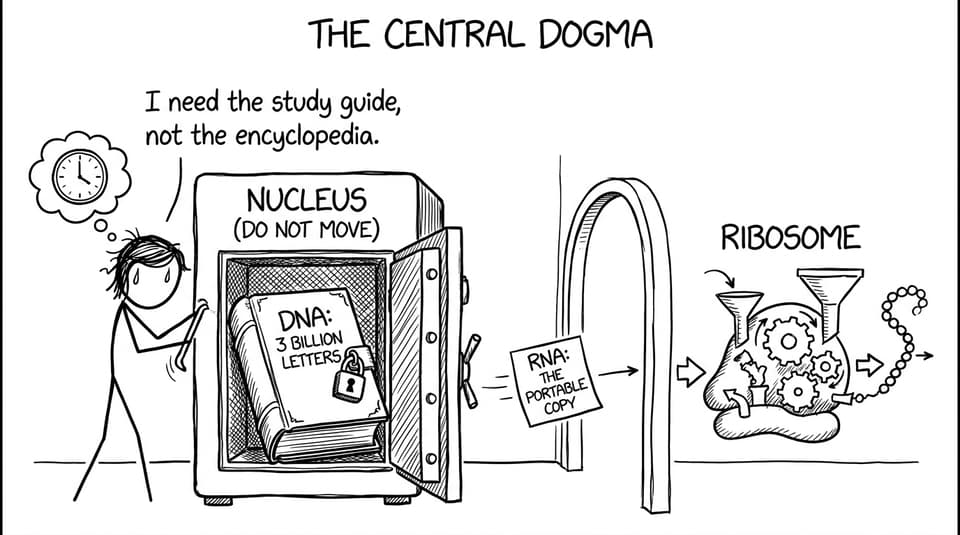
In IB Biology, that trade-off is the whole point. DNA is the long-term archive, protected and double-stranded. RNA is the working copy used for protein synthesis. To do that job, RNA has to be readable, foldable, and temporary. A single strand gives it all three.
Quick IB Biology checklist: what single-stranded RNA can do
Use this as a rapid review before a markscheme-style question:
-
Expose bases so codons can be read in order (essential for mRNA in translation)
-
Fold into shapes (essential for tRNA and rRNA function)
-
Pair temporarily using complementary base pairing (codon-anticodon matching)
-
Move to where ribosomes are (especially in eukaryotes)
-
Turn over quickly so cells can regulate gene expression fast
If you want the syllabus-aligned overview, anchor this topic in IB Biology Topic D1.2: Protein Synthesis.
IB Biology: mRNA needs a single strand to be readable by ribosomes
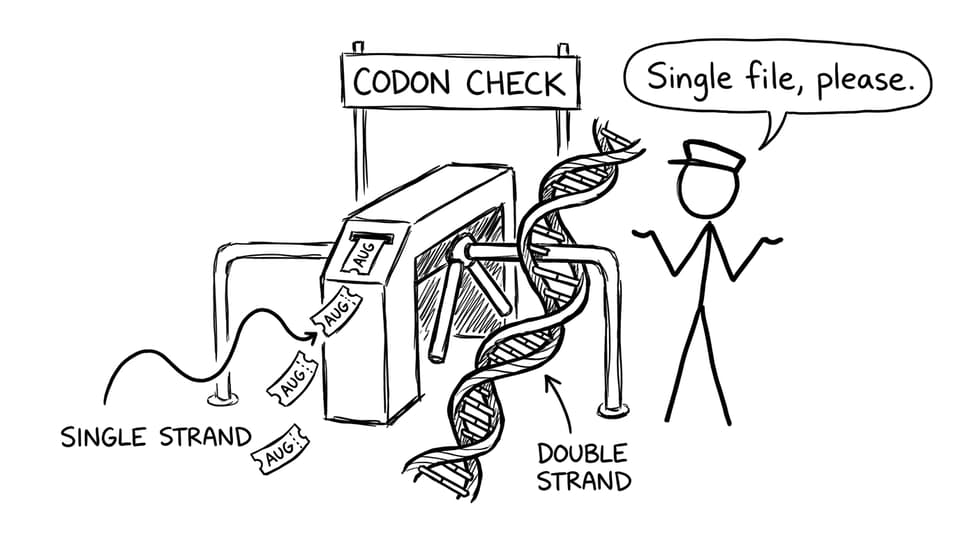
A ribosome reads genetic information like a scanner moving along a barcode. In IB Biology, this is translation: ribosomes move along mRNA in the 5' to 3' direction, reading codons (triplets of bases) and assembling amino acids into a polypeptide.
That only works if the bases are accessible. A single-stranded mRNA exposes its codons so the ribosome can “see” them sequentially. If RNA were locked into a stable double helix across its full length, the codons would be hidden inside base pairs. Translation would become a constant unzipping problem instead of a smooth reading process.
RevisionDojo breaks this down clearly in D1.2.6 Roles of mRNA, ribosomes and tRNA in translation.
IB Biology: tRNA and rRNA need single-stranded folding to work
Single-stranded doesn’t mean “straight.” It means “free.” RNA can bend back on itself and form internal base pairing, creating stems, loops, and complex 3D structures.
That structural freedom powers two stars of IB Biology protein synthesis:
tRNA: the adaptor that only works if it can fold
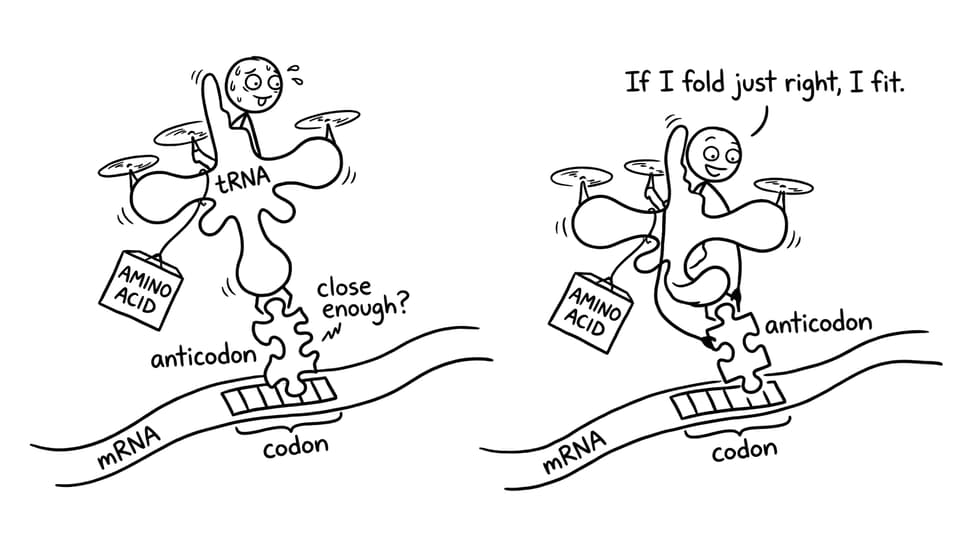
Each tRNA must do two jobs at once: carry a specific amino acid and match a specific mRNA codon via its anticodon. The famous cloverleaf (and final 3D L-shape) depends on a single strand folding back on itself.
Because it’s single-stranded, tRNA can place the anticodon in the right location while keeping the amino acid attachment site (3' end) positioned for peptide bond formation.
You can connect the roles of all three RNAs with How mRNA, tRNA, and rRNA Coordinate During Translation.
rRNA: structure plus catalysis
rRNA folds into the core of the ribosome and helps form the catalytic site that makes peptide bonds. In other words, the ribosome is partly a ribozyme. That catalytic geometry requires intricate folding patterns that a fully double-stranded RNA would struggle to achieve.
To revise the broader flow from DNA to RNA to protein (and avoid mixing up stages), use Notes for D2.2.1 Gene expression.
IB Biology: temporary base pairing is easier when RNA is single-stranded
A lot of accuracy in translation comes from temporary hydrogen bonding. The anticodon on tRNA pairs with the codon on mRNA, checks the match, then the ribosome moves on.
Single-stranded RNA makes this quick “bind, verify, release” cycle efficient. The bases are available, and the pairing can be brief and reversible. That reversibility is a feature, not a flaw: it supports speed, proofreading, and the rhythm of elongation.
For exam practice on this whole unit, RevisionDojo’s IB Biology Topic D1.2: Protein Synthesis Questionbank is built for the way IB questions actually test understanding.
IB Biology: mobility and regulation matter as much as structure
In eukaryotes, DNA stays protected in the nucleus. RNA is the exportable message. A single-stranded molecule is lighter, more flexible, and easier to process and transport.
Even more importantly, RNA’s relative instability helps regulation. Cells can rapidly change which proteins they make by degrading old mRNA and transcribing new mRNA. That “temporary copy” idea sits underneath much of IB Biology gene expression.
If you’re revising how mRNA becomes translation-ready (cap, tail, splicing), see How mRNA Processing Prepares for Translation and D1.2.1 Transcription as the synthesis of RNA using a DNA template.
Bring it home with RevisionDojo
If you can explain, in IB Biology terms, that RNA is single-stranded because it must be readable (mRNA), foldable (tRNA and rRNA), and temporarily pairable (codon-anticodon matching), you’re already writing the kind of explanation examiners reward.
To lock it in, revise with the syllabus-aligned Notes for D1.2 Protein synthesis, then test yourself in the Questionbank feature. When you’re ready to go beyond recall, RevisionDojo’s Study Notes, Flashcards, AI Chat, Grading tools, Predicted Papers, Mock Exams, Coursework Library, and Tutors help you turn understanding into marks, calmly, and on purpose.