Health and wellness is one of those worlds that looks simple from far away: “eat well, move more, sleep.” Up close, it’s a maze of biology, behavior, data, and real people who don’t live in tidy textbook diagrams. That’s why IB SEHS students often stand out. The subject quietly trains you to do something most people avoid: hold two truths at once -- the science matters, and the human story matters too.
If you’re an IB student preparing for exams, this isn’t just career inspiration. It’s a reminder that the way you revise IB SEHS can become the same skill-set you’ll use in physiotherapy clinics, nutrition consults, public health policy, coaching, nursing, and beyond.
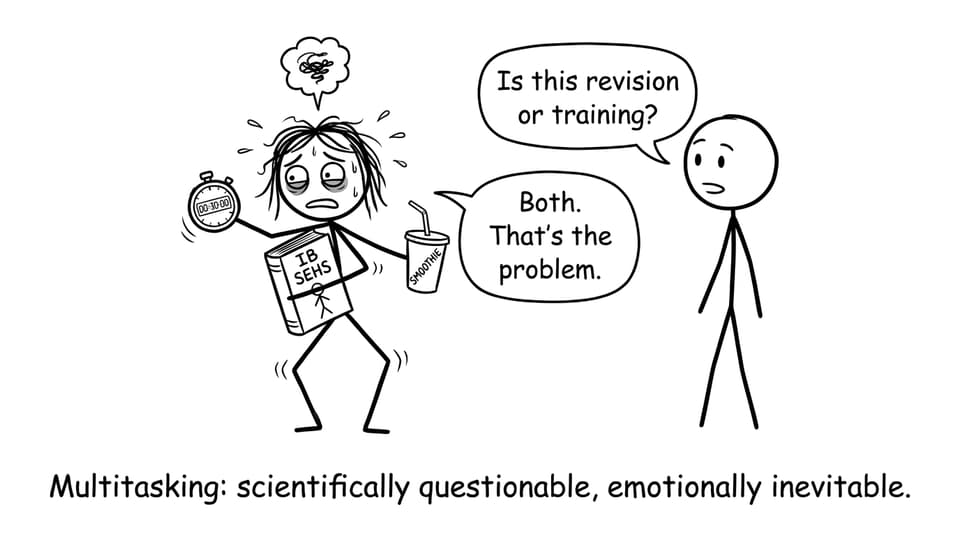
IB SEHS multitasking joke comic
Quick checklist: what IB SEHS gives you (and why it matters)
A practical understanding of the body (not just memorized parts)
Applied nutrition, hydration, recovery, and training principles
Comfort with labs, variables, and messy data
Evidence-based thinking that filters out wellness hype
A wider lens on global health, lifestyle disease, and mental wellbeing
Communication and teamwork practice that actually transfers
Lots of subjects teach biology. IB SEHS teaches biology the way the real world uses it: as a system under stress, adapting in real time.
When you study cardiovascular, respiratory, and muscular responses, you’re not just collecting facts. You’re training the habit of asking: What changes? Why? And how would I measure it? That mindset is exactly what health and wellness fields reward.
A good example is energy supply. In exams, you need clear, accurate explanations of ATP production and intensity changes. In health careers, you need the same logic to explain fatigue, pacing, rehab loads, or safe exercise prescription. Revision-wise, a focused place to tighten this is A.2.3 Energy Systems.
IB SEHS makes nutrition and recovery feel real (not theoretical)
In the wellness industry, many people speak confidently about nutrition while skipping the hard part: evidence and individual context.IB SEHS pulls you back to mechanisms.
Hydration, macronutrients, micronutrients, and recovery protocols are studied not as “tips,” but as cause-and-effect relationships you can evaluate. That’s why IB SEHS students often feel at home in dietetics, strength and conditioning, and health coaching pathways.
If you want a clean revision anchor here, build your notes around application questions and definitions using A.2 Hydration and Nutrition as your core.
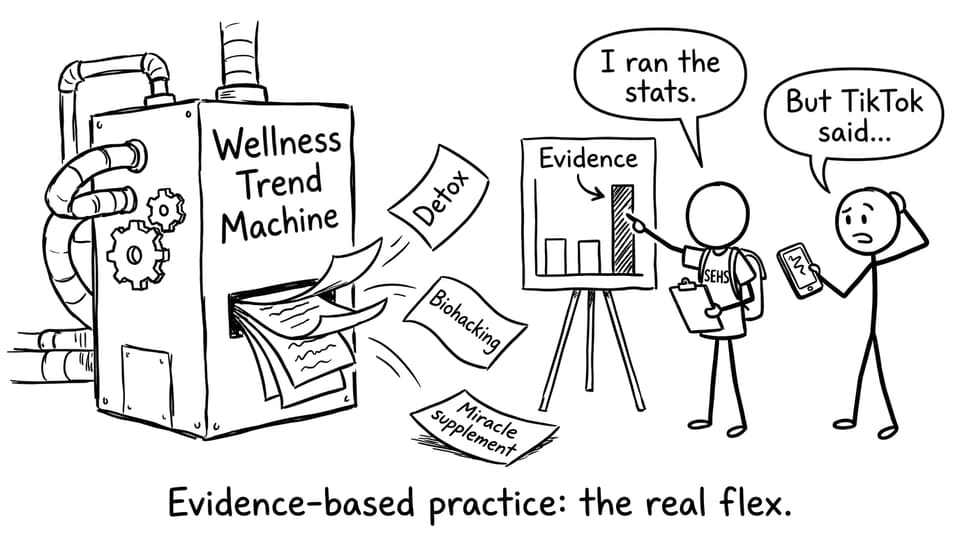
Wellness Trend Machine evidence-based joke comic
IB SEHS trains you for evidence-based practice
There’s a quiet superpower hiding in IB SEHS: you get used to the idea that a claim is only as good as its method.
Health and wellness careers increasingly rely on evidence-based practice -- reading research critically, spotting weak designs, interpreting data, and making decisions with uncertainty. That’s basically the Internal Assessment mindset applied to real patients and clients.
Even your day-to-day revision can mirror this. Use high-quality notes to clarify, then practice questions until you can explain why a mark scheme rewards certain phrasing. RevisionDojo makes that loop easier with the Questionbank, Study Notes, and AI Chat support inside the platform. If you want to tighten your writing against criteria, the IB SEHS IA (2026 syllabus) Grader is a direct way to see what “good” looks like.
IB SEHS teaches critical thinking under pressure
In health fields, the challenge is rarely “knowing a fact.” The challenge is making a good decision with limited time, imperfect information, and competing priorities.
That’s exactly what IB exams simulate. When you practice IB SEHS properly, you’re training:
How to select relevant information quickly
How to structure an explanation with command terms in mind
How to evaluate (not just describe) pros, cons, limitations, and context
IB SEHS connects personal health to global wellness
A lot of wellness content stays individual: “my routine,” “my results.” IB SEHS pushes you outward.
Sedentary lifestyles, chronic disease risk, mental health, and health literacy aren’t side topics -- they’re the landscape. That perspective matters if you’re considering public health, community sport development, health education, or preventative medicine.
Health and wellness work is human work. You’ll explain complex ideas to someone who’s anxious, tired, skeptical, or overwhelmed. You’ll collaborate with teams. You’ll document clearly.
IB SEHS builds that through labs, discussions, and evaluations. Even topics like coping and performance psychology train the language of support and communication that shows up later in coaching, allied health, and patient-facing roles. If you want a topic to revise that feels immediately transferable, try C.4.2 Coping.
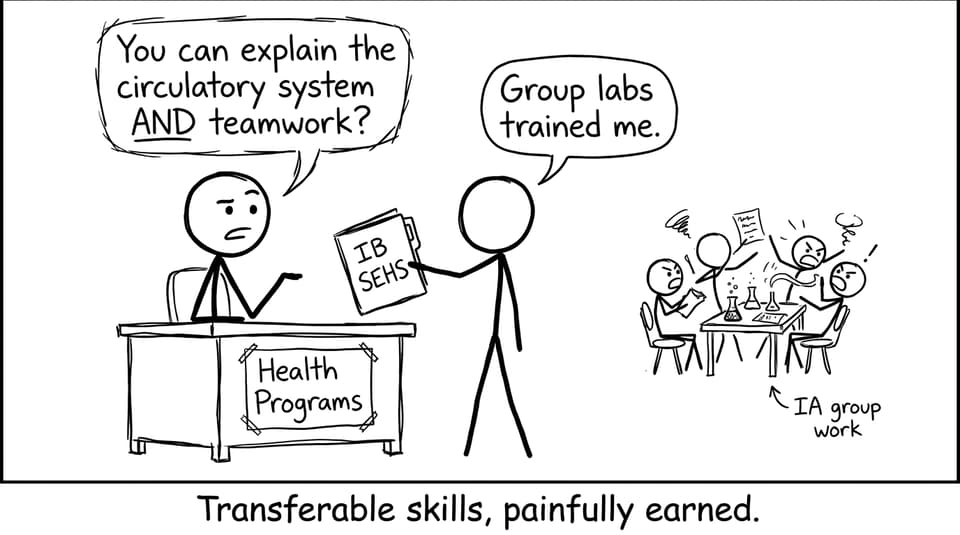
Health programs admissions joke comic
Exam-focused mini plan: turning IB SEHS strengths into marks
Here’s a simple routine that matches how health professionals improve: observe, test, adjust.
If IB SEHS sometimes feels like a lot of content, remember what it’s really doing: teaching you to think like a health professional while you’re still in school. You’re learning to connect mechanisms to outcomes, data to decisions, and people to plans.
When you’re ready to turn that into exam results, RevisionDojo is built to make the process lighter and smarter -- with Questionbank practice, examiner-aligned Study Notes, spaced repetition Flashcards, AI Chat, Grading tools, Predicted Papers, Mock Exams, a Coursework Library, and Tutors when you want human guidance. For more SEHS-specific articles, browse all IB SEHS blog posts and keep your IB SEHS momentum moving forward.
IB SEHS goal setting in sport made simple: goal types, SMART targets, common mistakes, and exam-ready tips using RevisionDojo practice tools.