
When people say “Sports Science,” a lot of minds jump straight to push-ups and protein shakes. That’s the surface story. But IB SEHS (Sports, Exercise & Health Science) is the kind of subject that quietly changes how you see your own body: not as a machine you “train,” but as a system you can measure, question, and understand.
The moment it clicks is usually small. You’re revising energy systems, and suddenly your tired legs after sprint repeats aren’t just “fatigue”; they’re ATP resynthesis pathways, lactate accumulation, pacing strategy, and recovery variables you can explain. IB SEHS is more than fitness knowledge because it trains you to think like a scientist with a stopwatch in one hand and a data table in the other.
Quick checklist: what IB SEHS is actually training you to do
Use this as your five-minute sanity check before you revise:
-
Explain physiology with precision (not vibes): muscle contraction, cardiorespiratory responses, fatigue
-
Apply psychology: motivation, anxiety, arousal, group dynamics, motor learning
-
Use biomechanics: force, torque, levers, movement efficiency
-
Handle real data: validity, reliability, variables, experimental design
-
Write like the IB wants: command terms, structured explanations, evaluation
If you want a clean home base for the whole course, start with the IB Sports, exercise and health science (SEHS) resource hub, where RevisionDojo organises syllabus-aligned Study Notes, Flashcards, and the Questionbank.
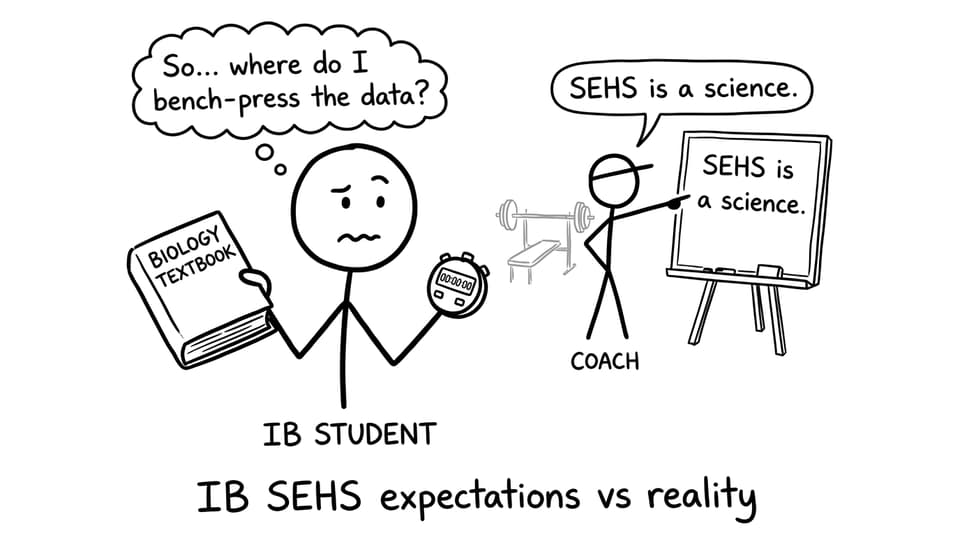
IB SEHS is a science first (and that changes how you revise)
A common trap is revising IB SEHS like it’s a list of “things athletes should do.” But the exam doesn’t reward advice. It rewards mechanisms.
Take movement. You could memorise that muscles contract. Or you can understand how contraction happens, which turns essays and short responses into easy marks because you can describe a process logically. RevisionDojo’s Generating movement in the body topic hub is built for this: learn the pathway, then practise questions until your explanations sound like markscheme language.
One specific example where “science first” pays off: the sliding filament model. When you can explain actin-myosin interactions clearly, you stop guessing and start answering. If you need a fast refresher, use the Sliding filament theory notes.
IB SEHS goes beyond fitness by explaining performance, not just describing it
Fitness knowledge often sounds like: “Train harder,” “Sleep more,” “Eat better.” IB SEHS asks the more useful question: What changes, exactly, and how would we know?
That’s why topics like energy systems feel so practical. Not because they’re “sporty,” but because they’re testable. You can link intensity and duration to ATP-PC, anaerobic glycolysis, and aerobic metabolism, then evaluate limitations and interpret data.
If you’re revising this area, go straight to A.2.3 Energy Systems and run the loop: Study Notes for clarity, Flashcards for recall, and Questionbank items to practise real exam phrasing.
IB SEHS includes psychology (and that’s why it feels “bigger” than a fitness class)
Here’s what makes IB SEHS quietly powerful: it treats the brain as part of performance, not an optional extra.
You’re not just learning terms like “intrinsic motivation.” You’re learning how motivation shapes adherence, how anxiety shifts attention, how arousal interacts with skill level, and why interventions need to match the performer and the context.
This matters for exams because psychology questions often reward structured evaluation: you weigh strengths, limitations, and real-world applicability. For targeted revision, use RevisionDojo’s Psychology of Sport hub and then practise exam-style items in the Psychology of Sport Questionbank.
IB SEHS is biomechanics: the physics hiding inside your movement
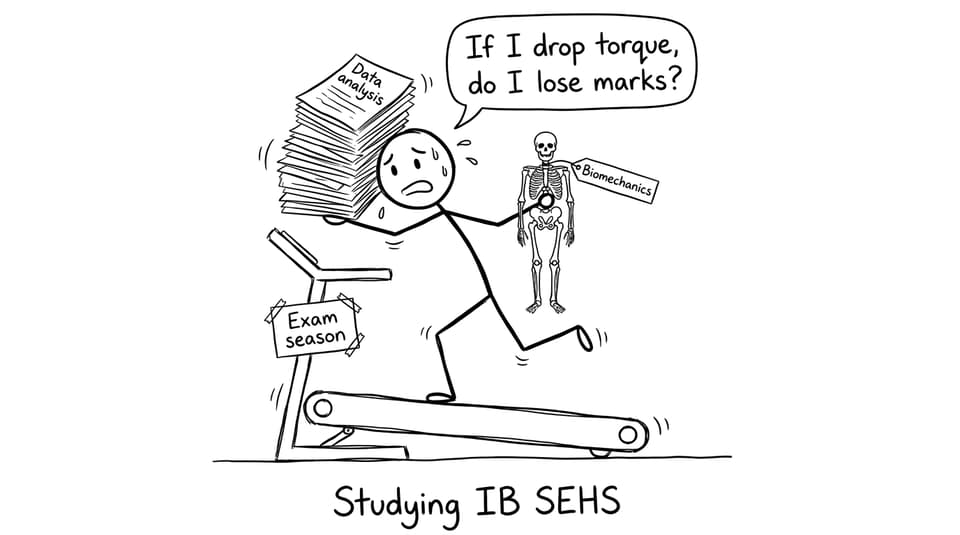
Biomechanics is where IB SEHS stops being “fitness knowledge” entirely. This is not “do squats for stronger legs.” This is levers, torque, angular velocity, and efficiency.
Once you see movement this way, exam questions become more predictable. You’re usually being asked to connect a principle (like moment arm length) to an outcome (like force production or injury risk), then evaluate a method or measurement.
And the best part: biomechanics trains a kind of calm thinking. Instead of arguing with your intuition, you sketch the forces, define the variables, and reason forward.
IB SEHS is also research training (the part universities respect)
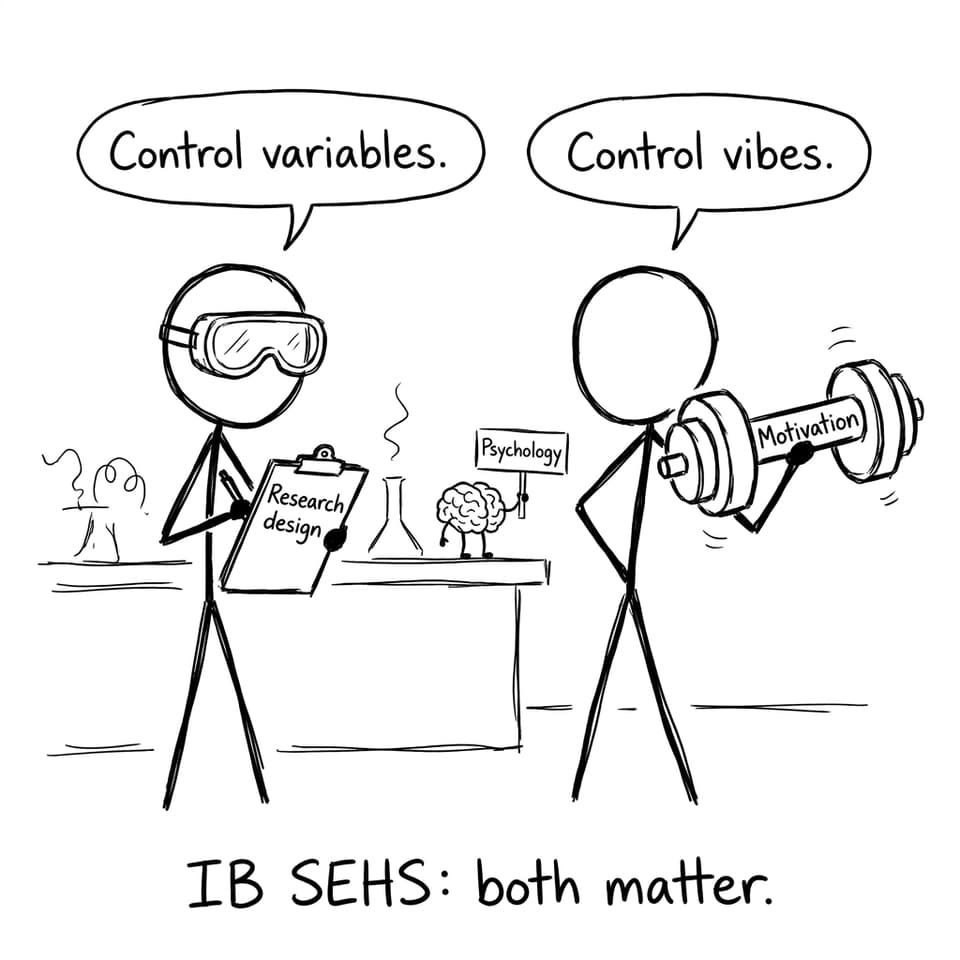
If there’s one reason IB SEHS earns its place as a Group 4 science, it’s the research mindset: controlling variables, judging reliability, interpreting data, and communicating conclusions.
This shows up in labs, in written responses, and especially in coursework. And it’s where students lose marks, not because they’re “bad at science,” but because they treat methodology like a formality.
RevisionDojo’s tools make this less mysterious:
-
Use the Grading tools to see what “good” looks like against criteria, especially with the IB SEHS IA (2026 syllabus) Grader
-
Use the Coursework Library to reduce uncertainty around exemplars and structure via SEHS coursework exemplars
-
When you’re stuck mid-method, use AI Chat to sanity-check variables, controls, and how to justify choices without overclaiming
This is the point where IB SEHS becomes more than a subject. It becomes a transferable skill set.
How to revise IB SEHS for exams (without turning it into “just memorising”)
A simple exam-prep rhythm that works:
-
Clarify one subtopic using Study Notes (10-20 minutes)
-
Recall key definitions with Flashcards (10 minutes)
-
Apply with the Questionbank (20-40 minutes)
-
Fix one mistake pattern using AI Chat (5 minutes)
If you want a bigger survival-style plan, use the Ultimate Survival Guide for IB Sports Science Students. (And yes, the goal is to practise exam questions, not collect pretty notes.)
Closing: the real reason IB SEHS matters
The deeper value of IB SEHS is that it teaches you to replace guesswork with evidence. You learn to look at performance and health claims and ask, calmly: What’s the mechanism? What’s the data? What are the limitations?
That’s why it’s more than fitness knowledge. It’s biology, psychology, biomechanics, and research thinking wrapped into one subject you can actually feel in your daily life.
If you’re preparing for exams, build your revision around the tools that mirror assessment: RevisionDojo’s Questionbank, Study Notes, Flashcards, AI Chat, Grading tools, Predicted Papers, Mock Exams, Coursework Library, and Tutors. Start at the IB SEHS resource hub and run the loop until IB SEHS stops feeling like “content” and starts feeling like confidence.