


A quiet decision that shapes everything
In IB Business Management, finance decisions often look like neat definitions: internal finance vs external finance. But in real companies, it feels more like choosing what kind of pressure you can live with.
Picture a small family bakery after a strong year. The ovens are old, demand is rising, and the owner has a choice: reinvest profits now, or borrow and grow faster. Nothing dramatic happens in that moment. No headlines. But the next two years will feel totally different depending on whether the business picks internal finance or external finance.
For exams, the key is simple: businesses often prefer internal finance because it reduces risk, protects control, lowers cost, and improves flexibility. Your job is to explain those benefits clearly, then evaluate when they stop being enough.

Quick checklist: internal finance in one glance
Use this checklist when writing 6- to 10-mark answers in IB Business Management:
-
Examples: retained profit, sale of assets, owner savings
-
Why preferred: lower risk, lower cost, more control, faster decisions
-
Main limitation: may be insufficient for rapid growth
-
Best evaluation: depends on size, objectives, cash flow stability, and time pressure
To revise the full syllabus area, keep 3.2 Sources of Finance open as your anchor.

Why businesses prefer internal finance (and how to say it in exams)
Lower risk and less financial pressure
Internal finance usually doesn’t create mandatory repayments. That matters because repayment schedules don’t care about a bad month, a weak economy, or a delayed customer payment. In IB Business Management, you can frame this as improved liquidity protection and reduced gearing pressure.
If you want topic-aligned wording and examples, revise 3.2.1 Internal Sources of Finance.
Keeping control of decision-making
Some external finance, especially equity, can dilute ownership. Even debt can come with conditions, monitoring, or expectations about strategy. Internal finance lets owners keep their independence and protect their mission, which is especially relevant for founder-led and family firms.
Link this idea to growth choices using Internal vs External Growth (1.5.2).
Cost-effectiveness: avoiding interest and issue costs
External finance can be expensive: interest, arrangement fees, legal costs, and time spent negotiating. Internal finance avoids many of those direct costs and protects profit margins. In exam evaluation, this is a strong argument when profitability is already tight.
To compare against the other side, revisit 3.2.2 External Sources of Finance.
Flexibility and speed
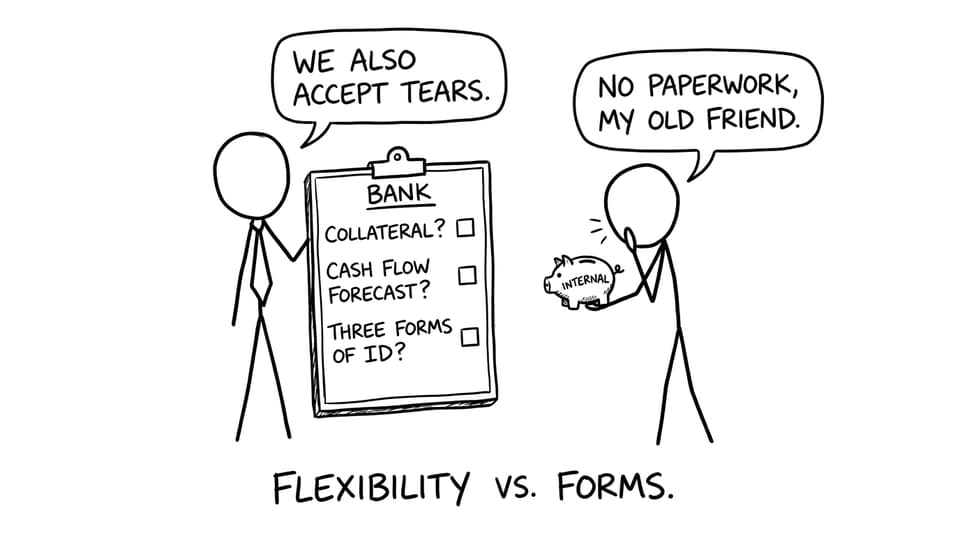
Internal finance can be used quickly and allocated however managers choose. No lender interviews, no covenant restrictions, no waiting. In IB Business Management terms, this supports faster tactical decisions and reduces administrative delay.
The big limitation: internal finance can cap growth
The weakness is scale. Internal finance depends on how much profit the business generates and what assets it can sell without harming operations. If a firm needs a large, immediate investment (new location, machinery, R&D), internal finance may simply be too small or too slow.
That’s why many firms combine sources: internal finance for stability, external finance for acceleration. For balance, you can read Why businesses use external finance (and the risks).
Exam tip: how to evaluate like an IB examiner
In IB Business Management, don’t just list advantages. Evaluate using context:
-
Business size: small firms value control; larger firms may access cheaper debt.
-
Objectives: growth-focused firms may accept external finance to scale faster.
-
Cash flow predictability: stable cash flow makes external repayments safer.
-
Time pressure: urgent opportunities often push firms toward external finance.
Then practise. RevisionDojo makes this easier with Topic 3.2 Questionbank practice and 3.1 Introduction to Finance Questionbank. If you’re revising fast, the IB Business Management cheatsheets are a clean way to lock in definitions and evaluation phrases.
Closing: turn the concept into exam marks
The reason businesses prefer internal finance over external finance isn’t mysterious. It’s human: less pressure, fewer outsiders, and more freedom to move at your own pace. In IB Business Management, turning that into marks means linking each advantage to the business’s context, then judging when internal finance becomes a bottleneck.
If you want to revise this topic with momentum, use RevisionDojo’s Study Notes, Flashcards, and Questionbank for Topic 3.2, then test your judgement with Mock Exams and Predicted Papers. When your explanations get sharper, use AI Chat and Grading tools to refine evaluation. If you’re stuck, the Coursework Library and Tutors help you rebuild confidence fast.


