


External finance feels like the moment a small business stops tiptoeing and starts sprinting.
In IB Business Management, that sprint matters because it explains so many real choices: how firms fund growth, how they survive a cash-flow squeeze, and why a “good idea” can still fail under pressure. External finance is simply money raised from outside the business (think loans, overdrafts, share capital, or investors). It can unlock opportunity fast, but it also brings risks that examiners love to test.
What external finance means in IB Business Management
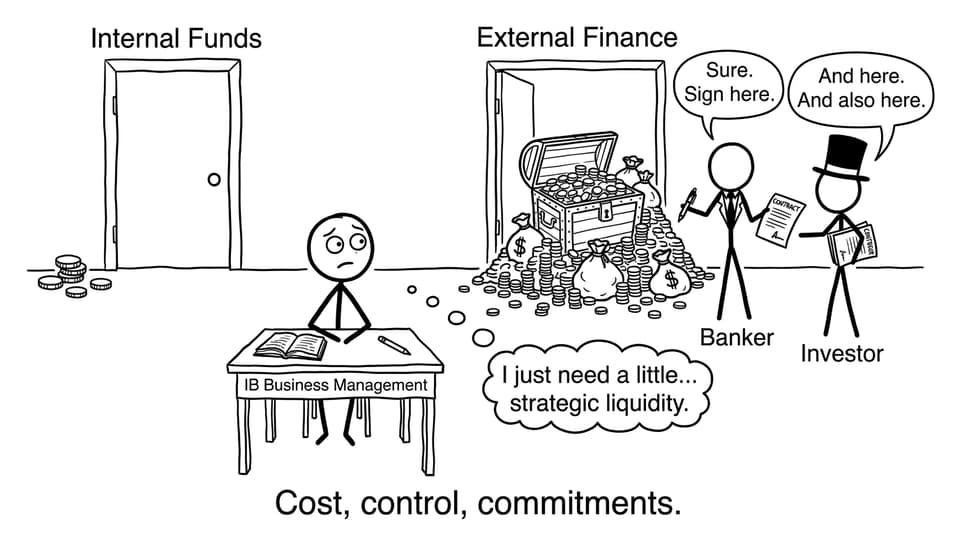
External finance is funding that does not come from retained profit or the sale of existing assets. In IB Business Management, you’ll usually contrast it with internal finance and then evaluate implications for:
-
Cost (interest, dividends, fees)
-
Risk (repayment pressure, gearing)
-
Control (ownership dilution, investor influence)
-
Flexibility (commitments vs agility)
If you want the syllabus-aligned breakdown, start with 3.2 Sources of Finance and then zoom in on 3.2.2 External Sources of Finance.
Why businesses use external finance
Insufficient internal funds (the quiet, common reason)
Most growing firms don’t have enough retained profit at the exact moment an opportunity appears. External finance fills that gap so a business can buy equipment, expand capacity, upgrade technology, or enter a new market. This point links directly to 3.2.1 Internal Sources of Finance: internal funds can be safer, but they’re often limited.
Faster growth (speed is a competitive advantage)
External finance can compress time. A loan or new equity injection gives immediate capital, letting firms scale before competitors catch up. In IB Business Management essays, this is a strong “benefit” point when paired with a realistic condition, like strong forecast demand or a first-mover advantage.
Risk-sharing (especially with equity)
Equity investors share the downside in a way lenders don’t. If performance falls, shareholders may receive lower dividends, but the business isn’t forced into fixed repayments. This is why equity can be attractive for higher-risk industries where cash flows are uncertain.
Building credit history (future access gets easier)
Borrowing responsibly can improve credibility with banks and lenders, potentially lowering future borrowing costs. It’s not always tested explicitly, but it’s a clean evaluative add-on in IB Business Management responses.
The risks that come with external finance
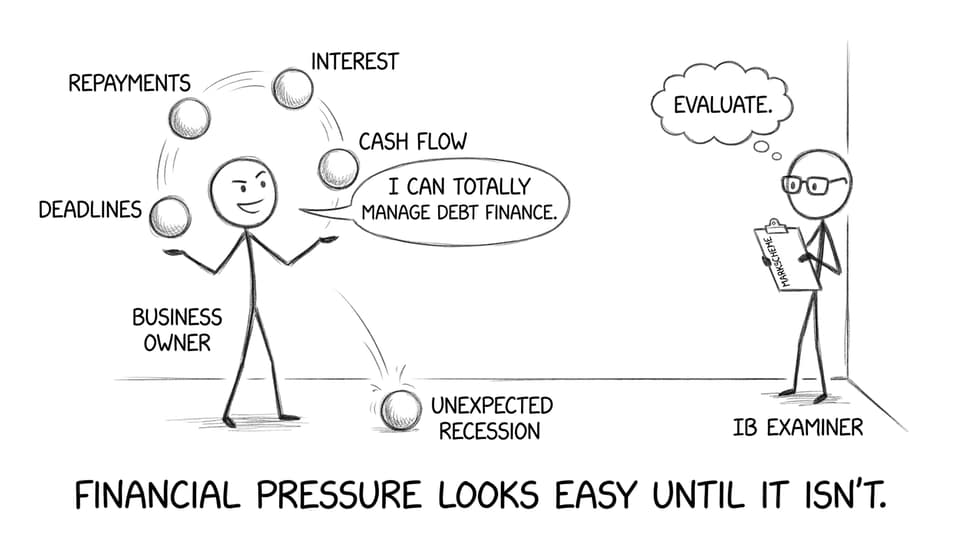
Financial pressure (repayments don’t care about bad months)
Debt finance requires regular interest and repayments even if revenue drops. That creates cash-flow strain and can push a firm toward insolvency.
Loss of control (equity can dilute ownership)
Issuing shares or bringing in investors can reduce founder control. New shareholders may influence strategy, demand performance targets, or push for short-term decisions.

Higher long-run costs (interest, fees, dividend expectations)
External finance can be more expensive than internal finance once you include interest charges, arrangement fees, and administrative requirements. In exam evaluation, compare “cheap now” vs “expensive over time.”
Long-term commitments (less flexibility when conditions change)
A long-term loan can lock a firm into fixed payments for years. If market demand shifts, that commitment can prevent the business from adapting quickly.
To practice turning these into top-mark answers, use RevisionDojo’s Topic 3.2 Sources of Finance Questionbank and the wider IB Business Management Resources hub. For exam strategy, How Do Businesses Choose the Right Source of Finance for Their Needs is a strong companion read.
Quick exam checklist (how to evaluate external finance)
In IB Business Management, don’t stop at definitions. Evaluate using:
-
Time frame: short-term vs long-term need
-
Cash-flow stability: can the firm handle repayments?
-
Control preferences: is dilution acceptable?
-
Cost: compare interest vs dividend expectations
-
Business objective: growth, survival, innovation, market entry
Closing: turn the topic into marks
External finance is attractive because it buys time and scale, but it also buys pressure, cost, and sometimes shared control. For IB Business Management, your edge comes from evaluating which source fits the situation, not just listing pros and cons.
If you want to revise this topic efficiently, RevisionDojo brings it together with Study Notes, Flashcards, AI Chat, and a targeted Questionbank for timed practice. You can also build exam readiness with Predicted Papers, Mock Exams, Grading tools, and even support from Tutors when you want feedback that feels like a real examiner.


