


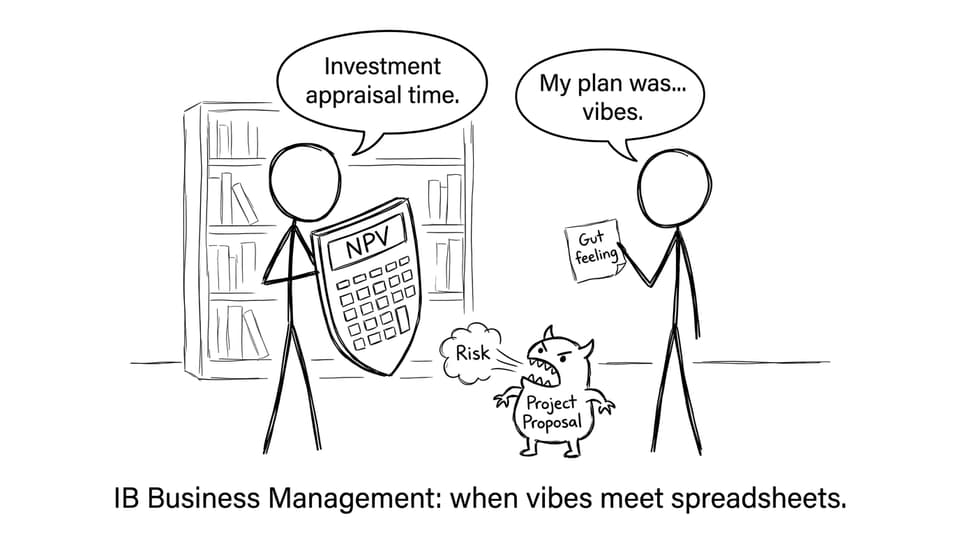
Investment decisions rarely fail because the spreadsheet was wrong. They fail because someone fell in love with an idea before asking what it would cost to keep it alive.
That is why investment appraisal sits at the center of IB Business Management finance: it slows the excitement down just enough to ask the unglamorous questions. How long until we get our money back? What is the return? What could go wrong? And, quietly, what are we giving up by choosing this project over another?
What investment appraisal helps a business decide
Before a firm commits to a new factory, product launch, or store expansion, investment appraisal helps managers:
-
Estimate expected returns (profitability)
-
Compare competing projects using consistent metrics
-
Manage risk and uncertainty
-
Protect liquidity with cash flow planning
-
Check strategic fit with long-term objectives
-
Build transparency for stakeholders (banks, investors, owners)
For the syllabus focus, you can revise the core topic here: IB Business Management 3.8 Investment Appraisal.
Estimating returns: turning forecasts into decisions
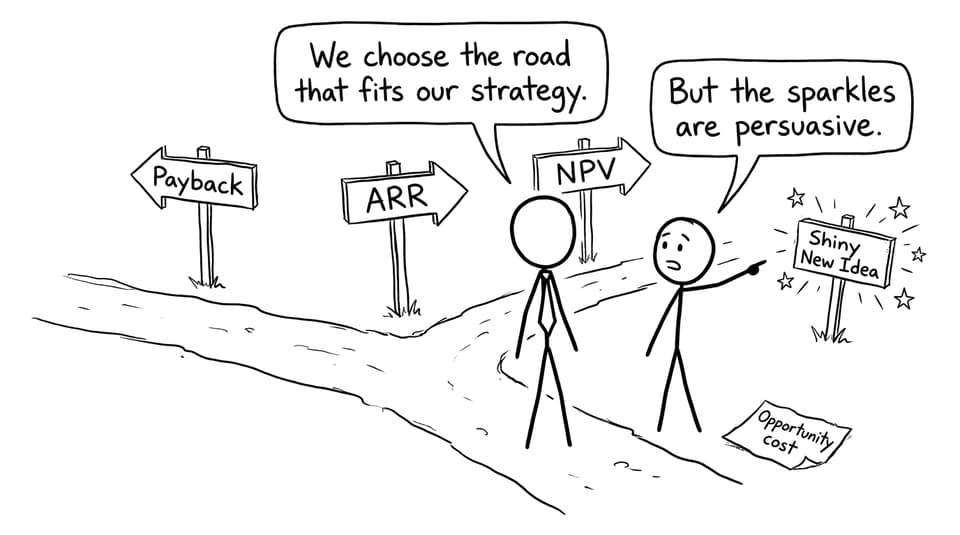
In IB Business Management, you are expected to explain how tools like payback period, ARR, and NPV translate predictions into a choice.
-
Payback period highlights speed: how quickly the initial investment is recovered. In real firms, speed often equals safety, especially when markets change fast.
-
ARR (average rate of return) reframes the project as a percentage return, which helps when managers want a simple profitability comparison.
-
NPV (net present value) adds realism by discounting future cash flows. It answers a mature question: “What are those future receipts worth today?”
If you want technique-specific exam support, use Investment Appraisal Techniques Notes and then drill questions in the Investment Appraisal Questionbank.
Comparing projects: the hidden cost of “yes”
Every “yes” to a project is a “no” to something else. This is opportunity cost, and it is one of the most examiner-friendly evaluation points you can add in IB Business Management.
Investment appraisal creates a common language to compare projects with different timelines and risk profiles. A firm might prefer the highest NPV project, but in the real world it may still choose a faster payback option if cash is tight or if uncertainty is high.
To extend that thinking, see: Why Do Some Businesses Prefer NPV Over Other Investment Appraisal Methods?.
Managing risk: planning for the messy middle
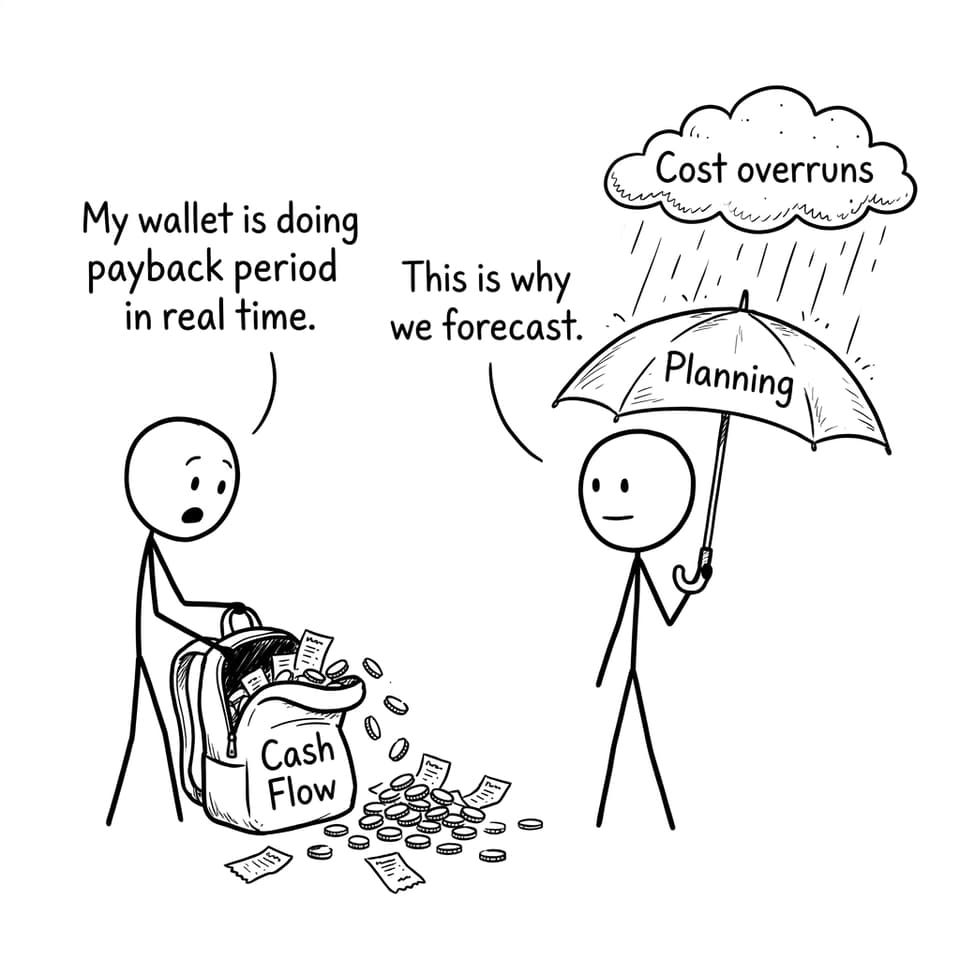
Even strong forecasts can be disrupted: costs overrun, competitors react, demand shifts. Investment appraisal does not remove uncertainty, but it forces managers to acknowledge it.
In exam terms, risk evaluation can include:
-
Sensitivity to changing sales volume or costs
-
The length of time capital is tied up
-
The reliability of assumptions used in forecasts
-
Whether the project can be scaled back if conditions worsen
A quick way to strengthen definitions in your writing is to use RevisionDojo’s IB Business Management Key Definitions.
Protecting cash flow: profitability is not liquidity
A project can look profitable on paper and still break a business through cash shortages. That is why investment appraisal is closely linked to cash flow forecasting in IB Business Management.
If inflows arrive later than expected, the firm still has to pay wages, rent, and suppliers now. Appraisal encourages managers to map cash timing so the business stays liquid while the investment matures.
Link your finance answers with:
Strategic alignment and stakeholder confidence
A final reason businesses use investment appraisal is that it turns a private hunch into a defendable decision. That matters when funding requires bank approval, when shareholders demand clarity, or when senior leaders need a rationale that matches strategy.
In other words, appraisal is not only about numbers. It is about trust.
For broader revision planning, start at IB Business Management Resources or browse all IB Business Management blog posts.
Closing: make your exam answers feel like real decisions
Businesses use investment appraisal because capital is precious, time is irreversible, and mistakes are expensive. In IB Business Management, your edge comes from writing as if you are the manager: comparing projects, discussing risk, linking to cash flow, and judging strategic fit.
If you want to turn that thinking into marks, RevisionDojo is built for it: practise with the Questionbank, lock in concepts with Study Notes and Flashcards, clarify confusion using AI Chat, and level up with Grading tools, Predicted Papers, Mock Exams, the Coursework Library, and support from Tutors. Start with Investment Appraisal and build outward from there.


