


A hook worth remembering
A finance manager once told a class of interns, “Two projects can look identical on paper until you ask one quiet question: when do we get the money?” That question sits at the heart of IB Business Management investment appraisal.
Businesses don’t prefer net present value (NPV) because it’s the fanciest calculation. They prefer it because it’s the method that most closely matches how real decisions feel: money arrives late, risks change, and the future is never as clean as a worksheet.

Quick checklist: Why NPV often wins
-
It uses the time value of money (discounting).
-
It measures total value added (a clear positive/negative result).
-
It includes all cash flows across the whole project.
-
It can reflect risk by changing the discount rate.
-
It helps firms rank competing projects when capital is limited.
If you’re revising IB Business Management, connect each bullet to exam language like “more objective,” “more realistic,” and “supports better decision-making.”
Time value of money: the reason NPV feels more “real”
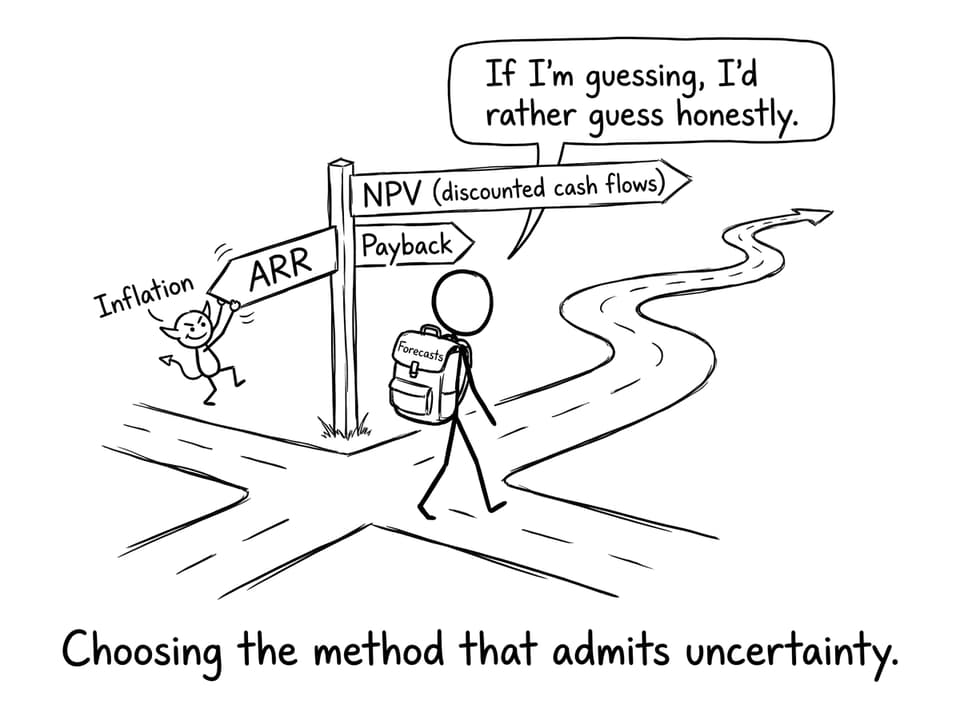
Payback period and ARR can be useful, but they treat a dollar today and a dollar in five years as if they have the same weight. NPV refuses to do that.
Because inflation, uncertainty, and opportunity cost exist, businesses discount future cash inflows back to today’s value. In IB Business Management, this is often the simplest way to explain why NPV is preferred: it builds the time value of money into the decision, rather than adding it as an afterthought.
To tighten your definition and method, see Net Present Value (HL only) notes and the broader 3.8 Investment Appraisal topic hub.
A single number that shows value added
A key advantage businesses like is how NPV communicates.
-
Positive NPV: the project is expected to add value to the business.
-
Negative NPV: the project is expected to reduce value.
That clarity matters when boards have to choose, justify, and defend decisions. Payback tells you “how fast,” ARR tells you “average profitability,” but NPV tells you “how much value, in today’s terms.” In IB Business Management evaluation, that’s a strong line of analysis.
For quick comparisons with the other techniques, use Investment Appraisal Techniques (3.8.1) notes.
NPV counts the whole story, not just the first chapters
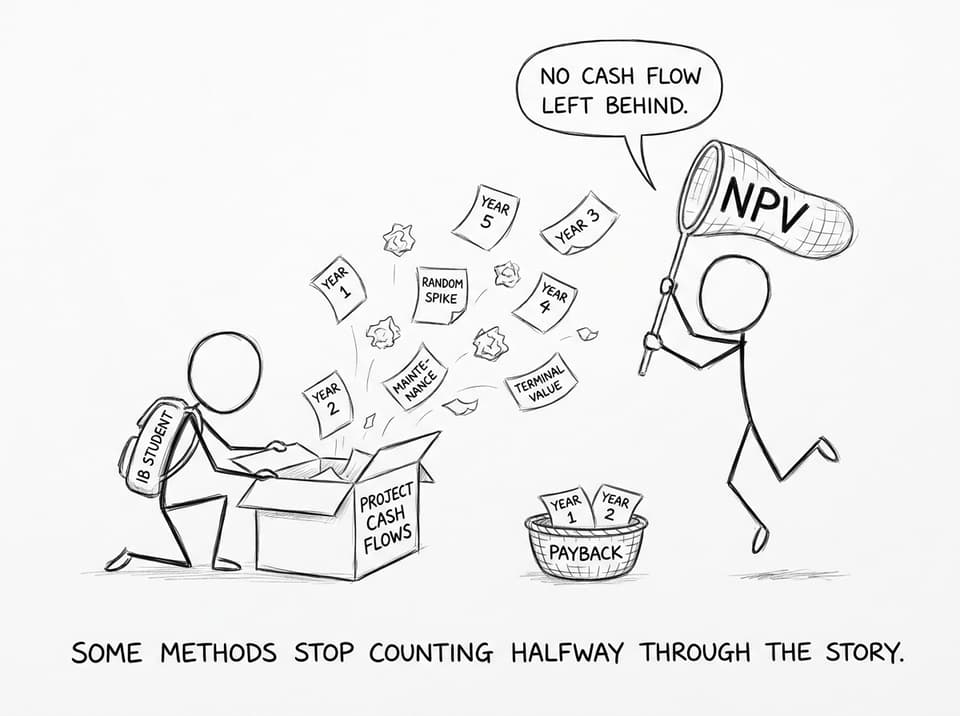
Payback period can ignore everything after the break-even moment. That can lead to a dangerous habit: picking the project that returns cash fastest, even if another project generates far more wealth later.
NPV includes all expected cash flows throughout the project lifespan, making it especially useful for long-term investments and uneven revenue patterns. In exam terms, it gives “a more complete picture of profitability,” which is exactly what many businesses want.
Risk becomes visible through the discount rate
Another reason businesses prefer NPV is flexibility. If a project is riskier, managers can apply a higher discount rate, reducing the present value of future cash inflows. This helps decision-makers compare projects on a more equal footing.
In IB Business Management, this is a subtle but high-value point: NPV doesn’t remove uncertainty, but it forces the business to acknowledge it.
Where RevisionDojo fits into your exam prep
If NPV questions feel computational, make them routine:
-
Practise with the Investment Appraisal Questionbank for exam-style prompts.
-
Use RevisionDojo Flashcards to lock in definitions like “discount rate” and “opportunity cost.”
-
Use AI Chat to check your evaluation paragraphs for Paper 2-style depth.
-
Build timed practice with Mock Exams and Predicted Papers (for realistic exam pressure without guessing what the examiner wants).
-
If you’re stuck, RevisionDojo Tutors can help you turn calculations into strong commentary.
You can also keep formulas tight using the Business Management Data Booklet and definitions from the IB Business Management glossary.
Conclusion: NPV is the method that respects time
Businesses prefer NPV because it respects the one variable every investment depends on: time. It discounts future cash flows, measures value added, captures the whole project, and makes risk easier to discuss. If you can explain those points clearly, you’re already thinking like a decision-maker, not just a calculator.
To keep your IB Business Management revision sharp, use RevisionDojo’s Study Notes, Questionbank, Grading tools, and AI Chat to turn NPV from a formula into a confident exam explanation.


