
Choosing six subjects can feel uncomfortably close to choosing a future. Parents worry that one wrong decision will close a university door; students worry that the “right” combination will leave them exhausted for two years.
The reassuring answer is that there is rarely one perfect combination. Your child should choose subjects that satisfy the IB Diploma structure, preserve likely university options, match demonstrated strengths and create a sustainable Higher Level workload. University prerequisites come first when a degree direction is already visible. Beyond those requirements, genuine ability and interest are usually better guides than prestige, peer choices or assumptions about which subjects look impressive.
The goal is not to construct the hardest Diploma. It is to build the strongest coherent one for your child.
The short answer for parents
If you are asking which IB subjects should my child take, work through these decisions in order:
- Confirm which subjects and combinations the school actually offers.
- Identify possible university courses and countries.
- Check official university entry requirements for specific subjects and levels.
- Place genuinely necessary subjects at Higher Level.
- Choose the remaining HL subjects from areas of sustained strength and interest.
- Use Standard Level strategically to preserve breadth and manage workload.
- Review assessment styles, not just subject names.
- Ask the school’s IB coordinator to verify that the final combination satisfies Diploma rules.
This order matters. A student considering engineering may need a particular mathematics pathway and Physics at HL for some universities. A student without a settled career direction has more freedom and should usually protect flexibility rather than specialize prematurely.
What is the IB Diploma structure?
The full IB Diploma Programme combines six academic subjects with three core elements: Theory of Knowledge, the Extended Essay, and Creativity, Activity, Service.
Students normally choose one course from each of five groups:
- Studies in language and literature
- Language acquisition
- Individuals and societies
- Sciences
- Mathematics
The sixth course may come from the arts or, subject to IB and school rules, be replaced by another language, humanities or science course. Availability varies considerably between schools, so the published school options booklet is the practical starting point.
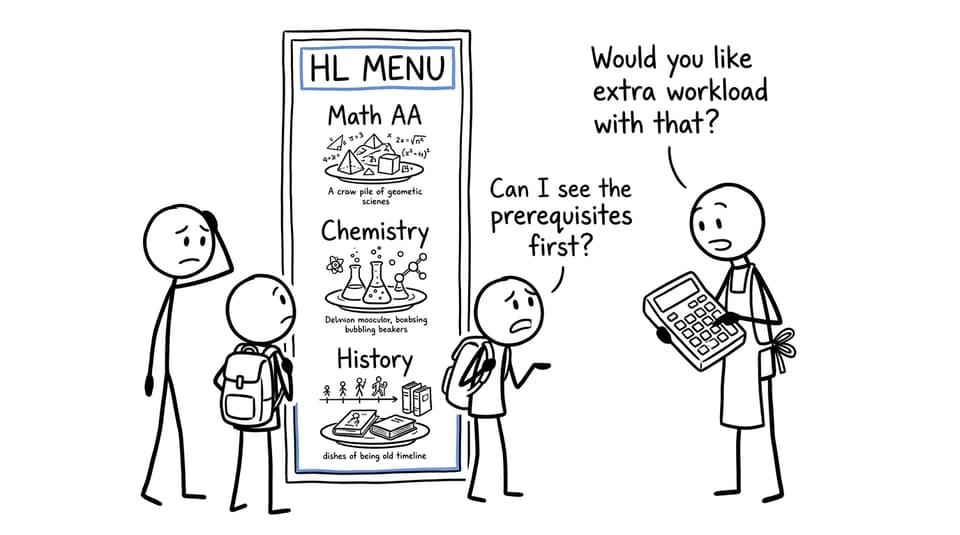
Students take at least three and no more than four subjects at Higher Level, with the remainder at Standard Level. Three HL and three SL subjects is the usual arrangement. The IB recommends 240 teaching hours for an HL course and 150 for an SL course. HL therefore represents substantially more than a more impressive label: it brings greater scope, depth and demand.
Parents wanting to understand the available disciplines can explore RevisionDojo’s IB syllabus and subject overview before discussing specific options with the school.
Choose university prerequisites before preferences
Subject selection becomes clearer when the family separates requirements from preferences.
Requirements are non-negotiable conditions set by universities. Depending on the institution and degree, these may specify a particular IB subject, HL status and minimum grade. Mathematics, engineering, medicine and some science or economics courses are especially likely to impose subject-specific conditions. Requirements also vary by university and country, so a combination that works for one institution may not work for another.
Do not rely on broad statements such as “medicine needs Biology and Chemistry” or “engineering needs difficult Maths.” Open the current admissions page for each plausible course and record the exact wording. Mathematics deserves particular care because the IB offers Mathematics: Analysis and Approaches and Mathematics: Applications and Interpretation at both SL and HL, while universities may treat those pathways differently.
A useful family exercise is to create three lists:
| Category | What to record |
|---|---|
| Likely direction | Degrees your child is seriously considering |
| Possible direction | Courses they may want to preserve as options |
| Unlikely direction | Routes they are comfortable closing |
Then check several universities in each likely destination country. Admissions rules can change between application cycles, so confirm them again before applying.
Match subjects to evidence, not identity
Students sometimes say, “I am a science person,” or, “I have never been good at essays.” These identities are often built from a few school experiences. Subject selection deserves better evidence.
Look at recent grades, teacher feedback, independent study habits and the kind of difficulty your child tolerates. A student might enjoy Biology but dislike learning precise terminology. Another may earn strong History grades yet find sustained reading exhausting. Interest starts the engine; working habits determine how long it runs.
Ask four questions for every candidate subject:
- Does my child enjoy the actual course content, rather than just the subject’s reputation?
- What does the assessment require: calculation, writing, interpretation, experimentation, performance or coursework?
- Has my child demonstrated the underlying skills consistently?
- Would they still choose this subject if their closest friends chose something else?
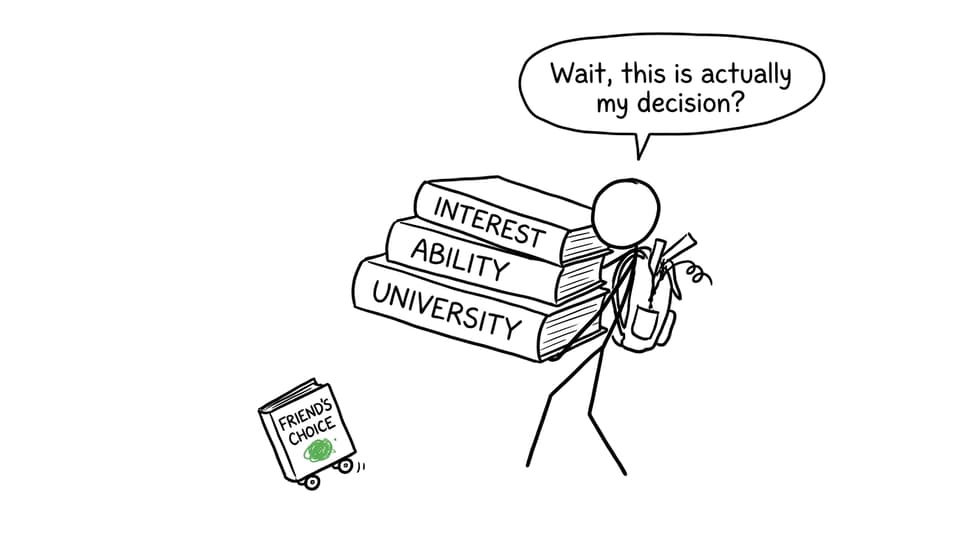
Teachers are particularly useful here. They can distinguish between a temporary gap that can be repaired and a mismatch between the student’s habits and the demands of HL study. Their advice should inform the decision without replacing the student’s ownership of it.
Decide the IB HL and SL subjects carefully
The best HL choices usually perform at least one of three jobs:
- Meet a university prerequisite.
- Develop a skill central to the student’s likely degree.
- Build on a subject in which the student has both ability and durable motivation.
Ideally, each HL does more than one.
SL subjects play a different but equally valuable role. They preserve intellectual breadth, contribute to the Diploma score and make the overall schedule sustainable. Choosing SL is not admitting weakness. It is deciding where depth will produce the greatest return.
The wrong question is, “Which subjects are easiest?” Difficulty depends on the learner, teacher, syllabus and assessment format. A better question is, “Where can this student perform consistently while completing six subjects and the core?”
Families can read a fuller explanation of IB HL vs SL and consider whether universities care about subject level. These distinctions are especially important when an admissions condition names an HL subject explicitly.
Think in combinations, not isolated subjects
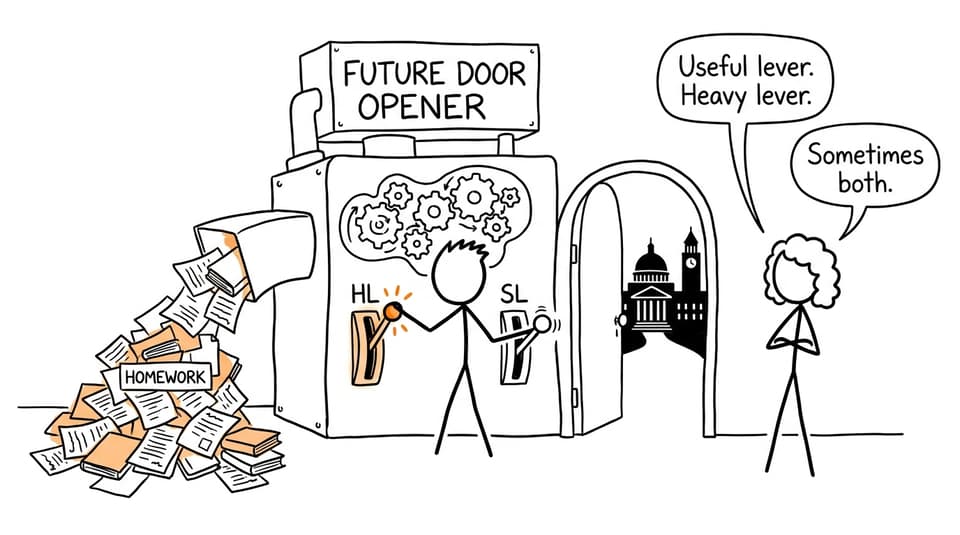
Each subject can seem manageable alone. The combination creates the real workload.
Three highly demanding HL courses may be appropriate when they unlock a clear university route and suit the student’s strongest abilities. The same combination may be unnecessarily punishing for someone who chose it because it appeared prestigious.
Consider how deadlines and modes of work interact. A combination containing several coursework-heavy or writing-intensive subjects may produce pressure at similar points in the year. A science-heavy combination may require sustained practical work and frequent problem-solving. An arts course may involve ongoing portfolio, rehearsal or production commitments that cannot be compressed into one revision weekend.
Include the Extended Essay, Theory of Knowledge and CAS in this calculation. They are not spare-time decorations around the six subjects. A realistic plan leaves enough attention for the entire Diploma.
A simple stress test is to ask your child to describe an ordinary difficult week: three HL lessons, coursework progress, a test, activities and normal sleep. If the plan only works when everything goes perfectly, it does not work.
Common subject-selection mistakes
Choosing for prestige
An unnecessarily difficult combination does not automatically strengthen an application. Required subjects matter; so do grades and a student’s ability to sustain the programme. Challenge should have a purpose.
Following friends
Friends can make a classroom more enjoyable, but timetables change and friendships survive different lessons. The consequences of the choice remain with the student.
Treating current marks as the whole story
Grades provide useful evidence, but context matters. Improvement, curiosity, teacher feedback and willingness to practise can reveal readiness that one test result misses.
Ignoring assessment style
Enjoying classroom discussion does not necessarily mean enjoying timed analytical writing. Liking experiments does not guarantee enthusiasm for scientific data analysis. Preview the syllabus and assessment components before committing.
Delaying university research
A fifteen-year-old does not need a complete career plan. However, families should investigate any direction the student is seriously considering. It is easier to preserve an option now than discover a missing prerequisite during applications.
Preview the support available for each option
A subject becomes less abstract when students can see what studying it will involve. RevisionDojo lets families preview subject-specific explanations, lessons, Flashcards and Questionbank practice before choices feel final.
For example, compare the resources for IB Biology, IB Chemistry, IB Physics and IB Mathematics AA. Students considering humanities can inspect IB History resources, while those interested in computational thinking can explore IB Computer Science.
This is not a substitute for the school’s current subject guide. It is a way to turn a vague title into visible topics, terminology and question styles.
Once the Diploma begins, RevisionDojo becomes the all-in-one IB resource around that decision. Study Notes and AI Chat can clarify difficult concepts; Flashcards support retrieval; and the Questionbank turns understanding into application. Predicted Papers and Mock Exams build timed confidence, while Grading tools and the Coursework Library support written work. When a student needs individual direction, Tutors can help diagnose the obstacle rather than simply add more study time.
Make the final decision calmly
The best subject combination sits at the intersection of opportunity, ability, interest and sustainability. Remove any option that fails Diploma rules. Protect genuine university prerequisites. Then let the student’s demonstrated strengths and preferred ways of thinking guide the remaining choices.
Parents do not need to predict an entire life. They need to help their child avoid preventable restrictions without building a programme around fear.
The practical next step is simple: shortlist two combinations, verify both with the IB coordinator, check current university requirements, and preview each subject on RevisionDojo together. A good choice should open meaningful doors while leaving your child enough energy to walk through them.