




Choosing an IB school can feel unusually high-stakes. You are not simply comparing campuses. You are deciding where your child will manage six subjects, long-term coursework, final examinations, and the three-part Diploma Programme core.
The reassuring answer is that the best choice is rarely hidden in a ranking. What to look for in an IB school is authorized programme status, suitable subject choices, experienced teachers, coordinated academic support, a healthy student culture, transparent results, and knowledgeable university guidance. The right school is the one that can deliver those things consistently for your child, not merely describe them attractively.
The International Baccalaureate authorizes schools separately for its programmes. A school offering the Primary Years Programme or Middle Years Programme is not automatically authorized to offer the Diploma Programme. Families considering the final two years should therefore confirm the school's current DP status through the official IB World School directory.
A practical IB school checklist
Use this shortlist before becoming absorbed by facilities, marketing materials, or a single headline result:
- Confirm that the school is authorized for the relevant IB programme.
- Check whether your child can take the subjects and levels they need.
- Ask about teachers' recent DP experience and ongoing training.
- Examine how the school coordinates coursework and examination deadlines.
- Look for defined academic, learning, and wellbeing support.
- Review several years of results with appropriate context.
- Investigate university counselling for your likely destinations.
- Clarify admissions policies, fees, additional costs, and exit options.
- Speak with current students and parents when possible.
- Decide whether the school's daily culture suits your child.
Parents who are still asking what the IB Diploma is and how it works may find it helpful to understand the programme structure before comparing schools.
Begin with authorization, not reputation
An authorized IB World School has completed an IB process intended to confirm its readiness to implement a particular programme according to IB standards and practices. Authorization does not mean every authorized school will suit every student, but it is the essential starting point.
Ask the admissions team:
- Is the school currently authorized to offer the Diploma Programme?
- How long has it delivered the DP?
- When was its latest programme evaluation?
- Is the campus you are considering covered by that authorization?
- Who is the DP coordinator, and how long have they held the role?
Be precise about terminology. A candidate school is working toward authorization; candidacy is not the same as authorization. Likewise, a school may offer one part of the IB continuum without offering all four programmes. This guide to the PYP, MYP, DP, and CP explains the distinctions.

Check the actual subject timetable
A school can offer the Diploma Programme while providing a relatively narrow selection of subjects. A polished list of courses may also conceal timetable clashes, minimum class sizes, or subjects offered only in alternate years.
DP students study six subjects alongside Theory of Knowledge, the Extended Essay, and Creativity, Activity, Service. The subject combination matters because university courses can impose specific requirements, especially at Higher Level. A future engineering applicant may face different expectations from a prospective historian or linguist.
Ask for the current subject-choice form and a sample timetable. Then investigate:
- Which subjects are reliably available at HL and SL?
- Are any courses taught online or shared with another campus?
- What happens when too few students select a subject?
- Which combinations create timetable conflicts?
- Can students change levels after the programme begins?
- Are school-specific prerequisites used for entry into particular courses?
The goal is not to find the school with the longest catalogue. It is to find one that can reliably deliver the combination your child needs. Review how many subjects IB students take and discuss choosing HL subjects wisely before accepting a place.
Look for experienced teachers and stable leadership
IB teaching involves more than knowing a subject. Teachers must understand current course requirements, assessment criteria, internal assessment procedures, academic integrity expectations, and the style of thinking rewarded by the programme.
Rather than asking whether teachers are simply "qualified," ask more revealing questions:
- How many DP teachers have taught their current course through a complete two-year cycle?
- How does the school provide IB professional development?
- How are new teachers mentored?
- How do teachers standardize assessment within departments?
- What was staff turnover in the DP team over the last two years?
Some movement is normal, particularly in international schools. The concern is repeated disruption in key subjects or leadership roles without a clear continuity plan. An experienced DP coordinator is especially valuable because deadlines, registrations, accommodations, core requirements, and university documentation cross departmental boundaries.
Listen to how leaders describe improvement. Strong schools can usually identify both what they do well and what they are still working to strengthen. Perfect answers may be less informative than specific ones.
Examine how support works under pressure
Every school says it supports students. The useful question is what happens on an ordinary Wednesday when a student has an internal assessment draft, a difficult HL topic, an Extended Essay meeting, and mounting anxiety.
Effective support is a system. It may involve subject teachers, the DP coordinator, an Extended Essay supervisor, a learning-support team, counsellors, and communication with families. Ask who notices when work is missed, who contacts the student, and how support is coordinated.
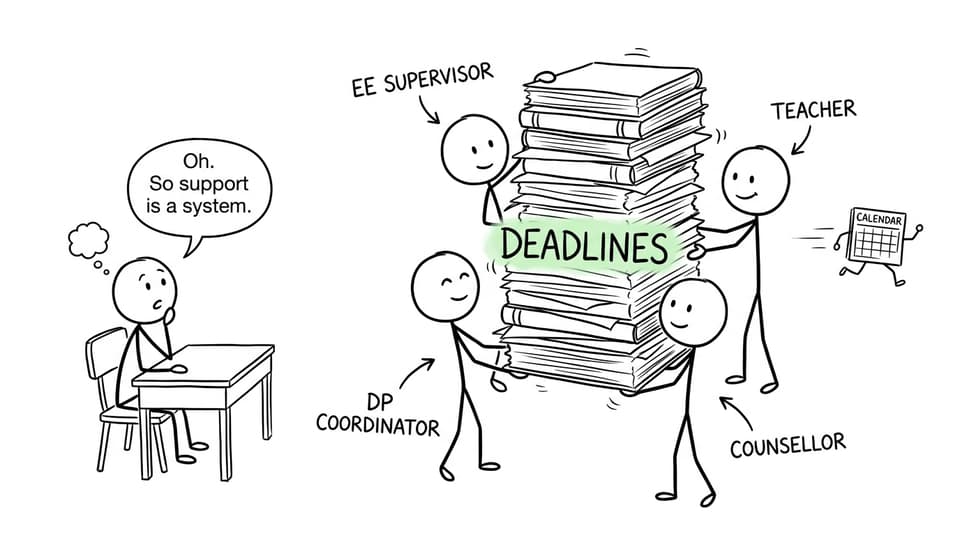
Look for concrete practices such as:
- A shared calendar for major coursework and core deadlines
- Scheduled Extended Essay supervision
- Clear feedback and academic integrity procedures
- Structured support for organization and study skills
- Access arrangements managed well before examinations
- Qualified counselling and safeguarding processes
- A defined response when performance or attendance declines
Students preparing for exams need enough challenge to grow, but challenge without coordination can become avoidable overload. A school should be able to explain how it teaches planning, not merely tell students to become organized. This guide to time management for IB students shows the habits families should expect a supportive environment to reinforce.
Wellbeing deserves similarly specific questions. Ask how students access counselling, how waiting times are managed, and how the school responds when academic pressure becomes unhealthy. Families can also review the warning signs and practical protections discussed in this guide to avoiding burnout during the IB Diploma.
Read IB results in context
Results can help parents assess a school, but one number rarely tells the whole story. Average scores may be affected by admissions selectivity, cohort size, which students enter the full Diploma, and whether the school reports all candidates or only a subset.
Ask for several years of information rather than one exceptional cohort. Useful questions include:
- How many students began and completed the full Diploma?
- What proportion received the diploma?
- What was the score distribution, not just the average?
- How large was each cohort?
- Were any students redirected to individual courses or another pathway?
- How does the school support students predicted to score below its average?
A high average may reflect excellent teaching, highly selective entry, or both. A more inclusive school may produce a lower average while helping a broader range of students make substantial progress. Neither model is automatically better; parents should understand which model they are choosing.

Treat third-party league tables as starting points rather than verdicts. The IB does not publish an official global school ranking, and independent methodologies vary. This explanation of how IB school rankings work offers additional context.
Evaluate university and careers guidance
University recognition of the IB is broad, but admissions policies differ by institution, country, and course. Recognition is not the same as guaranteed admission. Some degrees specify total points, particular HL grades, required subjects, or local qualification conditions.
The school should help students investigate these details before subject choices close. Ask:
- When does university counselling begin?
- Does the team understand the countries your child may target?
- How are course prerequisites checked against IB choices?
- How are predicted grades determined and communicated?
- Who manages references, transcripts, and application deadlines?
- What support exists for students who remain undecided?
Good counselling keeps options visible without promising outcomes. It also distinguishes between ambitious, realistic, and safer application choices. Because predictions may be considered in applications made before final results are available, parents should understand the school's evidence and review process. The guide to how schools predict IB scores provides a useful foundation for that conversation.
Observe culture when nobody is presenting
School culture is difficult to summarize and easy to sense. During a visit, notice whether students ask teachers questions comfortably, whether classrooms appear intellectually active, and whether adults speak about students as individuals rather than results.
If possible, speak to current DP students without a highly scripted presentation. Ask what happens when someone falls behind, whether deadlines cluster, how accessible teachers are, and what they would change. Their answers reveal how written policies operate in daily life.
For IB diploma parents, fit matters because different students respond to rigor differently. One may flourish in a competitive, highly structured environment. Another may perform better where collaboration, flexibility, and individual guidance are more visible. The strongest school on paper can still be the wrong environment for a particular learner.
Compare the complete commitment
Finally, establish the practical terms in writing. Depending on the school, costs may extend beyond tuition to registration, assessments, transport, technology, activities, trips, learning support, or university application services. Ask which charges are compulsory, which are refundable, and how they may change during the two-year programme.
Also clarify the admissions process. The IB itself does not impose one universal DP admissions threshold; schools establish local entry policies. Ask what grades, prerequisites, tests, or interviews are required and what happens if a student later needs a different academic pathway. This overview of requirements for joining an IB programme can help families frame those questions.
Choose evidence over impressions
The best IB school is not necessarily the one with the grandest campus, highest advertised average, or longest university list. It is the school that can show how authorization, subject access, teaching expertise, deadline coordination, wellbeing, and guidance come together around real students.
After each visit, score the same criteria while details are fresh. Confirm authorization independently, compare the actual subject timetables, request contextual results, and let your child reflect on where they felt able to ask questions. The natural next step is simple: shortlist two or three schools, send each the same written questions, and compare the specificity of their answers rather than the confidence of their brochures.