

This site uses cookie tracking technologies. Learn more in our Cookie Policy.
IB Business Management: Entrepreneur Mindset &… | RevisionDojo
Join 600k+ Students Already Crushing Their Exams
The moment opportunity looks like extra work
In IB Business Management, entrepreneurship can feel like a chapter you memorise: definition, traits, risks, done. But in real life, the entrepreneurial moment is quieter. It’s when everyone in your group chat complains about the same problem, then one person asks, “What would a better system look like?”
That question matters because entrepreneurs aren’t just “people who start businesses.” They’re people who notice value gaps, test solutions, and keep moving when the first version fails. If you can explain that mindset clearly, you’re already writing stronger exam analysis.
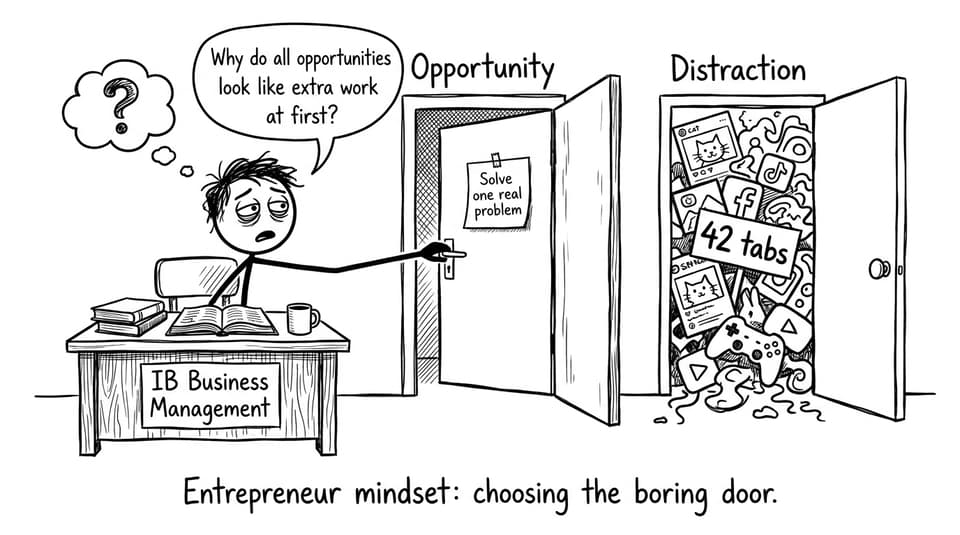
Entrepreneur mindset choosing opportunity
Quick checklist: what makes someone an entrepreneur?
Use this mini-checklist for IB Business Management short and extended responses:
Curiosity: they ask why a system is slow, expensive, unfair, or outdated.
Creative problem-solving: they redesign the process, not just complain about it.
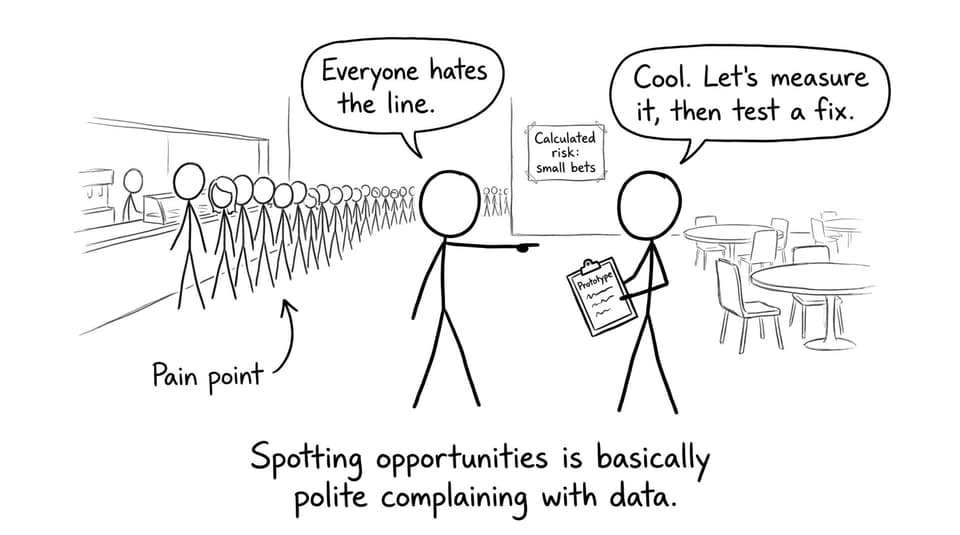
Calculated risk-taking: they test small before betting big.
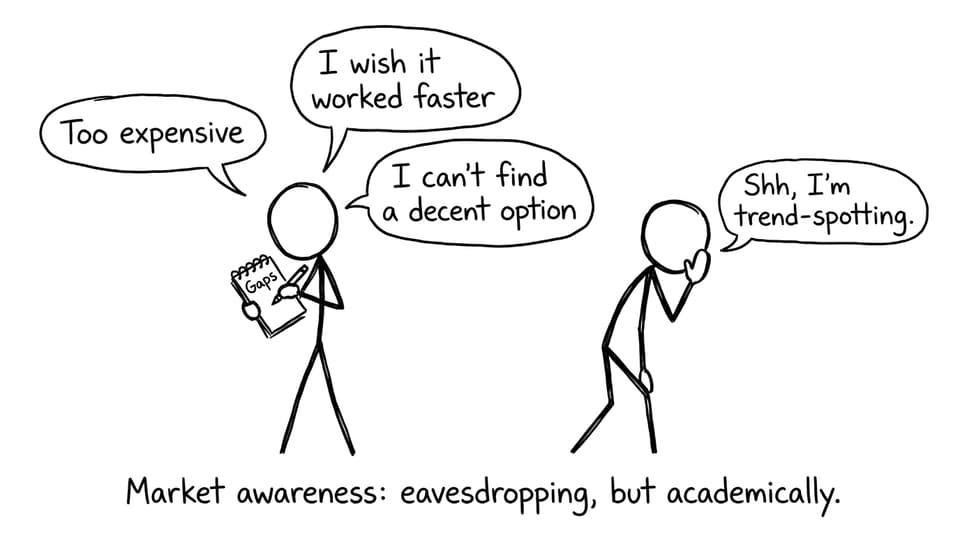
Market awareness: they track trends, customer needs, and competitor gaps.
Action and iteration: they launch, learn, improve, repeat.
If you want a syllabus-aligned foundation, keep the open while revising.
IB Business Management: the entrepreneur is a problem-spotter first
A useful way to think about entrepreneurship in IB Business Management is this: entrepreneurs are collectors of “pain points.” They notice friction other people accept.
A long queue, a confusing app, a slow delivery process, a service that ignores a certain group of customers. None of these are glamorous. But each one is a signal that value could be created.
In exam terms, that’s your opening analysis: identify the unmet need, then link it to how a new venture could create value for customers and stakeholders. For extra structure, revise how value is framed in How Businesses Create Value.
How entrepreneurs spot opportunities (and how you can write it)
They use market awareness, not guesswork
In IB Business Management, opportunity spotting is basically market awareness plus discipline. Entrepreneurs pay attention to:
shifting consumer preferences
new technologies
regulation changes
social and environmental expectations
competitor weaknesses
Then they validate with simple research: observation, informal surveys, interviews, or a minimum viable product.
They take calculated risks through small experiments
Entrepreneurs don’t love risk. They love information. So they reduce uncertainty by testing:
a prototype with a small user group
a limited launch in one area
a cheaper version of the product
a new distribution channel
In IB Business Management answers, this is where you score by using precise language: “reduces risk,” “improves decision-making,” “allows evaluation,” “limits financial exposure.” It also links naturally to planning steps in 1.1.4 Process of starting a business.
Calculated risk small bets comic
They leverage personal experience and specific knowledge
A common entrepreneurship pattern is simple: you notice problems more clearly in environments you know well. A student notices tutoring inefficiencies. A part-time retail worker notices stock issues. Someone in hospitality notices booking friction.
In IB Business Management, this is a great application angle: explain why the entrepreneur has better insight (experience, skills, networks), then evaluate whether that advantage is sustainable.
How to turn this into exam marks fast
If you’re revising IB Business Management, practise writing one tight paragraph using this flow:
Define entrepreneur (1 sentence) -> Explain traits -> Apply to a real problem -> Analyze impact on stakeholders -> Evaluate risks and feasibility.
Bring the entrepreneur mindset into your IB revision
If you can describe an entrepreneur as someone who spots a value gap, tests a solution, and learns fast, you’re thinking like IB Business Management examiners want you to think. Build that skill with RevisionDojo’s Questionbank, Study Notes, Flashcards, AI Chat, Grading tools, Predicted Papers, Mock Exams, Coursework Library, and Tutors so your understanding turns into marks under time pressure.