The first surprise of IB SEHS isn’t the science. It’s how quickly the subject becomes personal.
One week you’re memorising energy systems. The next you’re watching your own heart rate climb on a class test and thinking, So this is what “physiological response” feels like. Students often say that’s the hook: IB SEHS doesn’t stay on the page. It follows you into your training, your sleep, your nutrition choices, and the way you think about stress before exams.
Below are student-style insights into what taking IB SEHS actually feels like, what gets challenging, and what tends to make the course click.
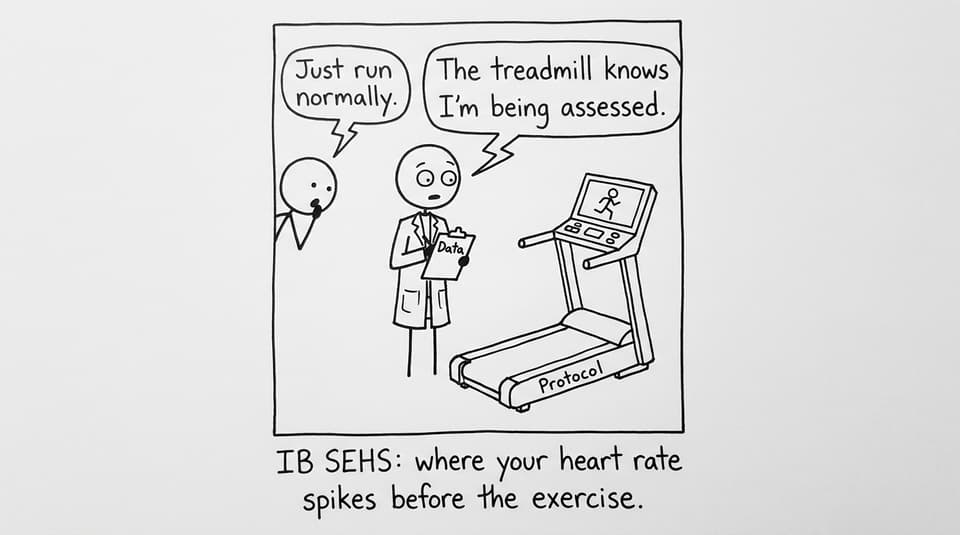
IB SEHS treadmill assessment joke
Quick checklist: what IB SEHS feels like day to day
Labs that are human-focused (and sometimes a little awkward)
Theory that connects directly to performance, health, and behaviour
A steady stream of write-ups and reflections if you want top marks
Statistics that are manageable, but only if you practise early
Exam questions that reward application, not just definitions
Students usually describe labs as the most enjoyable part of IB SEHS because they feel real. You’re not watching a colour change and pretending to care. You’re testing movement, fatigue, recovery, hydration, or focus and seeing your own data respond.
You learn quickly that protocol matters (and that classmates are not perfectly controlled variables).
Data collection is fun in the moment, but the quality of your notes decides how painful analysis becomes later.
The best labs become future study material because they create memories you can attach concepts to.
A practical tip students repeat: treat every lab like it might become an IA draft. That mindset makes you record conditions, units, and limitations with more care.
The theory-practice balance: less abstract, still demanding
Compared to other sciences, IB SEHS often feels more “applied.” But applied doesn’t mean easy. Students say the difficulty comes from switching gears: you might learn a physiological mechanism, then immediately need to evaluate it in a scenario, interpret results, and justify a conclusion.
Two places where this shows up strongly:
Hydration and nutrition
This is where students realise the course isn’t just facts, it’s decision-making. For targeted revision, see A.2 Hydration and nutrition and practise turning content into short, mark-friendly explanations.
Biomechanics and movement
Movement topics can feel intuitive until you have to explain them precisely. A good anchor topic is B.2 Forces, motion and movement, because it pushes you to connect definitions to actual performance situations.
Workload reality: manageable… if you respect the paperwork
Most students call IB SEHS “manageable” with a warning label: it rewards consistency more than heroic last-minute effort. The course has a quiet admin load: documenting labs, refining analysis, and keeping your thinking organised.
A lot of students hit the same turning point: once you build a simple weekly system, the stress drops.
Here’s what that system often looks like on RevisionDojo:
Use Study Notes to understand a micro-topic in 15--20 minutes.
Convert the key ideas into Flashcards style prompts (even if you’re using cheatsheets, write recall questions in your own words).
Drill exam-style application using the Questionbank.
When you’re stuck on wording or command terms, use RevisionDojo’s AI Chat to get an explanation that matches how marks are awarded.
Students often say this loop feels “boring” on purpose. That’s the point. Boring systems beat emotional motivation.
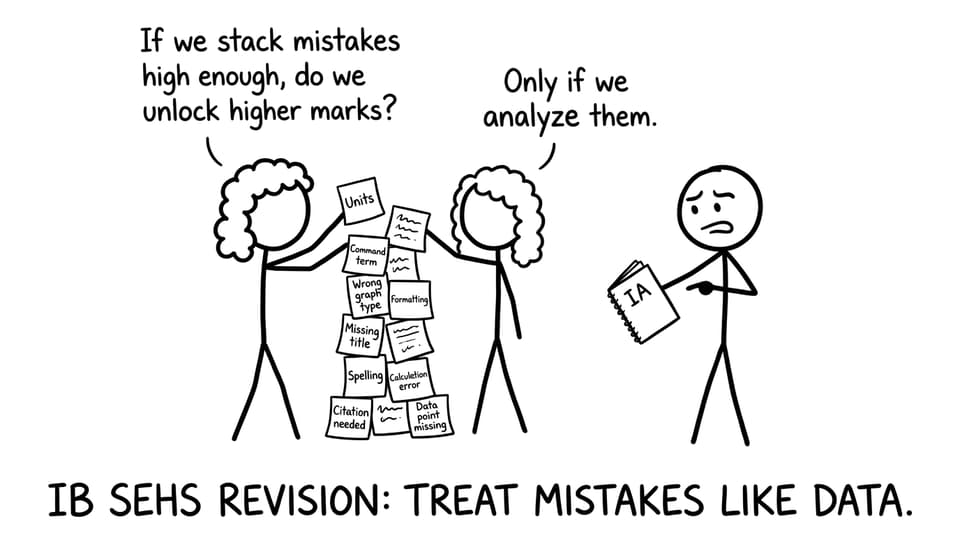
IB SEHS revision mistakes as data joke
The IA experience: rewarding, but only if you build it slowly
Students don’t usually fear the investigation itself. They fear what happens when they try to reconstruct their method and variables from memory.
A good student habit is to write your IA thinking in small steps:
What exactly am I measuring?
Why does this variable matter in IB SEHS terms?
What limitations will an examiner see instantly?
If you’re doing SEHS coursework beyond the IA (like an EE), the IB SEHS EE Grader can help you self-check against the rubric language before a teacher meeting.
Exam prep: the subject rewards “trained” answers
Students prepping for IB SEHS exams often say their biggest improvement came from seeing patterns in mark schemes. In other words, your knowledge needs a delivery format.
Two RevisionDojo reads that students find grounding during exam season:
Then, to make practice feel real, students lean on RevisionDojo’s Mock Exams and Predicted Papers to build timing, plus grading tools to see what top-band responses look like.
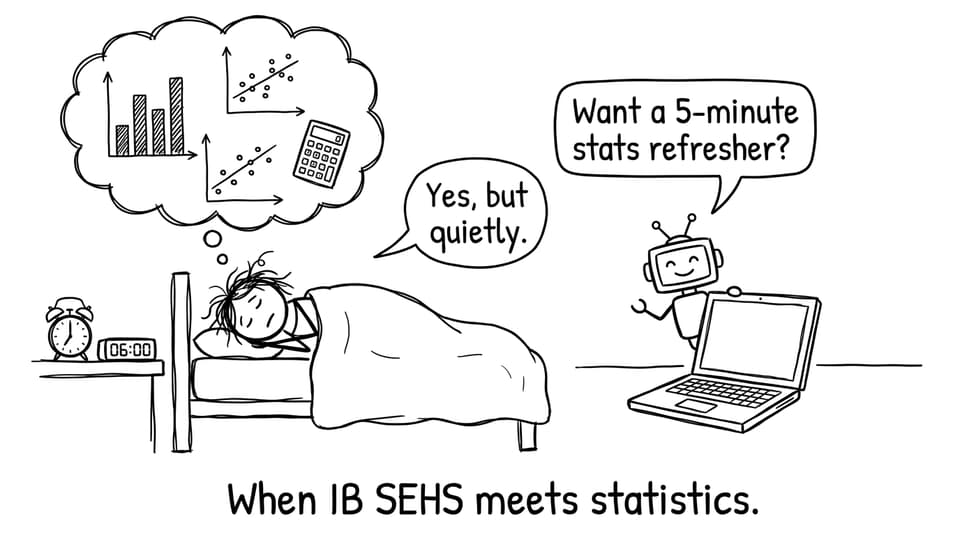
IB SEHS statistics sleep joke
Closing: the quiet advantage of IB SEHS
What it’s like to take IB SEHS is, in a way, what it’s like to learn yourself through science. The subject is engaging because it’s human, but it’s also rigorous because humans are messy and data is unforgiving.
If you want to feel calm walking into exams, build a small repeatable system: learn with RevisionDojo Study Notes, lock recall with Flashcards, apply with the Questionbank, and sharpen timing with Mock Exams and Predicted Papers. That’s how IB SEHS stops feeling like a pile of content and starts feeling like trained confidence.
IB SEHS goal setting in sport made simple: goal types, SMART targets, common mistakes, and exam-ready tips using RevisionDojo practice tools.