

The first time you realize IB Digital Society is “about you,” it’s slightly unsettling.
Not in a dystopian way (although you will probably write about surveillance). More in the quiet moment when your teacher asks whether a platform’s recommendation algorithm shapes your identity--and you suddenly remember every late-night scroll that felt like “choice.” In IB Digital Society, everyday tech becomes exam material. Your opinions still matter, but only if you can support them.
Quick reality checklist for IB Digital Society
If you’re deciding whether IB Digital Society fits you (or you’re already in it and want the honest version), expect this:
-
Frequent discussion lessons, with real case studies and conflicting viewpoints
-
Writing that rewards structure more than “hot takes”
-
Assessments that prioritize analysis and evaluation over memorization
-
An internal assessment-style mindset: research, reflection, and careful evidence
-
Natural overlap with TOK, CAS reflections, and Extended Essay thinking
A good starting point is the RevisionDojo subject hub for IB Digital Society resources, where you can see how the course breaks into topics, question practice, notes, and tools.
The day-to-day classroom experience
Most Group 3 subjects have a familiar rhythm: content, notes, recall, essays. IB Digital Society feels different. The class often begins with a stimulus: a headline about AI regulation, a short clip about misinformation, a data breach timeline, or a policy debate. Then the real work starts.
You’ll be asked questions like:
-
Should governments regulate AI systems that “black box” their decisions?
-
Does surveillance increase safety, or just move power away from citizens?
-
When does personalized content become manipulation?
The skill isn’t having a single “correct” opinion. It’s showing that you can hold multiple perspectives at once without getting vague.
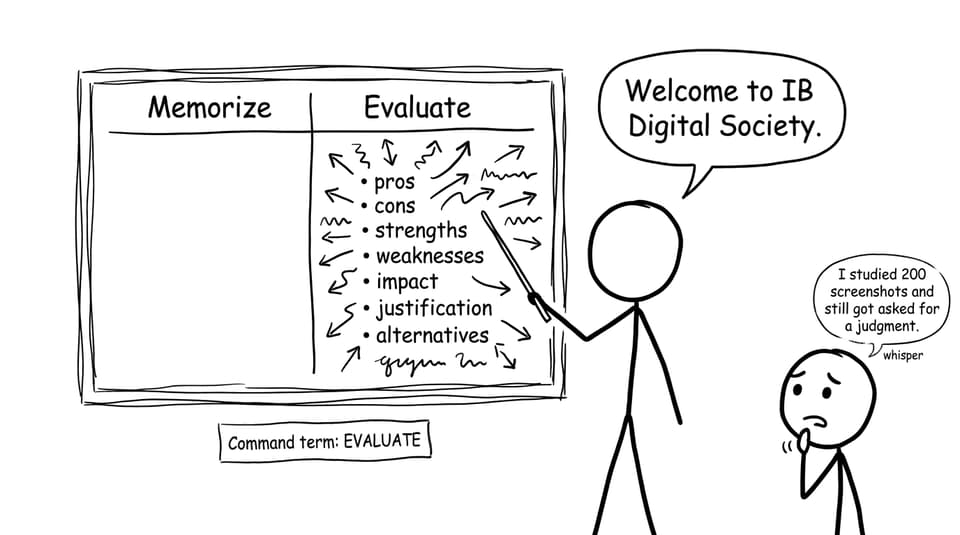
A practical cheat code here is command terms. If you “describe” when the question wants you to “evaluate,” you can write a beautiful paragraph and still lose marks. Revision gets easier once you train your brain to answer what the examiner actually asked. Use How to Use Command Terms Effectively in IB Exams as your anchor, then practise those verbs in timed sets using RevisionDojo’s Questionbank.
Assessments: why it’s not “easy,” just different
Students sometimes call IB Digital Society “easier” because it’s less memorization-heavy than History or some Economics units. That comparison misses the point.
The challenge in IB Digital Society is that you can’t hide behind recall. You need to:
-
select relevant evidence from a case study
-
connect it to a concept (power, culture, ethics, inequality, responsibility)
-
analyze consequences for different groups
-
make a justified judgment
That last step is where marks live.
If you want a clear picture of what makes the subject demanding (in the most realistic sense), read Is IB Digital Society Hard? Honest Expectations Explained. Then use the RevisionDojo Grading tools to get feedback on your writing before your teacher sees the final draft.
The internal assessment mindset (and how students actually choose topics)
One of the best parts of IB Digital Society is that your research can start from something you genuinely care about: privacy, representation, online activism, digital divides, algorithmic bias. The freedom is real, and that makes the work feel personal.
The trap is choosing a topic that’s emotionally interesting but academically fuzzy.
A strong IB Digital Society approach looks like this:
-
Start with a real-world digital issue (specific platform, policy, or event)
-
Turn it into a focused question
-
Define what “good evidence” looks like (data, credible reporting, research)
-
Plan how you’ll compare perspectives (users, governments, companies, communities)
RevisionDojo helps here because you can move from Study Notes to Flashcards to targeted practice questions without rebuilding your entire system every time you refine your argument.
Skills you build (that also raise your exam score)
The best outcome of IB Digital Society is that you learn to think with more precision.
You’ll practice:
-
Critical thinking: spotting assumptions in digital “solutions” and platform narratives
-
Research literacy: judging sources, data quality, and bias
-
Clear argument writing: building paragraphs that earn marks, not applause
-
Global awareness: understanding how the same technology can affect different cultures and groups differently
Those skills line up neatly with the learner profile, which is why Digital Society students often find TOK discussions less intimidating. If you want the bigger picture, read The 10 IB Learner Profile Traits Explained.
A simple way to revise IB Digital Society (without drowning in screenshots)
A lot of students revise IB Digital Society by collecting examples: scandals, policies, platform changes, and headlines. Examples help, but only if you can use them.
Try this loop instead:
-
Pick one theme (ethics, power, culture, inequality)
-
Learn the concept using RevisionDojo Study Notes
-
Do 10--15 Questionbank items on that theme
-
Use AI Chat to challenge your reasoning (“What’s the counterargument?”)
-
Turn your weak points into Flashcards
If you need a map of the themes that keep appearing across prompts, save IB Digital Society: Key Themes Explained and revisit it weekly.
Closing: why IB Digital Society feels personal (and how to use that)
The strange gift of IB Digital Society is that it trains you to look at your own digital life with adult eyes. You start noticing incentives, trade-offs, and unintended consequences. And by exam time, you’re not just repeating examples--you’re making judgments you can defend.
If you want to revise with less guesswork, build your routine inside RevisionDojo: start with Study Notes, drill with the Questionbank, tighten your writing with AI Chat and Grading tools, and keep your concepts active using Flashcards. For a clean starting point, open the IB Digital Society resources hub and set up a system you can actually sustain.
Because IB Digital Society rewards the same thing technology rewards: consistency, clarity, and good judgment.

