The IB Learner Profile isn’t a poster. It’s an exam-season advantage.
A week before exams, you can feel the difference between two kinds of IB students.
One is surrounded by notes, tabs, and good intentions. They are working hard, but the effort leaks out through gaps: practice without feedback, revision without focus, and stress without a system.
The other looks calmer. Not because they know more, but because their habits are tighter. They ask better questions, test themselves more often, and adjust faster when they miss marks.
That quiet edge is exactly what the IB Learner Profile was designed to build: a set of traits that turn learning into repeatable behaviour. In IB exam prep, those traits show up as clarity, judgement, resilience, and better answers under time pressure.
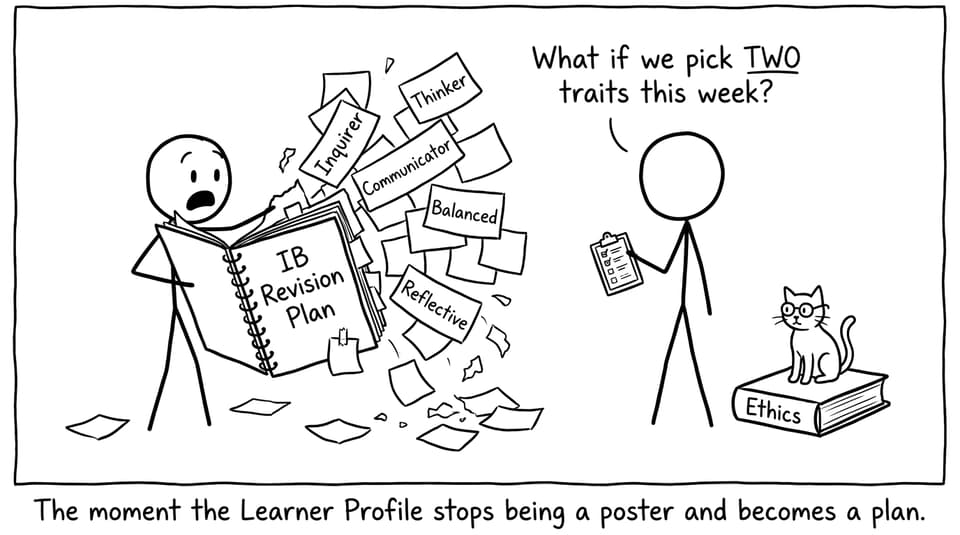
A quick IB checklist: make the Learner Profile practical this week
If you try to “be all ten traits” at once, nothing changes. Use this simple IB routine instead:
-
Pick two Learner Profile traits for the next 7 days.
-
Attach each trait to one visible action (something you can measure).
-
Do one loop per session: Study Notes --> practice --> feedback --> retest.
-
End with a 4-sentence reflection: what happened, why, what to change, when you’ll test again.
-
Keep it all in one place so you don’t lose momentum.
RevisionDojo is built for this loop: Study Notes, Flashcards, Questionbank, AI Chat, Grading tools, Predicted Papers, Mock Exams, a Coursework Library, and Tutors when you need a human reset.
You can start at the RevisionDojo IB hub and build your routine around your subjects.
What the IB Learner Profile actually is (and why examiners reward it)
The IB Learner Profile is a set of ten attributes the programme aims to develop in students across all subjects and assessments:
-
Inquirers
-
Knowledgeable
-
Thinkers
-
Communicators
-
Principled
-
Open-minded
-
Caring
-
Risk-takers
-
Balanced
-
Reflective
In the classroom, these sound like values. In exams, they become outcomes examiners can mark: focused analysis, relevant examples, coherent structure, honest evaluation, and thoughtful improvement.
A useful way to see it: the Learner Profile is the IB’s language for “how strong learners behave when it matters.”
The 10 IB Learner Profile traits (and how to turn each into marks)
Inquirers: train curiosity with questions, not highlighting
In IB revision, being an inquirer means you don’t just re-read. You interrogate.
Practical exam actions:
-
Turn every subtopic into 3-5 “why” or “how” questions.
-
Use targeted sets in a question bank to test what you think you know.
-
Keep a short “what I still don’t get” list for your next session.
A smart companion resource is IB Question Bank | How to Use It Effectively, because inquiry only matters if you check your answers against markscheme logic.
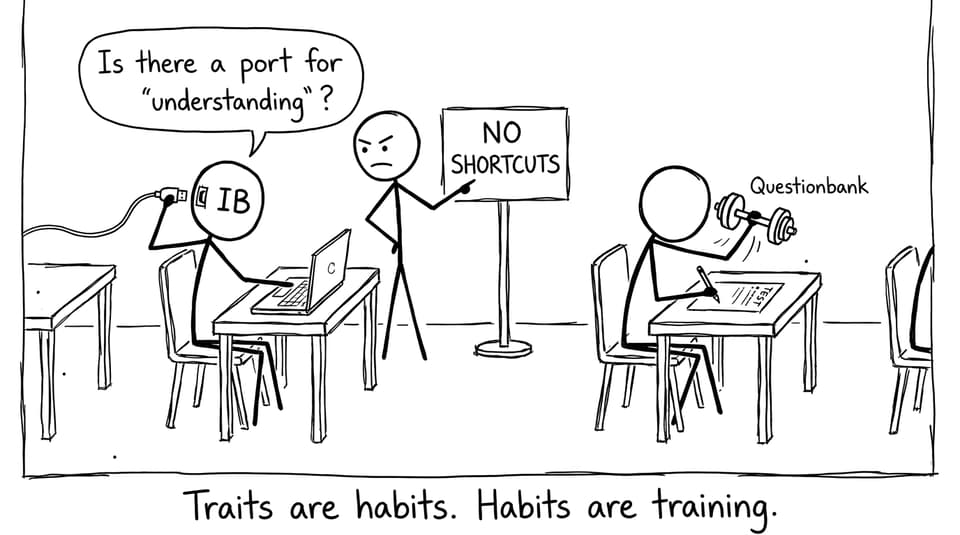
Knowledgeable: build breadth, then prove depth under pressure
Knowledgeable IB students don’t just collect facts. They can select the right facts quickly.
Practical exam actions:
-
Summarise each topic into “must-know” bullet points (not paragraphs).
-
Create spaced repetition cards for definitions, processes, and key terms.
-
Practise retrieving knowledge in exam phrasing, not textbook phrasing.
If you want recall to stick, pair your notes with IB Flashcards with Spaced Repetition (SRS) and keep daily review short but consistent.
Thinkers: move from “what” to “so what”
Examiners don’t reward description as much as students hope. In IB marking, the jump from “what happened” to “what it means” is where marks live.
Practical exam actions:
-
For each practice answer, underline the sentence that contains your judgement.
-
Add one limitation or alternative explanation (where relevant).
-
Learn command terms as decision prompts: analyse, evaluate, discuss.
To make this measurable, use practice sets and then apply feedback with tools like RevisionDojo’s Grading tools (so “thinking” turns into visible improvements).
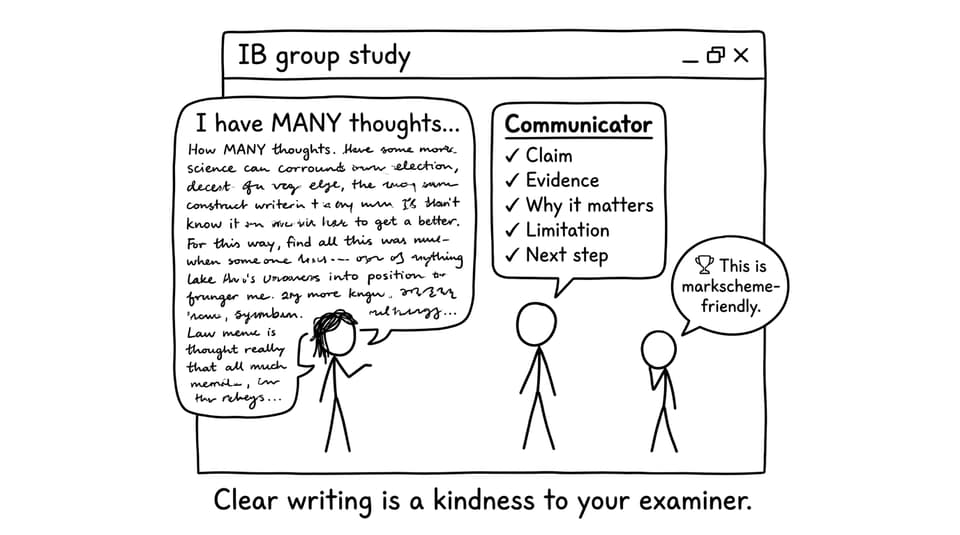
Communicators: structure is empathy for the examiner
In the IB, your best idea can earn fewer marks if the examiner has to hunt for it.
Practical exam actions:
-
Use signposting: claim --> evidence --> explanation.
-
Keep paragraphs single-purpose.
-
In essays, write the thesis and topic sentences first, then fill in.
RevisionDojo’s ecosystem helps here: you can draft responses, check them against criteria, and tighten structure using AI Chat without turning revision into a two-hour spiral.
Principled: honesty is a strategy (especially in evaluation)
Principled doesn’t mean perfect. It means accurate.
In IB coursework and written responses, principled students:
-
Don’t invent evidence.
-
Don’t hide weaknesses in method or argument.
-
Don’t pretend confusion is insight.
Practical exam actions:
-
When you’re unsure, write what you can justify clearly.
-
In evaluation-style questions, state limitations plainly, then explain impact.
-
Use markschemes to learn what “valid” looks like.
Open-minded: score higher by considering alternatives
Open-mindedness is not just global awareness. In IB exams, it can look like range: multiple perspectives, counterarguments, or different interpretations.
Practical exam actions:
-
For each big theme, prepare one counterpoint.
-
Practise “however” paragraphs that don’t derail your argument.
-
In sciences and individuals/societies, note assumptions and boundary conditions.
Caring: make group work and feedback loops kinder (and faster)
Caring in exam season is surprisingly practical. It’s how you create support systems that reduce stress and increase consistency.
Practical exam actions:
-
Swap one timed response with a friend and give criteria-based feedback.
-
In study groups, compare error patterns, not just scores.
-
Share one good explanation, then turn it into flashcards.
If you want a structured way to practise together, use the ideas from Collaborative IB Mock Exams: Study with Friends Online.
Risk-takers: practise what you avoid
Most IB students revise what feels comfortable first. Risk-takers do the opposite: they move toward the questions they dread.
Practical exam actions:
-
Do a “worst-first” set: the topic you score lowest on.
-
Attempt before you re-learn (so you can diagnose accurately).
-
Sit short timed sections to build courage and pacing.
A good tool-assisted workflow is building targeted papers with Custom IB Mock Exams: Build Practice Tests by Topic.
Balanced: treat energy like a resource you can budget
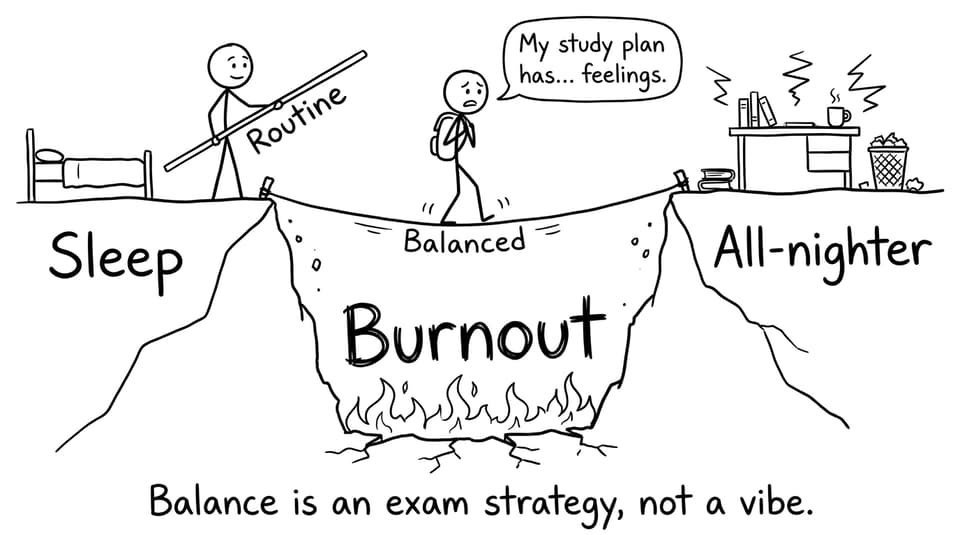
Balance is not a personality trait. It’s a plan.
In IB prep, balanced students protect the basics: sleep, food, movement, and realistic session length. That’s not motivational advice. It’s performance advice.
Practical exam actions:
-
Use 45-75 minute blocks, then stop.
-
Keep one full rest window per week.
-
Build a “minimum viable study day” for busy weeks.
Reflective: turn mistakes into rules
Reflective is the trait that makes every other trait compound.
Practical exam actions:
-
After every set, write one rule: “When I see X, I should do Y.”
-
Track patterns (misread command term, weak definitions, skipped units, vague evaluation).
-
Retest within 24-48 hours.
If you want to go deeper, Harnessing Reflection Data to Support IB Learner Profile Development offers a simple routine for turning reflection into measurable growth.
How to use the IB Learner Profile with RevisionDojo (a simple system)
Here’s a practical, non-glamorous IB loop that works across subjects:
-
Clarify: Use Study Notes to fix one weak concept quickly.
-
Recall: Use Flashcards for 5-10 minutes daily so facts stay available.
-
Apply: Use the Questionbank for targeted practice and fast feedback.
-
Simulate: Use Mock Exams to train timing and stamina.
-
Rehearse: Use Predicted Papers to practise full-paper decision-making in realistic formats.
-
Improve: Use Grading tools and AI Chat to understand what the markscheme wants.
-
Stabilise: Use the Coursework Library to reduce background stress from deadlines.
-
Escalate: Use Tutors when you need a real-time explanation or accountability.
You can also compare practice styles in IB Flashcards vs Practice Questions: Score Higher Fast so you choose the right tool for the right moment.
FAQ: IB Learner Profile and exam preparation
How does the IB Learner Profile help me score higher in exams?
The IB Learner Profile helps because it translates into behaviours examiners can reward: clearer reasoning, better structure, and more accurate evaluation. When you practise being an inquirer, you stop revising blindly and start testing what the paper actually asks. When you practise being a communicator, your ideas become easier to award marks for because they are organised and explicit. When you practise being reflective, your mistakes stop repeating because you turn them into rules you can apply next time. Over a few weeks, this compounds into more reliable performance under time pressure. The biggest benefit is that the Learner Profile gives you a stable identity during stress: you become the kind of student who responds to difficulty with a process.
Is the IB Learner Profile only relevant for coursework and CAS, not exams?
It’s relevant for exams because the IB doesn’t just test knowledge, it tests thinking and communication under constraints. Many exam questions are built to reward the same qualities the Learner Profile describes: analysis (thinkers), perspective (open-minded), clarity (communicators), and honest evaluation (principled). Coursework makes the traits visible, but timed papers make them urgent. In revision season, the Learner Profile becomes a way to choose better practice: do I need more recall, more application, or more reflection? If you use it that way, it stops being “extra” and starts being efficient.
I feel like I’m not naturally confident. How do I become a risk-taker in IB revision?
In IB prep, risk-taking doesn’t mean being fearless. It means creating safe, repeatable exposure to the topics and question types you avoid. Start with a small timed set (even 10-15 minutes) on your weakest area, then review immediately and write one improvement rule. Repeat that every other day, and you’ll build evidence that you can survive the discomfort. Confidence comes later, as a side effect of repetition and feedback. Tools help because they lower friction: a Questionbank gives you targeted questions, Grading tools show where marks were lost, and AI Chat helps you unblock without losing an hour. Over time, you stop “being brave” and start “following the plan.”
What’s the fastest way to use the IB Learner Profile if I’m short on time?
Pick two traits and attach them to one behaviour each, then run that loop daily for a week. For example: communicator (write a 5-line outline before any essay answer) and reflective (write one error rule after each practice set). Keep your revision narrow: one topic, one skill, one retest. Short on time is exactly when the IB Learner Profile matters most, because it prevents panic-revision that feels busy but doesn’t move scores. If you have RevisionDojo open, you can keep everything in one workflow: notes to patch gaps, flashcards to maintain recall, practice questions to earn marks, and analytics to track progress. The goal is not to do more. It’s to waste less.
Closing: make the IB Learner Profile your calm competitive edge
The IB Learner Profile is often introduced like a set of ideals. In exam season, it becomes something more useful: a way to choose your next best action.
Pick two traits. Practise them like skills. Track them like habits. Then let your results do what motivation can’t.
If you want an all-in-one system to train the Learner Profile through real exam behaviours, build your loop in RevisionDojo with Study Notes, Flashcards, Questionbank, AI Chat, Grading tools, Predicted Papers, Mock Exams, the Coursework Library, and Tutors. The goal is simple: make your IB preparation feel familiar before the exam room demands it.