


Privacy is the word everyone uses when something online feels wrong.
A friend posts a screenshot you didn’t expect. A school installs monitoring software “for safety.” A “free” app asks for location access that makes no sense. You feel the unease first, and only later try to explain it.
In IB Digital Society, that gap between feeling and explaining is where marks are won. Privacy isn’t a slogan or an absolute right that technology simply “takes away.” Privacy is a negotiated condition shaped by system design, consent, power, and real trade-offs. When you analyse privacy like that, you stop writing opinion pieces and start writing exam answers.
If you want a broader map of how the course ideas connect, keep this nearby: IB Digital Society: How All the Core Concepts Fit Together.
Quick privacy analysis checklist for IB Digital Society
Use this as a fast plan whenever you see a stimulus about tracking, data, surveillance, targeted advertising, facial recognition, school monitoring, or “safety tech” in IB Digital Society:
-
Define what “privacy” means in this context (control, boundaries, informational self-determination).
-
Identify what data is collected (explicit and inferred).
-
Explain how the system processes and shares that data.
-
Test consent: informed, meaningful, and reversible?
-
Make power visible: who benefits, who can opt out, who can challenge?
-
Compare impacts on individuals vs communities.
-
Evaluate trade-offs (benefits vs harms) and reach a justified judgment.
For targeted practice, RevisionDojo’s IB Digital Society Resources hub keeps notes, Flashcards, Questionbank practice, and exam tools in one place.
What privacy means in IB Digital Society
In IB Digital Society, privacy refers to the level of control people and communities have over personal information: what is collected, what is inferred, who accesses it, and what it is used for.
Two clarifications help instantly:
-
Privacy is not the same as secrecy. You can share something and still expect limits on reuse.
-
Privacy is not all-or-nothing. It changes by context (school, workplace, health, social media), and by design choices (default settings, retention, transparency).
This is why strong IB Digital Society answers treat privacy as a spectrum with boundaries that can be widened or tightened by system features.
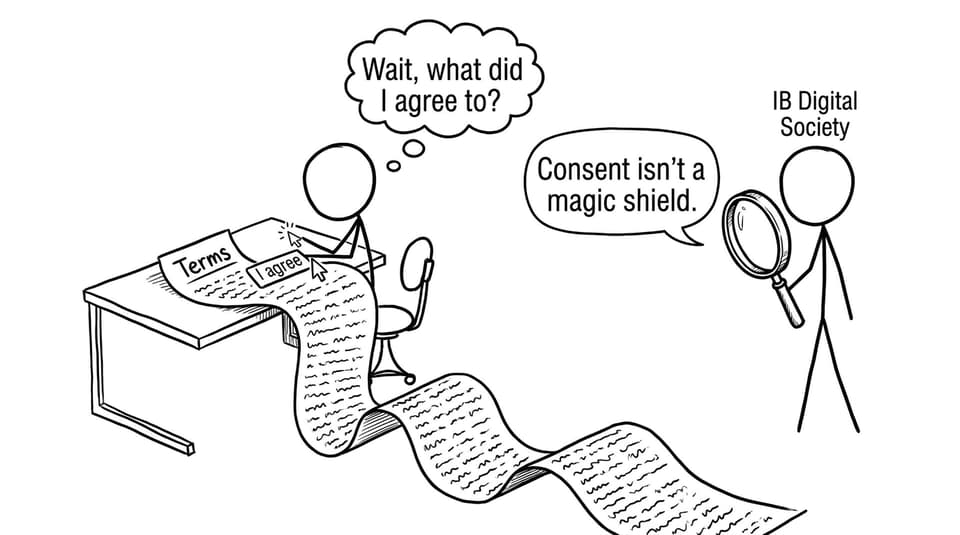
IB Digital Society privacy starts with systems, not “personal choices”
A common trap in IB Digital Society is blaming individuals: “They shouldn’t have clicked that,” or “They should read the policy.” That’s usually descriptive, and it hides the more examinable point: privacy outcomes are produced by systems.
When you analyse privacy, look at the architecture:
-
Collection: what data the system takes in (and what it infers).
-
Processing: how data becomes profiles, predictions, rankings, or risk scores.
-
Access: who can see it (company teams, third parties, governments, schools).
-
Retention: how long it’s stored, and how hard it is to delete.
To strengthen your examples, pair privacy with the wider lens of monitoring: Data Collection and Surveillance in Digital Society Explained.
Data collection: the “necessary vs proportional” test
Data collection sits at the heart of privacy in IB Digital Society because many harms start small: one permission, one log, one “improvement” to personalisation.
Two exam-friendly questions keep you balanced:
-
Is it necessary for the core function? (Maps need location; a calculator app does not.)
-
Is it proportional to the benefit? (A small benefit may not justify sensitive or continuous tracking.)
This helps you avoid the weak claim that “all data collection is unethical.” In IB Digital Society, examiners reward nuance: sometimes data collection improves safety, accessibility, or service quality. Your job is to judge whether the privacy trade-off is justified.
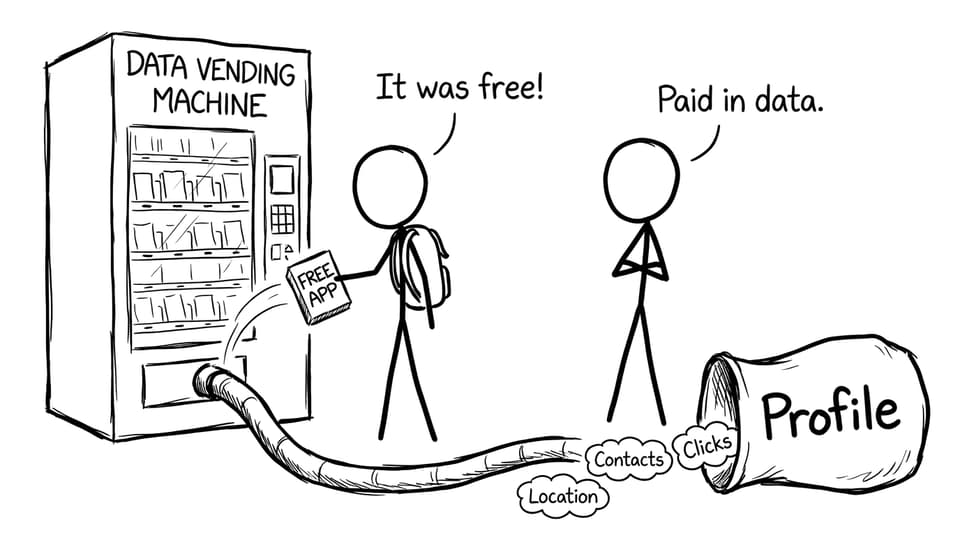
Consent: why “I agreed” isn’t the end of analysis
Consent often appears in privacy debates as a full stop: “Users consented, so it’s fine.” In IB Digital Society, consent is usually the beginning of the interesting part.
Analyse whether consent is:
-
Informed: is it clear what data is collected and why?
-
Meaningful: can users realistically refuse without losing essential access (school tools, work platforms, social participation)?
-
Reversible: can people withdraw consent and regain privacy without punishment?
If consent is buried, rushed, or effectively forced by social pressure or dependency, then privacy is not simply a personal choice. It becomes a question of design and power.
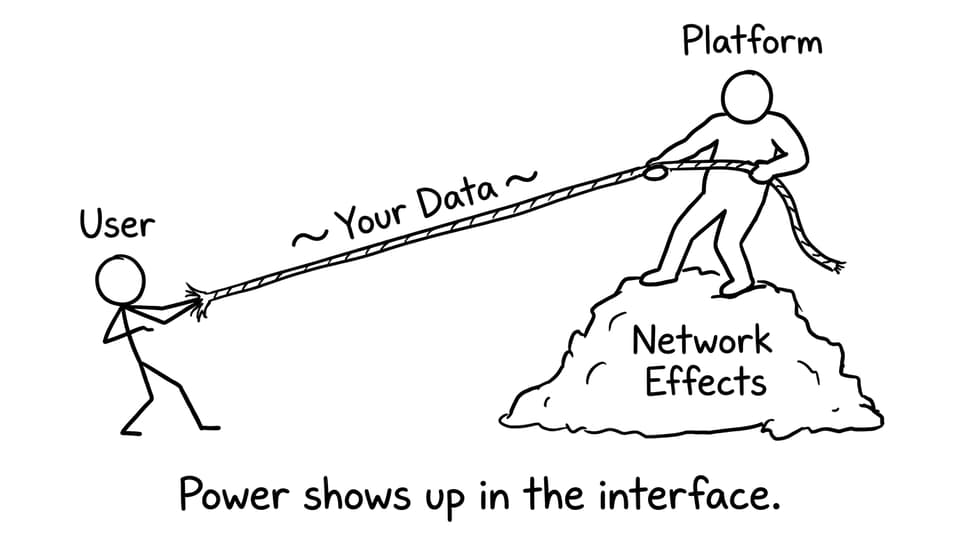
Power: who gets to set the privacy rules?
Privacy in IB Digital Society is inseparable from power because the party that controls the system usually controls the boundaries.
Make power concrete by asking:
-
Who controls the data infrastructure?
-
Who benefits financially, politically, or socially?
-
Who bears the risk if things go wrong?
-
Who can challenge a decision, correct a profile, or demand deletion?
This is also where you can connect privacy to digital rights and responsibilities: Digital Rights and Responsibilities in IB Digital Society.
Individual vs community impacts (how to reach top bands)
Many students can explain how privacy affects an individual. Fewer explain community-level impacts, which is often what separates competent answers from excellent ones in IB Digital Society.
At the individual level, privacy connects to:
-
autonomy (freedom to act without constant observation)
-
agency (ability to control personal information)
-
wellbeing (stress, self-censorship, exposure to manipulation)
At the community level, privacy connects to:
-
targeted surveillance of specific groups
-
normalisation of monitoring (“this is just how life works now”)
-
unequal risk (some communities have fewer ways to opt out)
A strong exam paragraph often uses both levels: “Here’s how it shapes one student’s behaviour, and here’s how it scales into a social pattern.”
Surveillance: purpose, proportionality, and behavioural change
Surveillance is the practical mechanism through which privacy is reduced, traded, or reshaped. In IB Digital Society, don’t just label something as surveillance and move on.
Instead, analyse:
-
Overtness: is monitoring visible and understood, or hidden?
-
Scope: targeted vs mass, temporary vs continuous.
-
Purpose: safety, profit, governance, discipline.
-
Behavioural effects: do people self-censor, conform, or avoid participation?
This is where you can build ethical evaluation without moralising: surveillance can produce benefits (security, accountability), but it can also shift power and chill expression.
How to use privacy in exam answers (a simple paragraph frame)
When a question asks you to analyse or evaluate in IB Digital Society, use a repeatable structure:
-
Claim: Identify the privacy issue and the system feature causing it.
-
Mechanism: Explain how data flows through the system (collection, processing, sharing).
-
Impact: Individual + community consequences.
-
Concept link: Bring in power, ethics, rights/responsibilities, or inequality.
-
Judgment: Evaluate trade-offs and justify your conclusion.
To get used to command-term expectations across exams and the IA, it helps to review how the assessment is built: IB Digital Society Assessment Overview: Exams and Internal Assessment.
How privacy fits naturally into the IA
Privacy works well in the IA because it creates built-in evaluation: you can rarely discuss privacy without discussing stakeholders, responsibility, and trade-offs.
Three ways to make privacy analysis sharper in an IB Digital Society IA:
-
Pick one specific system feature (a recommendation algorithm, biometric check-in, tracking policy) instead of a whole industry.
-
Make your inquiry question evaluative, not descriptive.
-
Use sources to support analysis rather than to “prove” obvious facts.
These guides help you stay focused and score higher:
Closing: turn privacy into marks
The fastest way to improve privacy answers in IB Digital Society is to stop treating privacy as a moral headline and start treating it as a system question. Track how data is collected and used. Test whether consent is real. Make power visible. Then evaluate trade-offs with calm, evidence-based judgment.
If you want that practice to feel structured (and not endless), RevisionDojo brings it together: Study Notes for clarity, Flashcards for recall, the Questionbank for exam-style drilling, AI Chat for quick feedback, Grading tools to learn how marks are awarded, plus Mock Exams, Predicted Papers, Coursework Library support, and Tutors when you want a human check.
That’s the mindset shift IB Digital Society rewards: less outrage, more analysis, and conclusions you can defend.
