
Your first instinct in IB coursework is usually to hunt for what’s broken.
It makes sense. Deadlines compress. Feedback feels urgent. And when you’re also revising for IB exams, every flaw looks like a threat.
But here’s the quieter truth that top students learn early: your highest marks often come from the parts you don’t rewrite. They come from the paragraphs where your thinking is already sharp, your evidence is already doing work, and your structure is already making an examiner’s job easy.
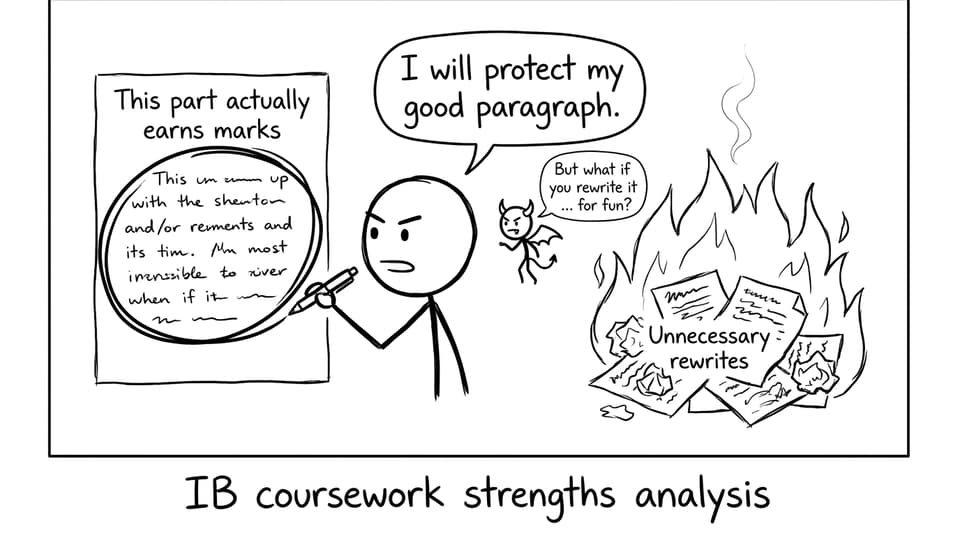
An IB coursework strengths analysis is simply the habit of noticing those parts on purpose--and using them as your anchor while you improve the rest.
IB coursework strengths analysis: a quick checklist
Use this before you change anything:
-
Identify 2--3 sections that already meet the top descriptor language (per criterion).
-
Label why they work (clarity, analysis, evaluation, methods, evidence handling).
-
Protect them from “panic edits.”
-
Use them as your model for weaker sections.
-
Spend revision time where you’re just below the next band.
If you want a rubric-aligned starting point, browse subject-specific guidance in IB Coursework Guides.
Why IB students lose marks by editing the wrong parts
The biggest hidden cost in IB coursework isn’t a weak paragraph.
It’s rewriting a strong one until it becomes average.
This happens because “good” feels fragile. Students second-guess a clear argument, add extra sources, extend sentences, and accidentally blur the line between analysis and summary. The piece gets longer, but not better. And in IB assessment, length doesn’t automatically buy you marks.
A strengths-first approach reduces that risk. It also lowers stress, because your brain stops treating the whole draft like an emergency.
For a practical workflow you can reuse across IA, EE, and TOK, see Comprehensive Guide to IB Coursework Study Tips.
How to identify strengths the IB way (not the “vibes” way)
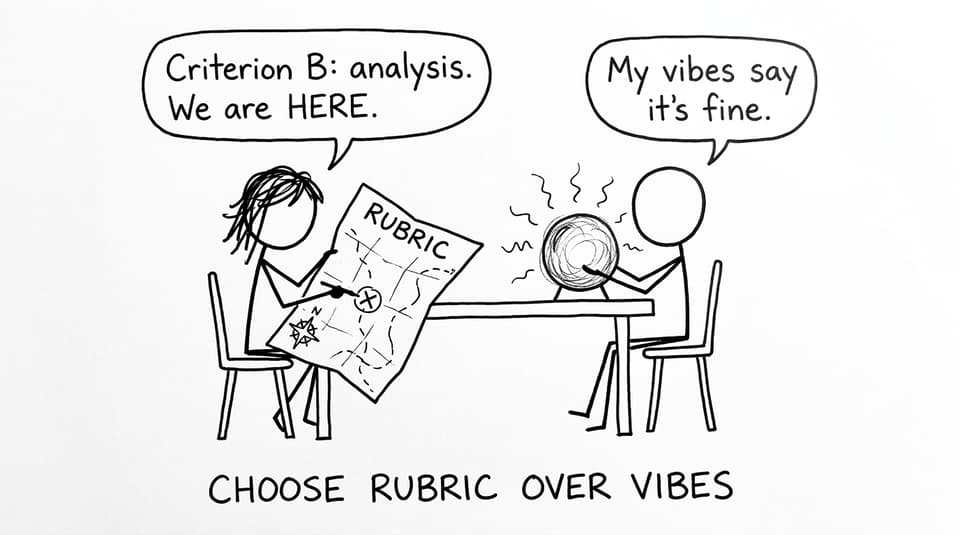
IB coursework is not graded by general impressions. It’s graded by criteria.
So a real IB coursework strengths analysis is criterion-based strength mapping: finding exact lines you can point to and say, “This earns marks because it matches this descriptor.”
Common high-scoring strengths include:
-
A sharply defined research focus (you’re not trying to prove everything).
-
Logical progression of ideas (each paragraph earns its place).
-
Evidence that is interpreted, not just presented.
-
Evaluation/reflection that shows consequences, limitations, and judgment.
-
Academic language that stays precise under pressure.
To make this fast, use the IB Coursework Grader for rubric-aligned feedback that highlights what’s already working and what is missing.
How to use your strongest sections as a template
Once you’ve found a strong paragraph, treat it like a reusable pattern.
For example:
-
If your evaluation is strong, steal its sentence structure for your weaker analysis.
-
If your introduction is clear, copy its level of specificity when you introduce a new section.
-
If your data commentary is sharp, replicate the same “claim → evidence → interpretation → link back to question” rhythm.
This is where models help. Instead of guessing what “good” looks like, compare against exemplar work in the IB Coursework Examples: IA, EE and TOK Exemplars library, and use RevisionDojo’s Coursework feature hub to keep your drafting and comparison in one place.
If you want a deeper guide on benchmarking, read IB Coursework Comparison: See How You Stack Up.
The smartest way to improve marks with less work
In IB coursework, the highest ROI often comes from “almost-there” criteria.
So after your strengths analysis, look for the areas sitting just below the next band. That’s where a small change can create a mark jump.
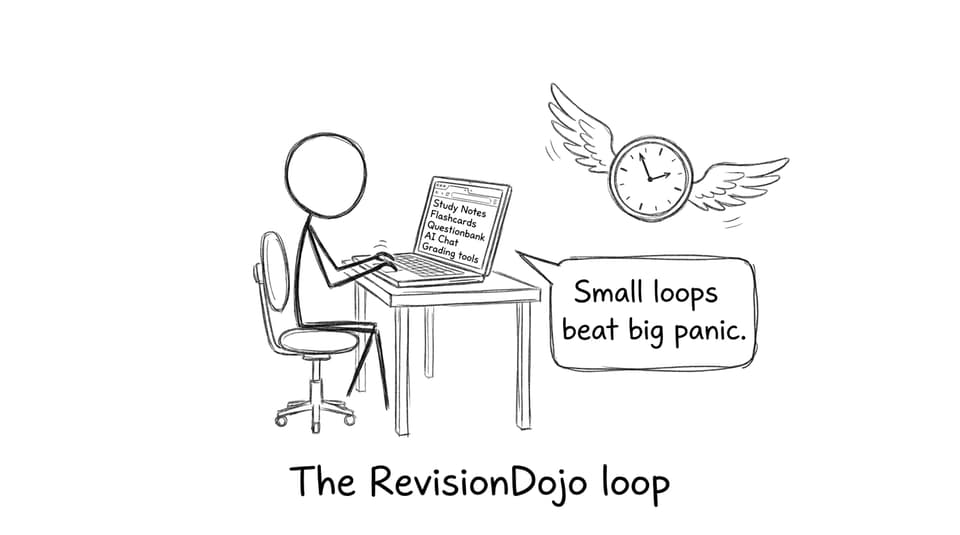
A simple loop:
-
Patch understanding quickly with RevisionDojo’s RevisionDojo for IB hub.
-
Turn your strongest insights into recall cues using Flashcards.
-
Pressure-test your explanations with exam-style practice using the Questionbank feature.
-
When you get stuck, use Jojo AI in Meet Jojo AI: Your Personal IB Study Assistant.
Common strengths students discover (and why it matters)
A surprising outcome of IB coursework strengths analysis is that your strengths may not match your self-image.
Some students have excellent critical thinking but lose clarity through messy structure. Others write beautifully structured work but stay too descriptive in evaluation. Some handle data well but don’t interpret implications. Many have sophisticated ideas that get buried under cautious wording.
Naming your real strengths helps you revise with accuracy. You stop “fixing everything” and start transferring what already works.
FAQ
How do I know if something is genuinely a strength in IB coursework?
A strength is anything you can defend with criterion language, not just something that “sounds good.” Start by rereading the relevant criterion and asking what an examiner must be able to award. Then highlight the exact lines in your work that clearly match those descriptors. If you can’t point to specific sentences, it might be a promising idea but not yet a scoring strength. Tools like the IB Coursework Grader help because they make strengths visible as criterion-level feedback, not vague comments. Finally, sanity-check by comparing your section to models in IB Coursework Examples: IA, EE and TOK Exemplars so your judgment doesn’t drift.
Should I focus on strengths even if my teacher says I have weaknesses?
Yes--because focusing on strengths doesn’t mean ignoring weaknesses. It means protecting the parts already earning marks while you improve the parts that are losing them. In IB, careless rewrites can introduce new problems: weaker clarity, less precise analysis, or broken coherence. A strengths analysis lets you revise surgically: keep what works, adjust what changes marks. This also makes teacher feedback more productive, because you can ask, “Which criteria are already strong, and where am I just below the top band?” That’s a better conversation than “What’s wrong with everything?”
How can coursework strengths help with IB exam preparation?
When you find a coursework strength, you’re discovering an academic skill you can reuse in exams: structured argument, evidence integration, evaluation, or clear communication. The IB rewards consistent thinking patterns across tasks, even when the format changes. Once you name your strengths, you can train them under timed pressure using RevisionDojo’s Questionbank feature and exam-style routines described in IB Question Bank: Thousands of Practice Questions. You can also lock in your best sentence structures via Flashcards so they show up automatically when you’re stressed. And when your schedule gets tight, using one platform for Study Notes, AI Chat, Grading tools, Predicted Papers, Mock Exams, Coursework Library, and Tutors keeps your IB workload coherent instead of scattered.
Final thoughts: revise like an IB student who trusts evidence
IB success is rarely about rewriting the most.
It’s about making the fewest changes that create the biggest mark shift--while protecting the parts that already earn marks.
Run an IB coursework strengths analysis, mark what works, and use those sections as your template. Then let RevisionDojo do what it does best: connect the Coursework Library and exemplars with the Coursework Grader, then reinforce the same skills through Study Notes, Flashcards, AI Chat, the Questionbank, Predicted Papers, Mock Exams, and Tutors.
If you want your next draft to feel calmer and score higher, start with your strengths--then build upward from there.