

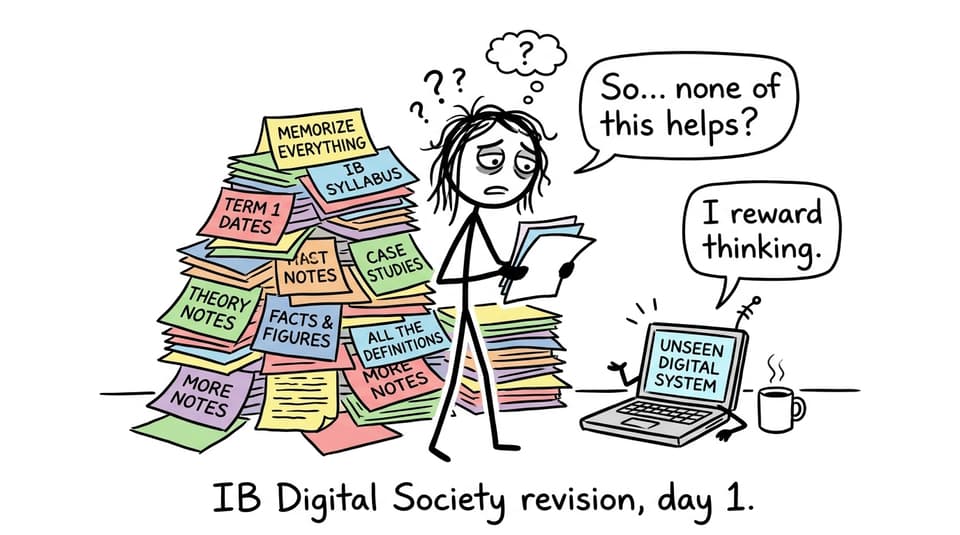
Revising for IB Digital Society can feel like trying to study a moving target.
One week it’s privacy and platforms. The next it’s identity, power, or the way a new algorithm quietly nudges a whole community. You sit down to “memorise content,” and the subject almost laughs back: I’m not asking what you remember. I’m asking what you can notice.
That’s the shift that turns IB Digital Society from stressful to controllable. The best students don’t revise by collecting more facts. They revise by building a repeatable process: concepts first, then application, then exam-style writing under time.
A quick checklist for IB Digital Society revision
Use this as your weekly rhythm for IB Digital Society:
-
Review 2--3 core concepts (in your own words)
-
Apply them to 2 unseen digital systems (short plans, not full essays every time)
-
Drill command terms (answer-shape practice)
-
Write 1 timed response and mark it for structure + evaluation
-
Log mistakes as rules: “Next time, I will…”
If you want one place to run that loop, start with the IB Digital Society hub and use RevisionDojo’s Questionbank, Study Notes, Flashcards, AI Chat, Grading tools, Predicted Papers, Mock Exams, Coursework Library, and Tutors as a single system.
Why IB Digital Society revision is different
In many subjects, more recall equals more marks. In IB Digital Society, recall helps, but it’s rarely the bottleneck.
The exam rewards students who can:
-
Apply concepts to unfamiliar digital systems
-
Analyse impacts on individuals and communities
-
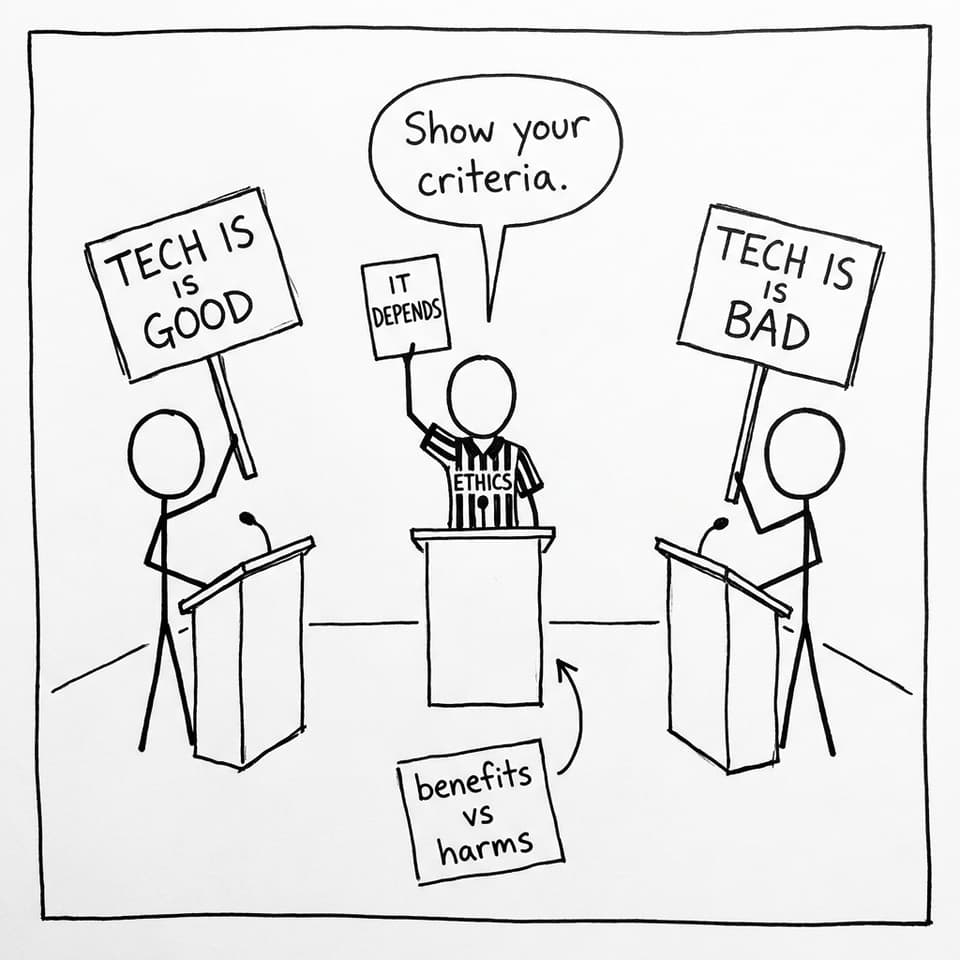
Evaluate ethical and social implications with criteria
-
Follow command terms precisely
So the goal of IB Digital Society revision is not to “learn the perfect example.” It’s to become fluent at thinking on paper.
A useful supporting read when you’re unsure what examiners actually reward is How IB Exams Are Marked (Use It to Your Advantage).
Start with flexible concepts (not fixed examples)
Concepts are your steering wheel in IB Digital Society. They keep you stable when the question uses a digital system you’ve never studied.
Pick a small set (power, ethics, identity, change, systems) and train them like tools:
-
Define the concept in 2 lines, in your own wording
-
Add 3 “shows up when…” clues
-
Practise applying it to multiple contexts
If “change” keeps appearing in your writing but never feels sharp, use Understanding Change in Digital Society: IB Concept Explained as a model of what conceptual precision looks like.
For a structured set of syllabus-aligned materials, move between the subject hub and topic pages like IB Digital Society Topic 3 - Content and IB Digital Society Topic 4 - Contexts. This is where RevisionDojo’s Study Notes and Flashcards become practical, not decorative.
Train with unseen digital systems (the exam’s real skill)
The exam feeling most students dread is simple: I don’t recognise this system.
That moment is exactly what IB Digital Society expects you to handle.
A strong unseen-system routine:
-
Identify the system in one sentence (what it does, for whom)
-
Choose 1--2 concepts that genuinely fit
-
Map impacts at two levels: individual + community
-
End with a judgement (who benefits, who is harmed, and under what conditions)
This is where practice questions matter more than rereading notes. Use the Questionbank feature to do short, frequent sets and get feedback you can actually act on.
If you’re rebuilding your revision workflow overall, RevisionDojo App: The Smarter Way to Prep for IB Exams explains the learn--practice--feedback loop cleanly.
Command terms decide your marks (so drill them like a skill)
Most lost marks in IB Digital Society are not “content gaps.” They’re command-term gaps.
If the question says evaluate and you only explain, you can write a full page and still miss the top band.
A practical drill:
-
Take one command term (evaluate, discuss, examine)
-
Answer 3 different prompts with the same structure
-
Check: did you use criteria, balance, and a justified conclusion?
Use How to Use Command Terms Effectively in IB Exams alongside Structure IB Answers to Maximize Marks. Together, they teach the “shape” examiners reward.
Write in a structure that makes evaluation visible
In IB Digital Society, great thinking can disappear if your writing hides it.
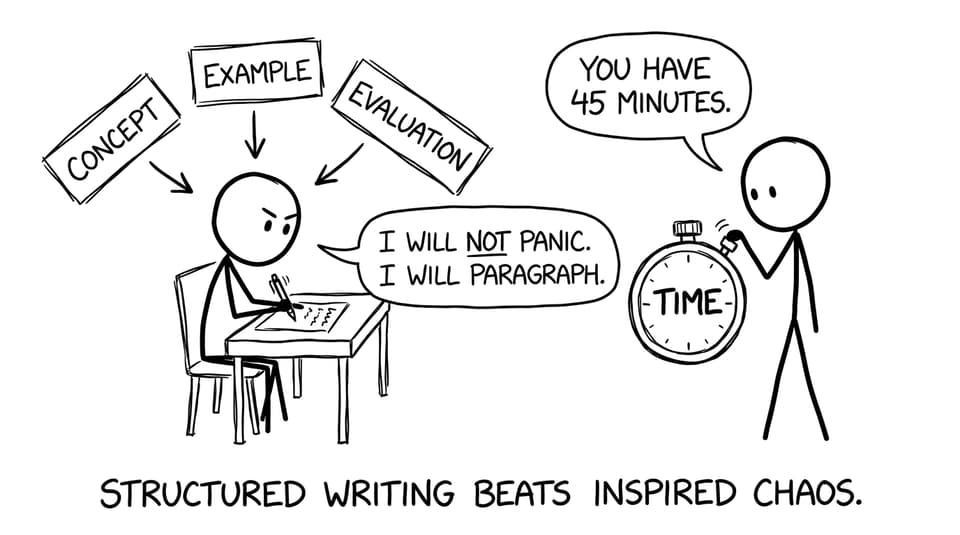
A reliable paragraph pattern:
-
Point: answer the question directly
-
Evidence/example: a specific feature of the system or a real-world reference
-
Analysis: how the concept explains impacts
-
Evaluation: trade-offs, stakeholders, and conditions
-
Link: tie back to the prompt and command term
Timed writing is where this becomes real. RevisionDojo’s Grading tools and AI Chat can help you spot whether your evaluation is actually a judgement, or just another explanation.
If exam stress blocks your comprehension mid-paper, keep IB Exam Panic: What to Do If You Don't Understand bookmarked for a quick reset routine.
Revise ethics as a method, not a topic
Ethics is where IB Digital Society answers either level up or stall.
Instead of memorising “privacy case studies,” build an ethics method:
-
Identify stakeholders (who is affected, who decides)
-
Define the value in tension (privacy vs convenience, innovation vs safety)
-
Weigh benefits and harms (short-term vs long-term)
-
Make a conditional judgement (when is it acceptable, and with what safeguards?)
When ethics feels vague, read Key Themes in IB Digital Society Explained and practise turning each theme into a judgement sentence you could defend.
Closing: make IB Digital Society predictable
The secret to IB Digital Society is that it only feels unpredictable when your revision is built on memorisation.
When you revise with concepts, unseen practice, command-term discipline, and timed structure, the exam stops being a guessing game. It becomes a routine you’ve already rehearsed.
If you want to run that routine without juggling ten tabs, start at the IB Digital Society hub. Use RevisionDojo’s Questionbank for targeted practice, Study Notes and Flashcards for clarity and recall, AI Chat and Grading tools for feedback, and Predicted Papers and Mock Exams to rehearse exam conditions. That’s how IB Digital Society revision turns into calm, repeatable progress.