



Case studies can feel like the safest part of IB Digital Society. You recognise the platform. You’ve seen the headline. You can recite what happened.
Then the exam question arrives and suddenly that safety becomes a trap.
Because IB Digital Society is not a subject that rewards having a “best example.” It rewards doing something with an example: linking it to a concept, weighing consequences, and making a judgment you can defend. The moment you treat case studies like trivia, your answer starts drifting away from the question.
This guide shows you how to use case studies effectively in IB Digital Society for both exams and the Internal Assessment (IA), without over-describing, forcing relevance, or turning your response into a news article summary.

Quick checklist: case studies that earn marks in IB Digital Society
Use this quick filter before you include any example in IB Digital Society:
-
One sentence of context (what system, who uses it, where it operates).
-
One precise detail (a feature, policy, design choice, or documented outcome).
-
One concept lens (power, ethics, change, identity, sustainability, etc.).
-
One impact on people or communities (winners/losers, inclusion/exclusion, harm/benefit).
-
One evaluation move (trade-off, limitation, stakeholder perspective, or condition).
If you can’t reach the evaluation move, the case study is probably just decoration.
What a “case study” actually means in IB Digital Society
In IB Digital Society, a case study is any real or realistic example of a digital system in use: a recommendation algorithm, a content moderation policy, a biometric ID program, a school surveillance tool, a platform design feature.
The important part is not the brand name. It’s the system and its relationship with people.
If you want a solid overview of the course expectations, start with the IB Digital Society resources hub and keep it open as your “home base” while you revise.
Why memorising case studies backfires in IB Digital Society
There’s a quiet pattern that shows up in weaker IB Digital Society answers:
Students memorise a big example, walk into the exam, and then try to “fit” the question to the example. The writing becomes a wrestling match. You can feel it in the paragraph: lots of background, few links to the command term, and a conclusion that feels like it arrived late.
A better mindset is this: IB Digital Society exams often give unfamiliar systems. Your job is to show transferable thinking. That’s why broad revision strategies matter more than collecting endless examples. If you’re unsure what the subject is really assessing, read Common Misconceptions About IB Digital Society Explained.
The “Point -> Proof -> Link -> Judge” method (exams + IA)
Here’s a paragraph structure that keeps case studies useful in IB Digital Society:
Make a point
Start with a claim that answers the question directly. Not “this system is bad” but “this design choice concentrates power by…”
Add proof
Bring in a case study detail as evidence. One or two lines is enough.
Link to a concept
Explain why that detail matters through a course concept. If you need help making concepts connect instead of sitting in separate boxes, use IB Digital Society: How All the Core Concepts Fit Together.
Judge
Offer evaluation: trade-offs, limits, stakeholders, or conditions. This is where top bands live.
This method works because it treats the case study as a tool, not the main character.

How to use case studies in IB Digital Society exams
In exams, your case study use should feel like a well-placed quote, not a biography.
-
Keep the example brief.
-
Use it only where it advances the argument.
-
Make the concept link explicit (don’t assume the examiner will infer it).
A practical habit: underline the command term and ask, “What would ‘evaluate’ require me to weigh?” Then choose an example detail that helps you weigh.
To strengthen exam planning, it’s worth reading IB Digital Society assessment overview: exams and internal assessment and pairing it with timed practice. On RevisionDojo, students typically do this using Questionbank sets, then run a draft paragraph through AI Chat and the Grading tools to see whether their “judge” step is actually present.
How to use case studies in the IB Digital Society IA
The IA in IB Digital Society is essentially sustained case study work: one digital system, analysed carefully, supported by sources, and evaluated through concepts.
The biggest mistake is trying to sound impressive by including multiple unrelated systems. Depth beats breadth almost every time.
To keep your investigation focused:
-
Define your real-world example tightly.
-
Choose sources that give claims and perspectives, not just descriptions.
-
Use the same case study consistently so your evaluation becomes sharper over time.
If you’re still deciding what to investigate, start with How to Write a Strong IB Digital Society IA Research Question and the official-style guidance in the IB Digital Society (DS) Internal Assessment Guide. For exemplars, browse Digital Society IA exemplars and notice how high-scoring work keeps returning to the same system instead of constantly switching examples.
Choosing “high-leverage” case studies for IB Digital Society
A strong IB Digital Society case study has three qualities:
-
A clear system (feature/policy/algorithm), not just a vague topic like “social media.”
-
Visible impacts on people or communities (privacy, access, identity, inequality, participation).
-
A tension worth evaluating (benefit vs harm, efficiency vs rights, innovation vs sustainability).
If your example is overly technical, you’ll often end up explaining how it works instead of analysing what it does socially. If it’s overly abstract, you’ll struggle to show evidence.
To generate ideas, RevisionDojo’s Study Notes and Flashcards inside the IB Digital Society Content topic page help you keep examples mapped to concepts, so you can reuse them across questions.
Linking case studies to concepts (the part markers actually reward)
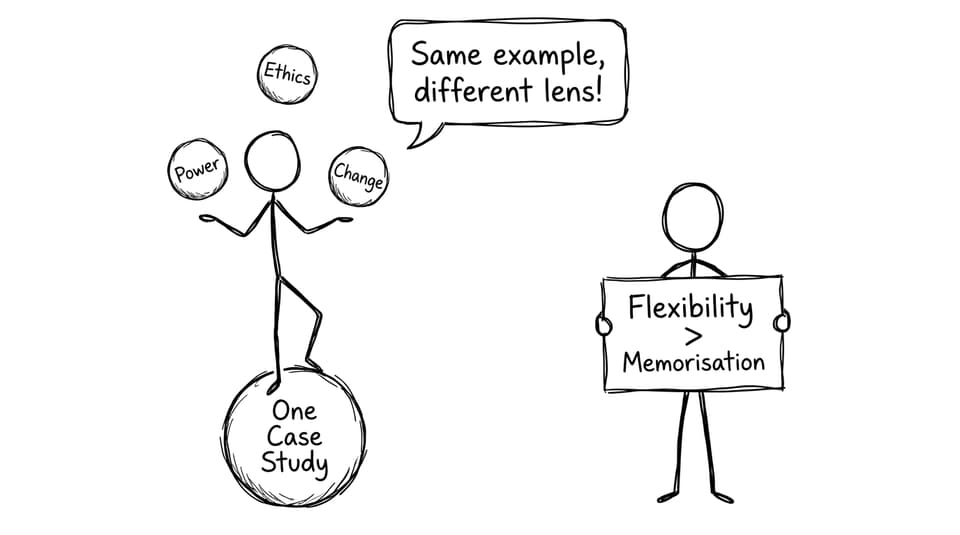
Markers don’t reward the name of the platform. They reward conceptual control in IB Digital Society.
Try these prompts:
-
Power: Who sets the rules, and who can challenge them?
-
Ethics: What values are in conflict, and what responsibilities follow?
-
Change: What shifts over time (behaviour, norms, institutions), and who adapts fastest?
If you want a concept refresher with real course language, Understanding Change in Digital Society: IB concept explained is a strong anchor.
Conclusion: treat case studies like evidence, not content
The easiest way to think about case studies in IB Digital Society is this: they are receipts for your reasoning.
Use fewer examples, but use them with intention. Keep them short. Link them to concepts. Evaluate, even briefly. And stay loyal to the question in front of you, not the example you revised last night.
If you want a simple workflow, build your core examples inside RevisionDojo Study Notes and Flashcards, practise adapting them through Questionbank prompts, then test your evaluation with AI Chat, Grading tools, Predicted Papers, and Mock Exams. That’s how case studies start working for you in IB Digital Society, instead of against you.