

Surveillance rarely announces itself.
It’s usually quieter than that: a “helpful” attendance app, a recommended video that knows your mood, a school Wi-Fi login that remembers where you were last Tuesday. In IB Digital Society, that quietness is the point. If you treat surveillance as only “cameras” or “the government,” you miss how digital systems monitor, predict, and nudge people through everyday data.
This guide shows you how to analyse surveillance in IB Digital Society in an exam-ready way: define it precisely, trace the data, map the power, and evaluate the trade-offs without falling into vague moral statements.
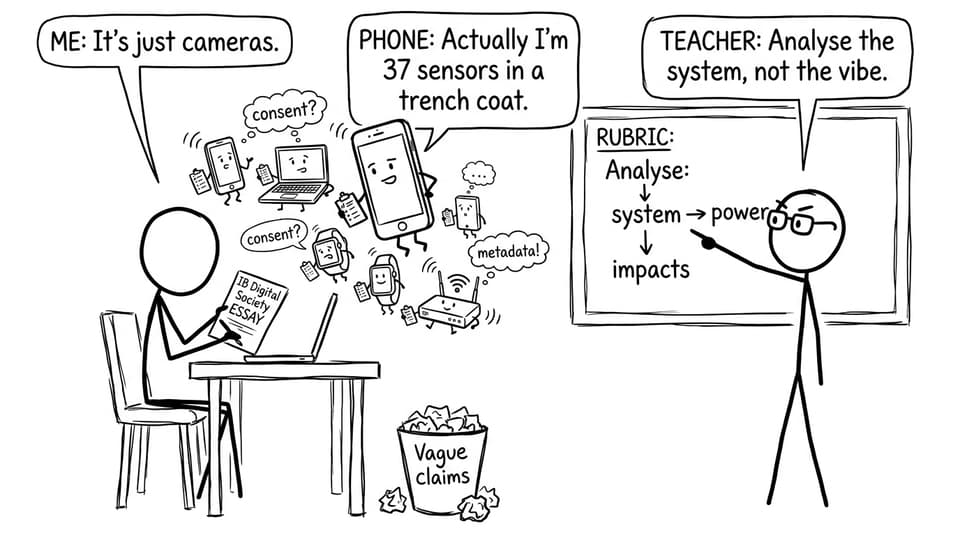
A quick checklist for surveillance analysis (save this)
When a prompt mentions monitoring, tracking, safety, productivity, personalization, or “data collection,” run this IB Digital Society checklist:
-
Define surveillance as systematic monitoring enabled by digital systems.
-
Identify what data is collected (and what it reveals indirectly).
-
Explain how monitoring happens (sensors, logs, algorithms, dashboards).
-
Clarify who controls the system and who is visible inside it.
-
Analyse impacts on individuals (autonomy, behaviour, wellbeing).
-
Analyse impacts on communities (inequality, normalization, chilling effects).
-
Evaluate consent, proportionality, and alternatives.
If you want a clean home base for revision, start with the IB Digital Society Resources hub and build from there.
What surveillance means in IB Digital Society
In IB Digital Society, surveillance is the collection, monitoring, and analysis of data about individuals or groups through digital systems. The key idea is that surveillance is often:
-
Continuous (always-on data trails)
-
Automated (dashboards and alerts, not humans watching all the time)
-
Embedded (built into platforms and infrastructure)
That’s why it helps to link surveillance to nearby concepts like privacy, power, ethics, and systems. If you need the wider map of how ideas connect, use IB Digital Society: How All the Core Concepts Fit Together.
Surveillance is designed into the system (not added later)
A strong IB Digital Society answer starts with the digital system itself. Ask:
-
What features create visibility (logging, biometric scans, geofencing, analytics)?
-
Is the monitoring constant or triggered (only during tests, only in “high-risk” locations)?
-
Is it obvious to users or mostly invisible?
A useful way to deepen your analysis is to treat surveillance like a system component: inputs (data), processes (analysis), outputs (decisions), and feedback loops (nudges, penalties, recommendations). Topic-based practice can help here, such as RevisionDojo’s 2.6 Systems page.
Follow the data: what’s collected, and what it implies
Data is the fuel of surveillance in IB Digital Society. Your job is to move beyond listing data types and show why they matter.
Common surveillance-related data includes:
-
Location (GPS, Wi-Fi triangulation, access logs)
-
Behavioural patterns (clicks, scroll time, keystrokes, watch time)
-
Interaction history (messages, likes, contacts)
-
Biometrics (face, voice, fingerprints)
Then take the next step: what can this data infer? Location can infer routines and relationships. “Time on task” can infer motivation (or pretend to). A face scan can become a persistent identifier across contexts.
To strengthen vocabulary and recall, pair your reading with Digital Society Flashcards and the Study Notes feature.
Surveillance and power: who gets to watch, decide, and challenge?
Surveillance is never just technical. In IB Digital Society, it’s also a story about power.
Ask power questions like:
-
Who owns the system (school, employer, platform, government contractor)?
-
Who can access the data, and under what rules?
-
Who can contest errors, bias, or misuse?
-
Who bears the risk if the system fails?
Power becomes clearer when you notice asymmetry: one side is measured in detail, the other side is mostly opaque. Students are “data subjects” long before they become decision-makers.
If you want a focused applied example, see Digital Surveillance in Schools and Workplaces Explained.
Individual impacts: autonomy, behaviour, and the “chilling effect”
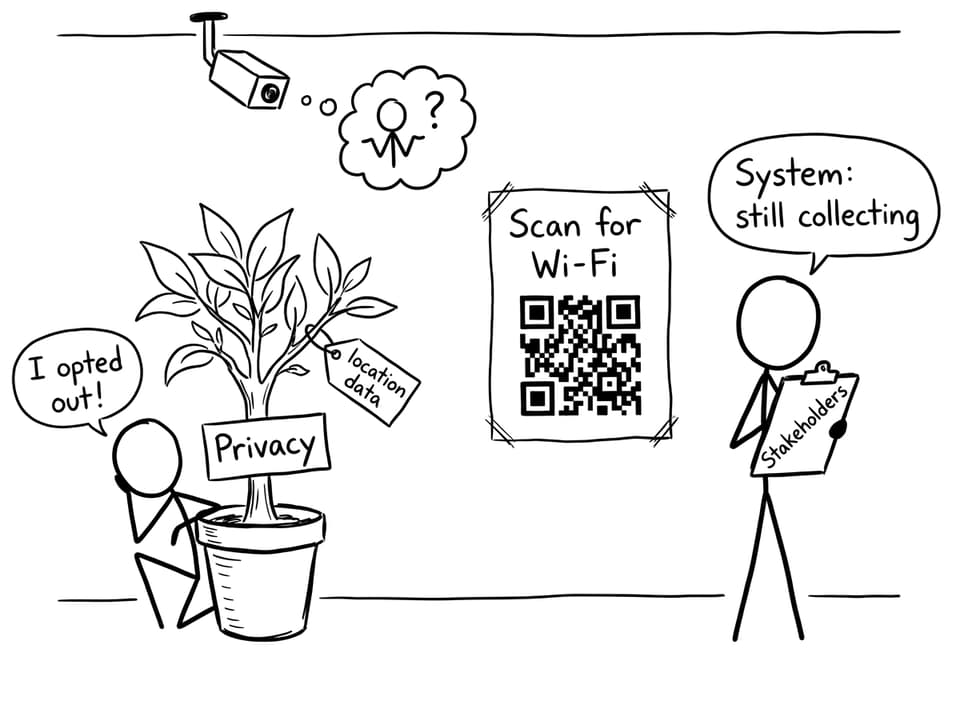
At the individual level, surveillance in IB Digital Society often shows up as behaviour change. Not always because someone is punished, but because being observed reshapes what feels safe to do.
Analyse:
-
Awareness: does the person know they’re monitored?
-
Agency: can they opt out without losing access?
-
Behaviour: do they self-censor, perform productivity, avoid topics?
-
Wellbeing: stress, distrust, and reduced autonomy over time
Make it concrete. “Students may feel anxious” is weaker than “continuous activity tracking can push students to prioritise measurable clicks over deeper learning, narrowing what they attempt.”
Community impacts: inequality, normalization, and who gets targeted
Higher-mark analysis in IB Digital Society includes communities, not just individuals.
Explore effects like:
-
Disproportionate monitoring of certain groups or spaces
-
Normalization of surveillance as “just how life works”
-
Long-term social effects, like reduced participation or trust
Community impacts are where you can discuss fairness and social consequences without turning your answer into a speech. You’re showing mechanisms, stakeholders, and patterns.
Consent, ethics, and the surveillance vs security trade-off
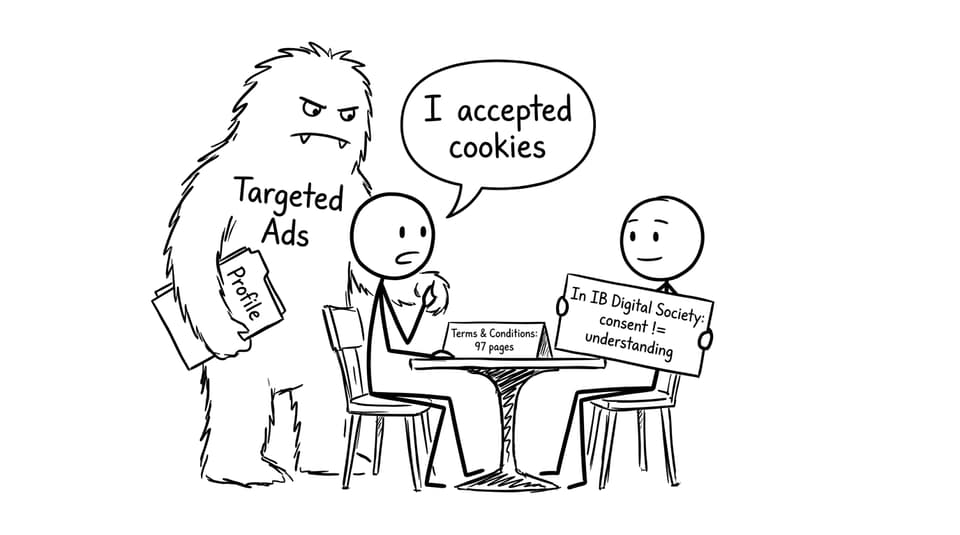
In IB Digital Society, consent is not a magic word that makes surveillance ethical. Evaluate whether consent is:
-
Informed (did users understand what was collected and why?)
-
Freely given (was there a real alternative?)
-
Specific (was it bundled into unrelated permissions?)
-
Revocable (can it be withdrawn later?)
Then evaluate justifications like safety, efficiency, and security:
-
Does surveillance actually achieve the goal?
-
Is it proportionate to the risk?
-
Are less intrusive alternatives available?
If you want a parallel concept lens, compare your reasoning with Understanding Privacy in IB Digital Society: How to Analyse It.
Turning surveillance into exam marks (not just opinions)
Most students lose marks in IB Digital Society by writing as if the examiner is grading their beliefs. Instead, write as if you’re grading the system.
A simple paragraph structure:
-
Define the surveillance in the system.
-
Explain the mechanism (data collected -> analysis -> action).
-
Analyse impacts on individuals and communities.
-
Link to power and ethics.
-
Evaluate using criteria (proportionality, effectiveness, consent, accountability).
Command terms decide the shape of your response. For structure help, use How to Use Command Terms Effectively in IB Exams and Structure IB Answers to Maximize Marks.
For practice, RevisionDojo’s IB Digital Society Questionbank lets you drill surveillance-style prompts with feedback, then lock definitions with flashcards and fix weak paragraphs using AI Chat.
Conclusion: learn to see the invisible rules
Surveillance in IB Digital Society is best understood as systematic monitoring built into digital systems through data collection and automated analysis. When you follow the data, map the power, and evaluate consent and proportionality, you stop writing opinions and start writing analysis.
To turn this into reliable exam performance, build a simple loop: revise key definitions with Study Notes and Flashcards, practise unseen prompts in the Questionbank, use AI Chat to fix one misconception at a time, and test stamina with Mock Exams and Predicted Papers. Start at the IB Digital Society Resources hub and make surveillance one of your strongest, most reusable concepts.

