

The night before a draft is due, most students don’t panic because they have no ideas. They panic because their ideas don’t line up. The evidence sits in one document, the concepts in another, and the argument is somewhere in their head.
In IB Digital Society, that “almost there” feeling is usually a structure problem. Examiners aren’t marking a scrapbook of interesting points about technology. They’re marking a focused inquiry into a digital system and what it does to people and communities. A clean IB Digital Society IA structure turns good thinking into visible marks.
If you want a quick refresher on the course itself before you write, start with the IB Digital Society resources hub.
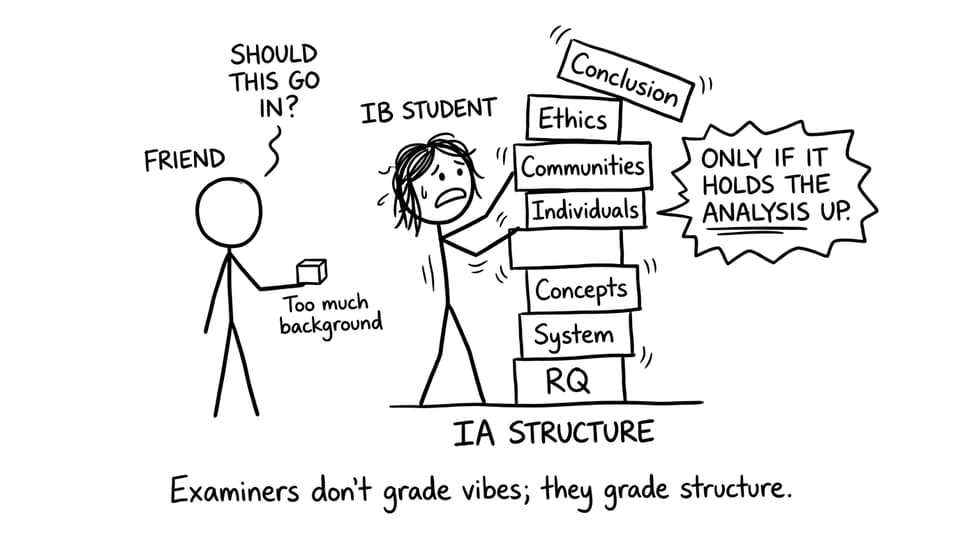
IB Digital Society IA structure: the examiner’s checklist
Use this as your planning spine. A strong IB Digital Society IA usually makes these elements easy to spot:
-
A precise research question (RQ) that invites analysis and evaluation
-
One clearly defined digital system (not “social media” in general)
-
Concepts used consistently, with depth (not a concept name-drop)
-
Evidence that is explained, not dumped
-
Separate impacts on individuals vs communities
-
Evaluation of implications and ethics that feels integrated
-
A conclusion that directly answers the RQ (no new ideas)
For help locking in the RQ early, use How to Write a Strong IB Digital Society IA Research Question.
Why structure matters in IB Digital Society
Examiners can only reward what they can clearly see. In IB Digital Society, structure is how you make three things unmistakable:
-
Focus: you stayed on one digital system and one inquiry direction.
-
Conceptual thinking: concepts are doing work inside your paragraphs.
-
Judgment: evaluation is justified, balanced, and based on your analysis.
A messy structure often creates a specific failure mode: you end up describing how the system works, then listing impacts, then tacking on ethics at the end. It reads like three different projects. Your goal is one continuous investigation.
Introduction: set up the inquiry, not a history lesson
The best IB Digital Society introductions are short and purposeful. Examiners want to find your investigation quickly.
Include:
-
Your research question in one sentence
-
The digital system you’re investigating (specific feature, policy, workflow, algorithm, tool)
-
Why it matters (significance in the real world, not “because I use it”)
-
The stakeholders: at least two groups affected in different ways
Avoid long background sections. Save detail for when it directly supports analysis.
If you’re unsure what counts as a strong inquiry stance, Inquiry in IB Digital Society, Explained Simply is a useful reset.
Digital system description: explain only what you will analyze
This section is your “reader onboarding.” It’s not where you try to earn marks through technical depth.
A strong system description:
-
Explains the core mechanism in plain, accurate language
-
Names key inputs/outputs (data in, decisions out)
-
Defines any terms the reader must understand
-
Stays tightly connected to your RQ
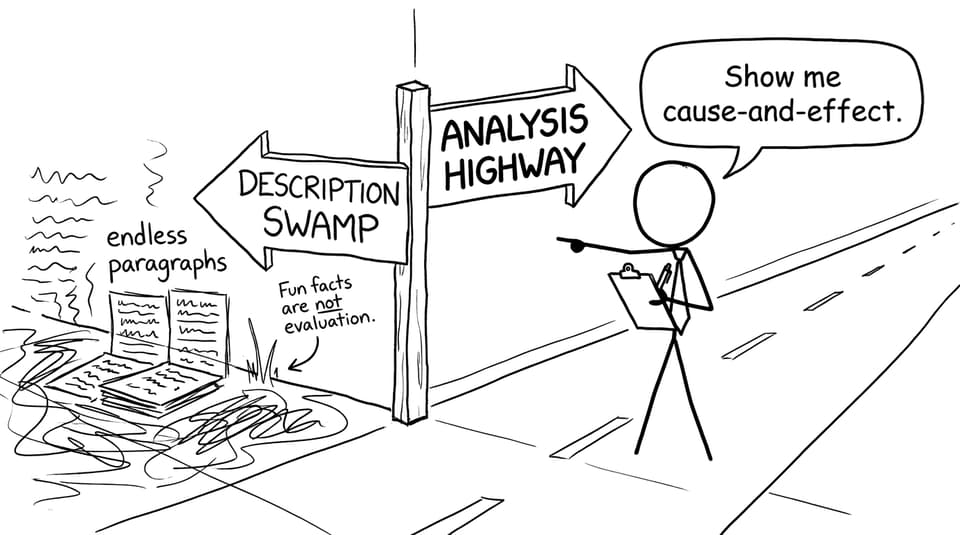
A common IB Digital Society trap: writing two pages of system explanation and then running out of space for the analysis that actually earns marks.
Conceptual framework: fewer concepts, used better
In IB Digital Society, concepts are lenses. The examiner isn’t counting how many you mention. They’re looking for whether your concept use is consistent and insightful.
Practical rules:
-
Choose 1--2 main concepts that naturally fit your system and RQ
-
Define them briefly in your own words (clear, not over-quoted)
-
Apply them repeatedly to evidence (concepts should guide interpretation)
If “power” is central to your system, Power and Control in Digital Systems shows how to turn a concept into a repeatable analysis method.
Impacts on individuals: show cause-and-effect, not a list
This section is where many IB Digital Society IAs start sounding strong. But to score well, don’t just name outcomes (stress, addiction, convenience, misinformation). Explain the chain.
A high-scoring paragraph often looks like:
-
System feature/process
-
Evidence/example
-
Cause-and-effect explanation
-
Concept lens (what does this reveal about identity, power, systems, change, values?)
-
Small, careful judgment (why this matters)
To strengthen how you integrate sources, read Using Evidence Effectively in the IB Digital Society IA.
Impacts on communities: the marks are often hiding here
Community-level analysis is where examiners can clearly see maturity. In IB Digital Society, “community” doesn’t mean “lots of individuals.” It means groups with shared conditions: access, representation, regulation, culture, geography, or power.
Do this well by:
-
Naming specific communities (students in a district, gig workers in a city, minority language users, small businesses)
-
Showing uneven impacts (who benefits, who is excluded, who pays the cost)
-
Connecting impacts to systems of power and access
If you need broader lenses for community impacts, IB Digital Society: Key Themes Explained helps you build stronger lines of argument.
Evaluation and ethics: a thread through the whole IB Digital Society IA structure
Evaluation is not “technology is bad” or “this should be illegal.” In IB Digital Society, evaluation means weighing trade-offs and reaching a justified judgment.
Strong evaluation typically:
-
Balances benefits vs harms using your evidence
-
Recognizes uncertainty and limitations
-
Addresses ethical tensions (consent, privacy, bias, autonomy, accountability)
-
Suggests realistic interventions or safeguards (when relevant)

Conclusion: answer the research question directly
Your conclusion should feel inevitable. In IB Digital Society, you’re not summarizing everything you learned. You’re answering the RQ with a reasoned judgment.
Include:
-
The clearest 2--4 findings (tied to your concepts)
-
Your final evaluation (what matters most, and why)
-
A brief nod to limitations (only if it strengthens credibility)
Common structural mistakes (and fast fixes)
-
Too much background: cut anything that doesn’t feed analysis.
-
Concept dumping: pick fewer concepts and apply them more.
-
No community section: explicitly separate individual vs community impacts.
-
Ethics at the end only: weave ethical reasoning into impacts and evaluation.
For a broader IA framework beyond IB Digital Society, the IB IA Guides hub is a solid reference point.
How RevisionDojo helps you build a stronger IB Digital Society IA
Structure gets easier when your tools keep you honest. RevisionDojo supports the full IB Digital Society workflow:
-
Use Study Notes and Flashcards to keep concepts sharp: IB Digital Society Revision Notes
-
Build exam-ready thinking with the Questionbank: Questionbank feature page
-
Use AI Chat to pressure-test whether a paragraph is analysis or description
-
Use Grading tools to check rubric alignment and clarity
-
Use Mock Exams and Predicted Papers to stay exam-ready while your IA runs in the background
-
Use the Coursework Library to see what “good structure” looks like across subjects
-
Use Tutors when you want human feedback on scope, argument flow, and evaluation
If you’re still choosing a system, How to Choose a Strong IB Digital Society IA Topic can save you weeks.
FAQ
What exactly do examiners look for in an IB Digital Society IA structure?
Examiners look for a coherent inquiry where every section helps answer the research question. In IB Digital Society, that means your digital system is clearly defined and your analysis stays tied to people and communities. They also look for concept-driven writing, where concepts act like lenses rather than decorative vocabulary. A strong structure makes it obvious where description ends and analysis begins. It also makes evaluation feel earned because it grows out of evidence and reasoning. Finally, examiners reward clarity: the easier your argument is to follow, the easier it is to award marks.
How do I stop my IB Digital Society IA from becoming too descriptive?
Start by labeling each paragraph draft with one word: “describe,” “analyze,” or “evaluate.” If too many paragraphs are “describe,” you’ve found the problem quickly. Then, add a cause-and-effect sentence after every key fact: “This leads to…” or “This changes behavior because…”. In IB Digital Society, description is only useful when it sets up a mechanism you can interpret using concepts. Another fix is to reduce your system explanation to only the parts you actually use later. Lastly, use evidence like a lever: present it briefly, then spend more words explaining what it means for stakeholders.
Do I need a separate ethics section in IB Digital Society?
You can include one, but ethics should not live only in a single late paragraph. In IB Digital Society, ethical reasoning is strongest when it is connected to specific system features and real impacts. For example, privacy concerns become sharper when you show what data is collected, who accesses it, and what decisions it influences. A dedicated evaluation section can help you weigh trade-offs cleanly, but your earlier sections should already be making ethical tensions visible. Examiners respond well when you acknowledge uncertainty and avoid moral panic. The goal is reasoned judgment, not dramatic language.
A final reminder on IB Digital Society IA structure
A strong IB Digital Society IA structure is less about fancy headings and more about a disciplined journey: system --> concept --> evidence --> impacts --> evaluation --> conclusion. When that chain is clear, examiners can see your thinking and reward it.
Build your draft with the IB Digital Society hub open, check your concept clarity with RevisionDojo’s Study Notes, test your understanding with the Questionbank, and use AI Chat plus Grading tools to turn a messy draft into a readable investigation. When you’re ready to go from “interesting” to “high-scoring,” RevisionDojo is the most reliable place to do it.