


In IB Geography, the Water-Food-Energy nexus can feel like one of those concepts that sounds obvious… until you try to explain it under exam pressure.
Picture a city during a heatwave. Reservoirs drop, electricity demand spikes (air conditioning), and food prices rise because farms need more irrigation while transport costs climb. Nothing “fails” in isolation. That’s the point. The nexus is the story of three systems tugging on the same rope.
What is the Water-Food-Energy nexus in IB Geography?
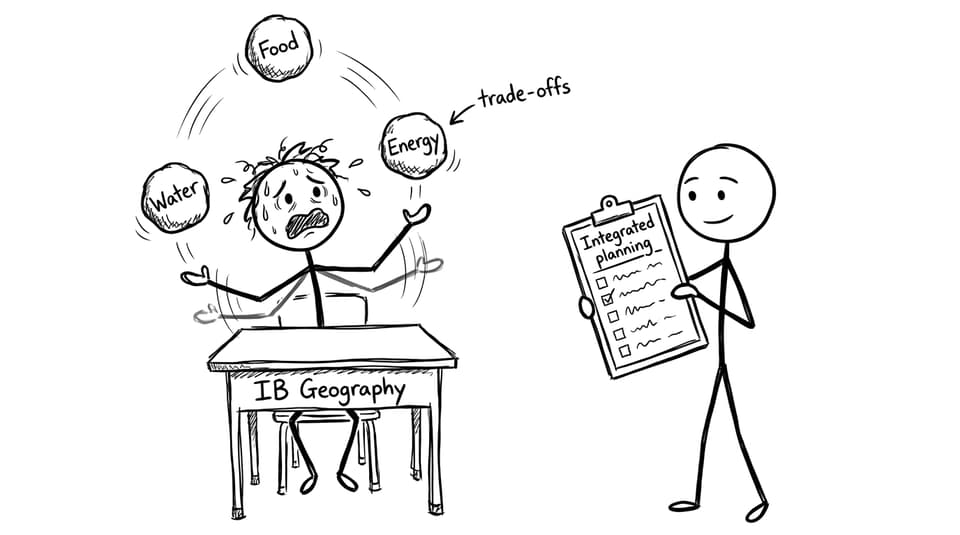
The Water-Food-Energy (WFE) nexus is the idea that water security, food security, and energy security are interconnected. Decisions in one system often create impacts (and trade-offs) in the other two.
In IB Geography, this sits inside Global Resource Consumption and Security, and it’s a handy framework for writing essays that move beyond single-cause explanations.
If you want the syllabus-aligned version, start with RevisionDojo’s IB Geography WFE nexus notes and then build speed with the matching WFE nexus Questionbank.
A quick checklist (exam-ready)
Use this mini-checklist whenever a question hints at interconnected resources:
-
Define the Water-Food-Energy nexus clearly (one sentence).
-
Explain two links between the three systems.
-
Identify one trade-off (a “solution” that creates a new problem).
-
Add one place-specific example (a country, region, or sector).
-
Finish with evaluation: who benefits, who loses, and what changes under climate stress.
For overall topic context, see Global Resource Consumption and Security and the companion unit notes.
Water connects to food and energy (more than you think)
Water is the silent input behind both food and energy.
Agriculture is a major freshwater user because irrigation stabilises yields. When water becomes scarce, food supply tightens, prices rise, and imports increase. At the same time, energy systems often need water: hydropower relies on river flow, and many thermal power stations require cooling water.
This is why IB Geography questions on water scarcity can quickly become nexus questions. A good extension read is how water scarcity affects people and ecosystems (linking physical scarcity to human impacts).
Food depends on energy (and that shapes security)
Food is not just “grown.” It’s manufactured by a long chain that depends on energy.
Energy powers fertiliser production, machinery, irrigation pumps, refrigeration, processing, and transport. So energy price shocks can become food affordability shocks. In IB Geography, that’s an excellent line of reasoning for evaluation: food insecurity isn’t only about droughts; it can be about fuel costs, infrastructure, and trade.
To connect this to wider patterns, RevisionDojo’s post on global patterns of resource consumption can help you frame how HIC/MIC/LIC consumption influences insecurity elsewhere.
Energy can compete with food (and intensify water pressure)
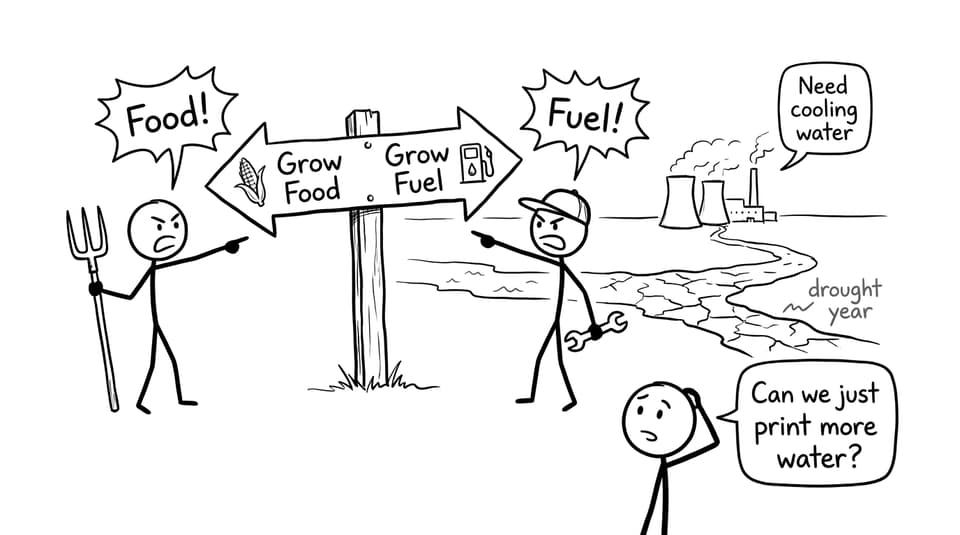
Some energy pathways directly compete with food systems. Biofuels link energy to cropland and irrigation demand. When land is limited (or water is already stressed), expanding fuel crops can push up food prices or displace food production.
Even without biofuels, energy can strain water: thermal plants can increase local freshwater withdrawals, especially in hot, dry periods when cooling needs rise. The nexus becomes sharper under climate change, which is why 3.2.2 Climate change and the nexus is worth revising alongside the core concept.
How to write it in an IB Geography exam (fast and clear)
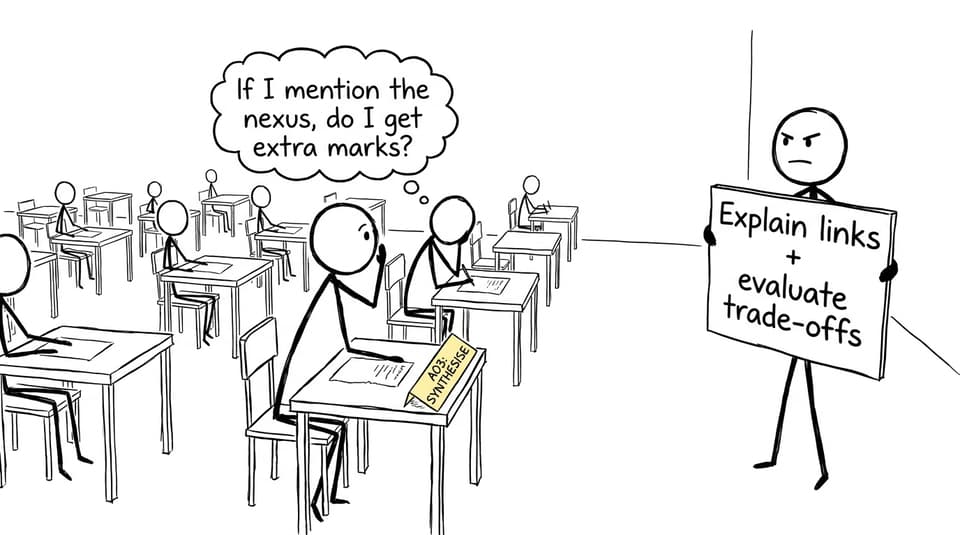
A high-scoring IB Geography response usually does three things:
-
Shows interdependence (one change ripples outward).
-
Uses a trade-off (a policy helps one sector but harms another).
-
Evaluates (stakeholders, scale, and sustainability over time).
RevisionDojo helps you practise this in a structured way: use the IB Geography resources hub to move from Study Notes to Flashcards, then test yourself with timed questions. If you want rapid retrieval, the IB Geography Flashcards are built for active recall.
Conclusion: make IB Geography feel connected
The Water-Food-Energy nexus is valuable in IB Geography because it trains you to think like a decision-maker: every solution changes the system.
If you want to turn that insight into exam marks, use RevisionDojo to go from understanding to execution: Study Notes for clarity, Flashcards for recall, Questionbank for exam practice, and tools like AI Chat, Grading tools, Mock Exams, Predicted Papers, and Tutors to sharpen evaluation. The nexus rewards connected thinking. Your revision should work the same way.