


Quality problems rarely arrive with fireworks. They arrive quietly: a late delivery, a confusing instruction, a customer who never comes back.
In IB Business Management, quality assurance isn’t just a definition to memorize. It’s a way of thinking that turns “we hope this works” into “this will work again tomorrow.” If you’re revising operations, understanding quality assurance gives you a clean way to explain consistency, cost control, and customer loyalty; all in one story.
What is quality assurance in IB Business Management?
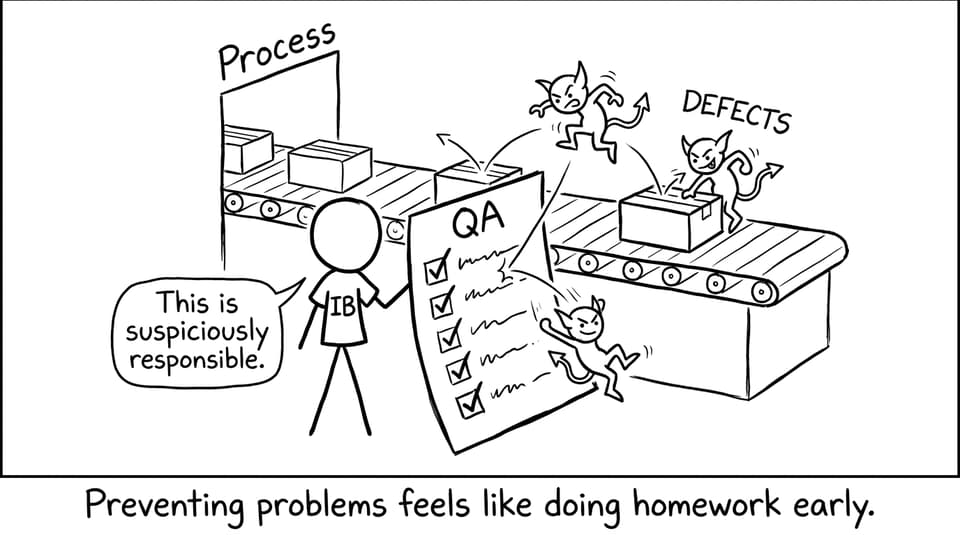
Quality assurance (QA) is a system of processes designed to make sure products or services meet consistent standards before they reach customers. The key idea is prevention: QA builds quality into the process rather than hunting for mistakes at the end.
This fits neatly inside Unit 5 (operations). If you want the syllabus-aligned version, anchor your notes to Quality Control vs. Quality Assurance (5.3.4) and the wider context in Lean production and quality management notes.
Quick exam checklist: what QA actually includes
Use this as a fast structure for a 4-marker or as a paragraph plan in longer responses:
-
Standardized procedures (clear methods, consistent steps)
-
Training so staff can follow the standard reliably
-
Monitoring and review of processes (spot weaknesses early)
-
Continuous improvement (small fixes that compound over time)
-
Documented standards (helps scale quality across sites)
For more operations framing, revise from IB Business Management revision notes.
Quality assurance vs quality control (don’t lose easy marks)
A common exam slip is mixing up QA and QC.
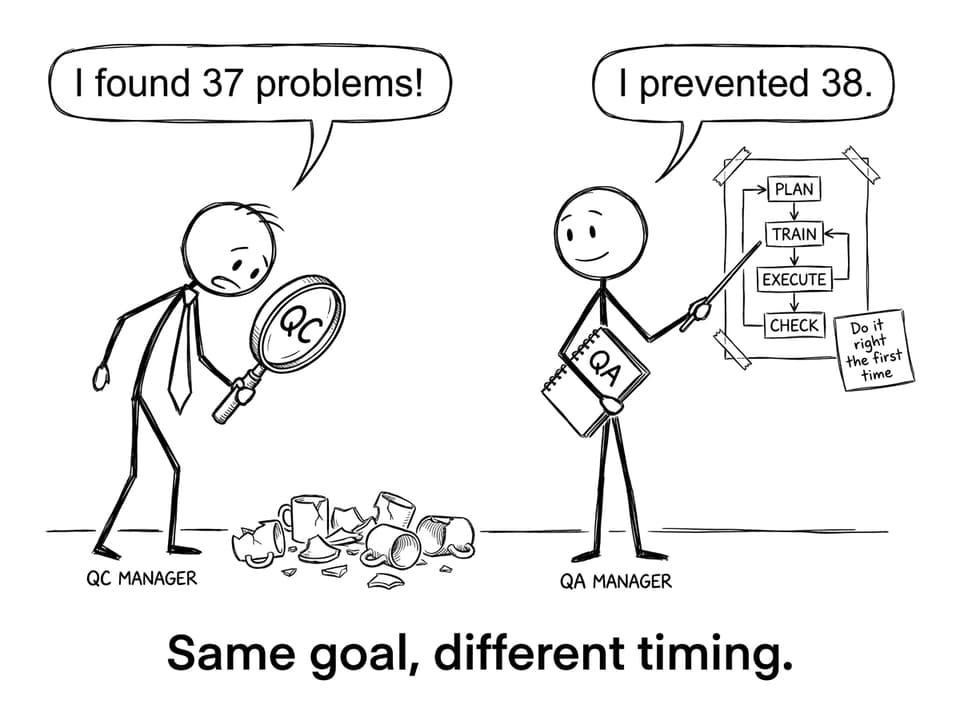
Quality control (QC) is detection: checking outputs and finding defects after production (or during). Quality assurance is prevention: designing processes so defects are less likely in the first place.
In IB Business Management, the best answers often link this difference to consequences: QA reduces rework and returns because problems are prevented; QC can still be necessary, but it’s often more expensive when defects are already “real.” For extra practice applying these definitions, build timed sets from the Unit 5 Operations Management Questionbank.
How quality assurance helps businesses maintain high standards
Quality assurance helps businesses maintain high standards because it makes quality repeatable, not accidental.
Prevention reduces cost and waste
Preventing mistakes is usually cheaper than fixing them. QA reduces scrap, returns, repairs, and downtime. In IB Business Management, you can translate that into a simple chain: QA improves efficiency; efficiency lowers unit costs; lower costs can improve profit margins or allow competitive pricing.
Consistency builds customer trust
Customers don’t praise a business for being good once. They return when it’s reliably good. QA supports consistent outputs because consistent processes produce consistent results. In exam terms, QA strengthens brand reputation and can increase loyalty.
Continuous improvement keeps firms competitive
QA encourages regular review, which supports continuous improvement (often linked to ideas like TQM in your wider topic). Small changes add up: fewer errors, faster workflows, clearer training, better teamwork.
Compliance and standards become easier
Some industries require strict standards. QA makes compliance more achievable because documentation, training, and standardized procedures reduce risk. That matters in case studies where legal issues, safety, or stakeholder trust show up.
How to write this in an IB-style answer
When you see QA in a case study, aim for this structure:
-
Define quality assurance clearly (prevention, process-focused)
-
Apply to the business context (what process could be standardized?)
-
Analyze impact (costs, consistency, reputation, efficiency)
-
Evaluate if needed (trade-offs like training cost or slower short-term output)
To tighten exam technique across topics, keep IB Business Management: Maximize Your Exam Score bookmarked.
Conclusion: QA is a mindset, not a buzzword
Quality assurance in IB Business Management is about building systems that make good outcomes predictable. Prevention, consistency, continuous improvement, and compliance all flow from that one idea.
If you want to lock this topic in quickly, use RevisionDojo as your operations home base: start with the Study Notes, drill with the Questionbank, review with Flashcards, ask AI Chat when you’re stuck, and level up with Mock Exams and Predicted Papers; plus Grading tools, a Coursework Library, and Tutors when you want feedback that actually changes your next attempt.


