



A quiet question that saves companies millions
A finance director once described big decisions like this: “It’s not the price tag that scares me. It’s the years attached to it.” A new factory, a product launch, a fleet of delivery vans; these aren’t one-week experiments. They’re long commitments, made with imperfect information.
That’s exactly why IB Business Management spends time on investment appraisal. It’s the set of tools businesses use to judge whether a major investment is financially worthwhile, using forecasts of costs, cash flows, risk, and return.

If you want the syllabus-aligned view, start with 3.8 Investment Appraisal and keep this article as the “why it matters” layer for exam answers.
Investment appraisal in IB Business Management (quick checklist)
Use this checklist when you see a case study investment:
-
Define investment appraisal clearly (evaluation of financial viability).
-
Identify likely methods: payback, ARR, and (HL) NPV.
-
Link to business aims: growth, profit, survival, risk reduction.
-
Comment on cash flow timing and liquidity pressure.
-
Mention uncertainty and assumptions in forecasts.
For key terms you can quote cleanly in responses, use the IB Business Management glossary.
Why businesses use investment appraisal before major decisions
It reduces risk when the numbers are large
When investments are expensive, a small forecasting error can become a big real-world problem. Investment appraisal makes managers slow down and test the decision. In IB Business Management, this often becomes your evaluation point: the method is “more objective” than intuition, but still depends on estimates.
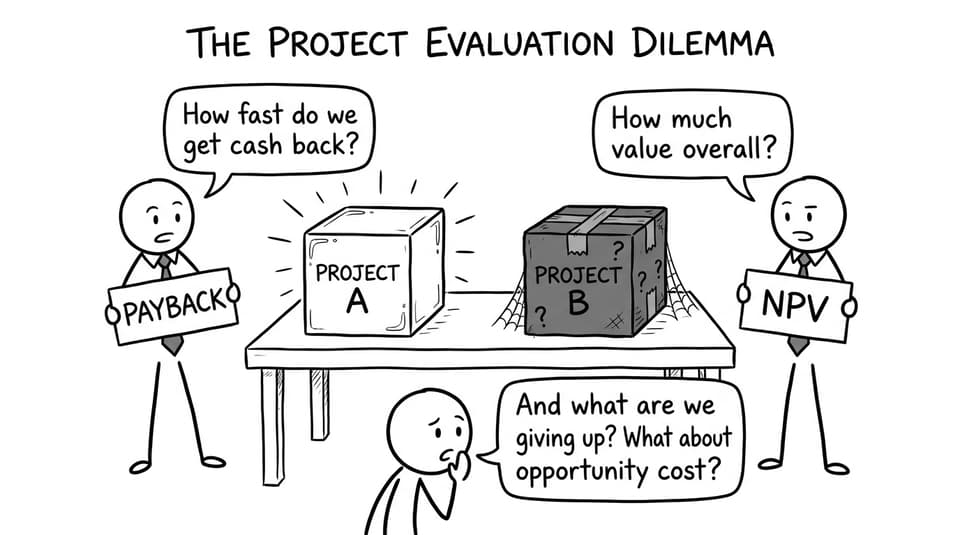
The most common “risk-first” method is payback period: how quickly cash inflows recover the initial cost. Fast payback often means lower exposure if demand drops or costs rise.
To revise the techniques properly, see Investment Appraisal Techniques (3.8.1) notes.
It helps compare alternatives when capital is limited
Most firms don’t choose between “invest” and “don’t invest.” They choose between competing projects. Investment appraisal creates a shared language for that comparison: speed (payback), profitability (ARR), and value added over time (NPV).
That comparison is where opportunity cost lives. Picking Project A means you can’t fund Project B. In IB Business Management, naming the opportunity cost explicitly is a high-quality analysis move.
It improves long-term planning (not just short-term profit)
A project can look attractive early and disappointing later, or the reverse. Investment appraisal forces the business to map the whole lifespan of an investment, which supports better capacity planning, staffing, and marketing decisions.
This is also where you connect to broader finance topics in IB Business Management. Investment decisions affect liquidity, debt levels, and future flexibility. If you need the wider context, use IB Business Management Unit 3: Financial Management.
It clarifies cash flow timing (the real stress test)
Profit is an opinion until cash arrives. Many investments fail not because they’re unprofitable long-term, but because they create a short-term cash squeeze.
That’s why businesses use investment appraisal alongside cash flow forecasting. If you want to tighten this link in your exam answers, revise 3.1 Introduction to Finance and the role finance plays in protecting stability.
It supports responsible, evidence-based decisions
In large businesses, managers often need approval from senior leaders, investors, or lenders. Investment appraisal gives a defendable trail: assumptions, calculations, and reasoning. Even if the project is rejected, the process builds learning for the next proposal.
For formula support (especially useful under time pressure), keep the Business Management Data Booklet bookmarked.
Where NPV fits (HL only) and why it feels “more real”
NPV discounts future cash flows back to today, reflecting the time value of money. In simple terms: money now can be reinvested, while money later arrives with uncertainty.

In IB Business Management, you’ll often evaluate NPV as the most complete method because it uses all cash flows and timing. But you should also mention limitations: forecasts can be wrong, discount rates are assumptions, and qualitative factors still matter.
To revise the method directly, use Net Present Value (3.8.2) notes. For an exam-style argument, read Why businesses prefer NPV over other methods.
Bring it home: how to turn this into marks
Investment appraisal is more than a calculation. It’s a story about risk, timing, limited resources, and opportunity cost, exactly the kind of story IB Business Management examiners want you to explain clearly.
To practise turning methods into full responses, use the 3.8 Investment Appraisal Questionbank and explore the wider IB Business Management resources hub. RevisionDojo’s Questionbank, Study Notes, Flashcards, AI Chat, Grading tools, Predicted Papers, Mock Exams, Coursework Library, and Tutors are designed to help you move from “I get the formula” to “I can explain the decision.”