



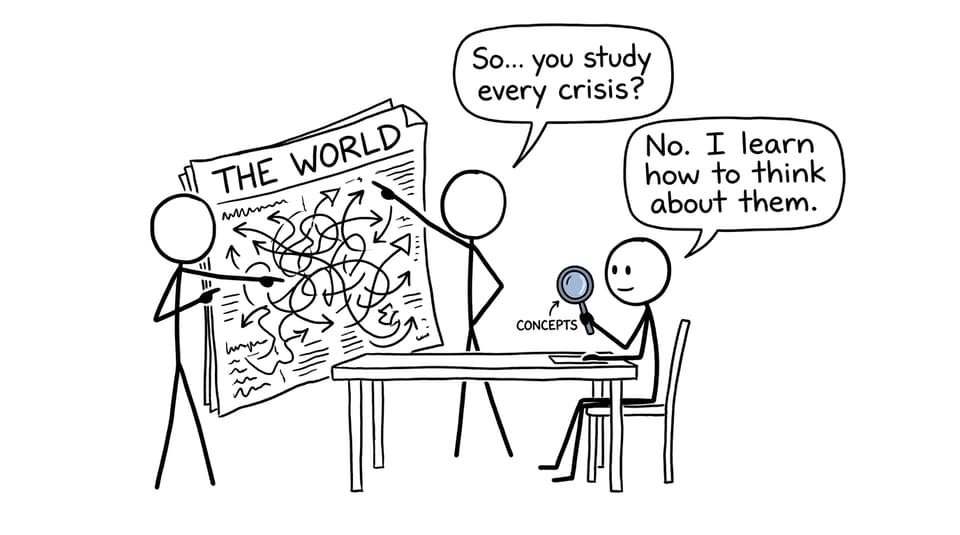
A subject called Global Politics can sound impossibly large. Parents may picture a teenager memorizing every election, conflict, treaty, and international organization while the news changes faster than any textbook can keep up.
The reality is more manageable. IB Global Politics teaches students how to analyze power, political systems, contemporary issues, and competing perspectives. Students study concepts, apply them to real situations, evaluate evidence, and construct reasoned arguments. They are not expected to know everything happening everywhere.
For parents asking what is IB Global Politics like, the simplest answer is this: it is a current, discussion-rich Group 3 subject that combines political theory, real-world examples, source analysis, research, and essay writing. It suits curious students who enjoy asking why institutions behave as they do, whose interests are represented, and whether proposed solutions would actually work.
IB Global Politics at a glance
Here is the overview most IB Diploma parents need first:
- Subject group: Group 3, Individuals and Societies
- Available levels: Standard Level (SL) and Higher Level (HL)
- Central focus: Power and political activity at local, national, international, and global levels
- Shared areas: Understanding power and global politics, rights and justice, development and sustainability, and peace and conflict
- Practical component: An engagement project completed by both SL and HL students
- Main skills: Source analysis, conceptual thinking, research, evaluation, essay writing, and consideration of multiple perspectives
- Additional HL demand: Independent case-study research into global political challenges and an additional examination paper
The current course, first assessed in 2026, recommends 150 teaching hours at SL and 240 at HL. That difference matters. HL is not simply the same class with a few extra readings; it creates substantially more room for independent inquiry, case studies, and assessment preparation.
What students actually study
Global Politics begins with ideas that help students make sense of events rather than merely collect them. The core examines concepts such as power, sovereignty, legitimacy, and interdependence. Students might consider why citizens accept an institution's authority, how globalization affects state sovereignty, or why governments cooperate in one situation but resist cooperation in another.
Those concepts are then connected to three thematic studies:
- Rights and justice: How rights are defined, protected, contested, and experienced by different groups
- Development and sustainability: What development means, how it is measured, and why economic, social, and environmental goals may conflict
- Peace and conflict: Why conflicts emerge, how violence takes different forms, and what makes peacebuilding effective or fragile
A classroom may move between theory, a news report, a historical comparison, a chart, and a contemporary case. The point is not to reward the student with the strongest political opinion. It is to reward the student who can define ideas accurately, select relevant evidence, recognize limitations, and reach a defensible judgment.
Parents who want to see the actual breadth of the subject can preview RevisionDojo's IB Global Politics revision notes. The topic structure gives a clearer picture than the subject name alone.
What lessons tend to feel like
The experience varies by school and teacher, but strong Global Politics lessons usually involve more discussion and interpretation than simple note-taking. Students may compare sources, test a claim against evidence, identify stakeholder perspectives, or use a political concept to explain a real situation.
That makes the course lively, but it also creates a subtle challenge. A student can sound informed in conversation without yet producing a precise examination response. Classroom confidence and assessed performance are not identical.
Written work requires discipline. Students must answer the exact command term, develop a coherent line of reasoning, and connect claims to carefully chosen examples. Saying that an issue is “complex” is only the beginning. The student must explain what creates the complexity and how it affects the judgment.
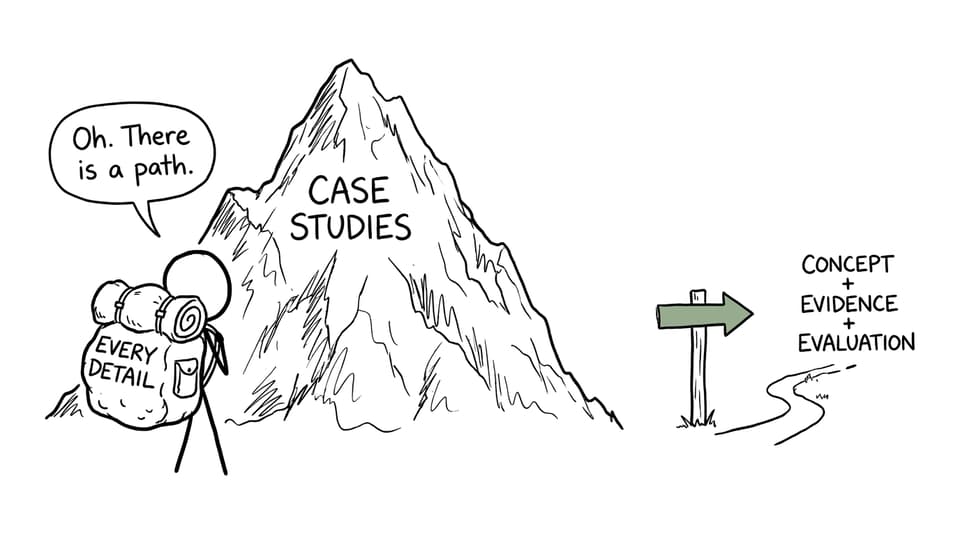
The subject is therefore less about memorizing headlines than learning a repeatable analytical process:
- Identify the political question.
- Define the relevant concept.
- Examine actors, interests, and power relationships.
- Apply specific evidence.
- consider competing interpretations.
- Reach a qualified conclusion.
For students building these habits, RevisionDojo's guide to effective Global Politics revision explains how to organize concepts, cases, and examination skills without turning revision into endless rereading.
How SL and HL differ
SL and HL students study the same common core and thematic studies. Both complete an engagement project, sit Paper 1, and sit Paper 2. The distinction is depth, independent research, teaching time, and the extra HL assessment.
| Feature | SL | HL |
|---|---|---|
| Recommended teaching time | 150 hours | 240 hours |
| Common core and themes | Yes | Yes |
| Engagement project | Yes | Yes, with additional HL expectations |
| Paper 1 | 30% | 20% |
| Paper 2 | 40% | 30% |
| Paper 3 | Not applicable | 30% |
| Engagement project | 30% | 20% |
At HL, students conduct extended inquiries using independently researched cases connected to global political challenges. Paper 3 asks them to work with stimulus material and draw upon that case-study knowledge. This rewards students who can organize evidence flexibly rather than memorize one prepared response.
The choice between IB HL and SL subjects should therefore reflect the student's interests, writing confidence, workload, and willingness to maintain a case-study bank. The Global Politics SL and HL comparison offers a useful starting point, although families should always confirm course arrangements with their own school.
What assessment actually demands
Paper 1 is source-based and lasts 1 hour 15 minutes for both levels. Students answer structured questions using the sources and their own knowledge of the course core. Sources may take forms such as written extracts, images, diagrams, or infographics. The challenge is to read purposefully, compare material, and apply concepts under time pressure. RevisionDojo's Paper 1 preparation guide previews the skills involved.
Paper 2 lasts 1 hour 45 minutes at both levels. It uses extended responses based on the thematic studies. Students answer one question focused on a thematic study and one integrating question that requires connections across themes and core ideas. The Paper 2 essay guide shows why argument structure, examples, counterclaims, and evaluation matter.
HL students also sit Paper 3, a 1 hour 30 minute stimulus-based assessment connected to the HL extension. They must use researched cases thoughtfully, which is why leaving case-study organization until the final weeks is risky.
Both levels complete an engagement project. This is a written report about a political issue explored through active engagement and research. The process asks students to encounter stakeholder perspectives and connect lived political activity with course concepts. It is not simply a long conventional research essay. The engagement project guide helps families understand the planning, engagement, analysis, and reflection involved.
Who is likely to enjoy the subject
Global Politics often suits students who:
- Follow contemporary issues and ask analytical questions about them
- Enjoy discussion but can also revise their position when evidence changes
- Are comfortable reading sources with different perspectives
- Prefer constructing arguments to recalling isolated facts
- Can maintain organized notes on concepts and case studies
- Want to understand how political decisions affect communities
It can be more difficult for students who rely heavily on memorized model answers. Political questions rarely become easier because a student has collected more facts. The skill lies in choosing the right evidence for the exact claim being made.
The subject also contains contested and sometimes emotionally difficult material. Students may encounter conflict, injustice, inequality, displacement, or state violence. A thoughtful classroom considers multiple perspectives without pretending every claim has equal evidential support. Parents can help by asking how the student reached a conclusion rather than testing whether that conclusion matches their own.
What parents can do without taking over
The most useful parental support is usually structural rather than political. A parent does not need specialist knowledge to ask productive questions.
Try prompts such as:
- “What concept does this example demonstrate?”
- “Which stakeholder sees the issue differently?”
- “What evidence would weaken your argument?”
- “Could you use this case for more than one theme?”
- “What did your teacher's feedback tell you to change?”
Encourage the student to create short, reusable case-study summaries containing context, key actors, evidence, conceptual links, contrasting interpretations, and limitations. RevisionDojo's advice on note-taking for IB Group 3 subjects provides a practical structure.
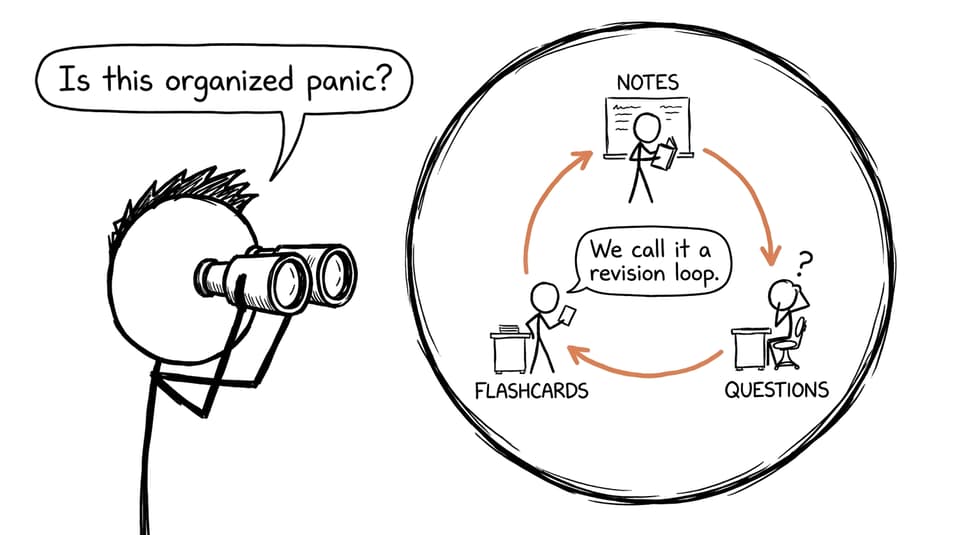
Parents can also help students protect regular study time. Twenty focused minutes spent retrieving concepts or outlining an argument is often more useful than an evening of passive highlighting. A sensible routine is notes for understanding, flashcards for recall, questions for application, and feedback for correction.
What effective exam preparation looks like
A student preparing for Global Politics should revise in layers. First comes conceptual understanding. Next comes a compact bank of adaptable evidence. Then comes timed practice, followed by honest review.
A practical weekly cycle might include:
- Review one concept using structured Study Notes.
- Retrieve definitions and links through Flashcards.
- Update one or two case-study summaries.
- Complete a targeted Questionbank task.
- Plan or write one timed response.
- Record whether the main weakness was knowledge, evidence, structure, evaluation, or timing.
This method turns revision into diagnosis. The student stops asking, “Have I looked at this topic?” and starts asking, “Can I use it accurately under assessment conditions?”
See what Global Politics support looks like
A course can feel abstract from a prospectus. The easiest way to understand it is to inspect the learning materials themselves. RevisionDojo's IB Global Politics resource hub lets families preview how the syllabus is divided into notes, lessons, flashcards, definitions, and practice questions.
A parent might open the Peace and Conflict topic resources with their child and look at three things: whether the notes make a difficult concept clearer, whether the flashcards expose gaps in recall, and whether practice questions reveal what the assessment expects.
That small preview is valuable because good support should not merely provide more content. It should help a student move from understanding to retrieval, then from retrieval to application. RevisionDojo brings that loop together through its Questionbank, Study Notes, Flashcards, AI Chat, Grading tools, Predicted Papers, Mock Exams, Coursework Library, and Tutors.
The reassuring answer for parents
IB Global Politics is demanding, but its demands are understandable. Students need conceptual clarity, well-selected evidence, balanced judgment, organized research, and repeated practice communicating under time limits. They do not need to memorize the entire world's political history.
The subject can help a young person become more careful with evidence and more aware of perspectives beyond their own. Those habits matter in an examination, but they also matter whenever a confident claim meets a complicated world.
The natural next step is simple: explore RevisionDojo's Global Politics notes, try a flashcard set, and inspect a few practice questions together. In ten minutes, both parent and student can see what the course asks and what effective support looks like before making any commitment.