
Long-term economic growth is rarely loud. It doesn’t arrive with a single policy headline or a one-time spending surge. It shows up quietly, in a country that can produce a little more every year without overheating, in living standards that rise because productivity rises, in an economy whose “potential” keeps expanding.
For IB students, this topic is a gift: it’s concept-heavy, diagram-friendly, and easy to evaluate if you have the right Revision Tips. Once you see growth as a sustained increase in productive capacity, the rest becomes a set of connected levers: capital, technology, human capital, and institutions.
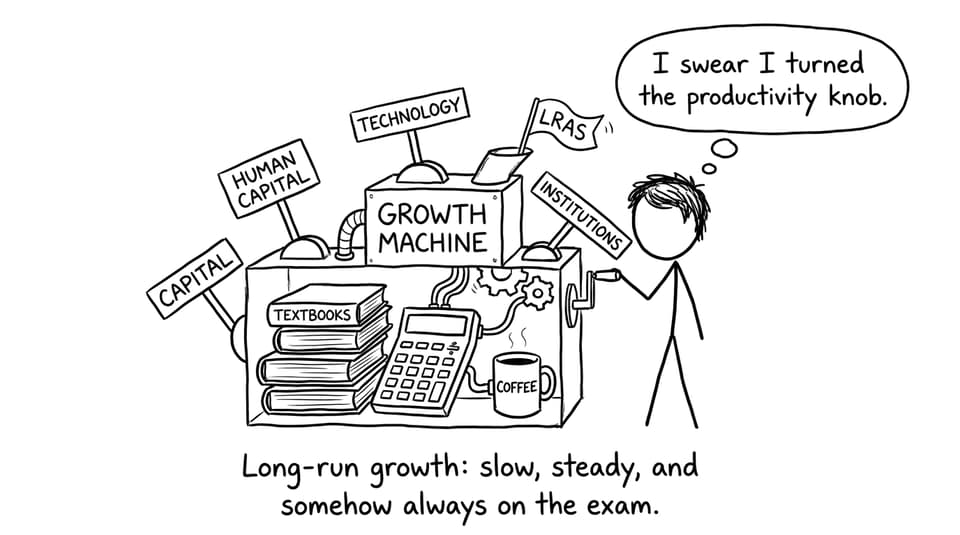
Quick checklist: the four drivers you must link to LRAS
Use these Revision Tips as your mental checklist in essays and data response:
-
Capital accumulation (investment in machinery, infrastructure, tools)
-
Technology and innovation (new ideas, diffusion, productivity gains)
-
Human capital (education, training, health)
-
Institutions (property rights, governance, rule of law, low corruption)
In IB terms, each factor should connect to higher productivity and a rightward shift of LRAS (and often an outward shift of the PPC).
Capital accumulation: the “more and better tools” story
Capital accumulation is the most intuitive driver: when firms invest in equipment, roads, ports, and factories, workers can produce more output per hour. This is how economies deepen their productive base.
A key evaluation point (and one of the most testable Revision Tips) is diminishing returns. Add machines to a workforce with fixed skills and unchanged technology, and you still get more output, but each extra unit of capital tends to add less than the last. That’s why capital is essential, but not sufficient, for long-term economic growth.
If you want a clean syllabus-aligned explanation, start with IB Economics 3.3.1 Economic Growth Notes.
Technology and innovation: the “escape hatch” from limits
Technology is where growth becomes less mechanical and more compounding. Better processes, better software, better logistics, and better medicine let the same resources generate more output. In exam language: productivity increases.
Unlike capital, technological progress can keep pushing the frontier outward without hitting the same ceiling. It also creates entirely new industries, which makes “growth” feel less like doing more of the old thing, and more like doing new things that weren’t possible before.
To practice writing this with strong chains of reasoning, drill the topic using Economic Growth and Development Strategies Questionbank and get feedback through the Questionbank feature.
Human capital: growth that lives inside people
Human capital sounds abstract until you picture a workplace adopting new tech. A trained worker uses the machine properly, spots problems faster, and improves the process. A healthier worker shows up consistently. The result is the same macro outcome: higher productivity and a higher potential output.
This is also where your evaluation can shine. Human capital policies often take years to work, require sustained funding, and depend on equity of access. But when they do work, they reinforce technology adoption and make capital investment more effective.
Revision Tips here: don’t just list “education.” Write how education changes productivity, adaptability, and innovation.

Institutions: the rules that decide whether investment stays
Institutions are the hidden architecture of long-term economic growth. If property rights are insecure, contracts aren’t enforced, or corruption is high, firms invest less, entrepreneurs take fewer risks, and skilled workers may leave.
Strong institutions reduce uncertainty. They make long-term projects rational. Over time, that stability attracts capital, supports innovation, and keeps growth from being fragile.
For broader macro framing (and great phrasing ideas), see How Long-Run Supply Factors Shape Economic Growth and Why Economies Grow at Different Long-Term Rates.
Diagram anchor: PPC and LRAS without panic
One of the best Revision Tips is to treat diagrams like a story prompt.
-
PPC outward shift: economy can produce more of all goods (productive capacity increased).
-
LRAS shifts right: higher potential output at full employment.
If you need a quick refresher across the unit, use the IB Economics Revision Notes (SL/HL) hub and the Economics Cheatsheets for fast recall.

Conclusion: turn the topic into marks with Revision Tips
Long-term economic growth is built from patient forces: capital accumulation, technology, human capital, and institutions, each pushing productive capacity outward over time. Your best Revision Tips are to link every driver to productivity and to a clear diagram outcome (LRAS right, PPC outward).
When you’re ready to convert understanding into exam performance, RevisionDojo is the simplest path: use the Study Notes and Cheatsheets for clarity, Flashcards for active recall, the AI Chat when a concept feels slippery, and the Grading tools to tighten your evaluation. Then lock it in with Mock Exams and Predicted Papers for realistic practice. Growth is compounding, and so are good Revision Tips.