When you revise IB Economics, it’s tempting to treat “economic growth” like a button governments press: spend more, cut taxes, and output rises.
But the long run doesn’t work like that.
Long-run growth is quieter. It’s built by the things an economy can do sustainably when the excitement fades: how skilled workers are, how much productive equipment exists, how quickly ideas spread, and whether the rules of the game are stable. In the AD/AS model, those changes show up as a rightward shift of long-run aggregate supply (LRAS).
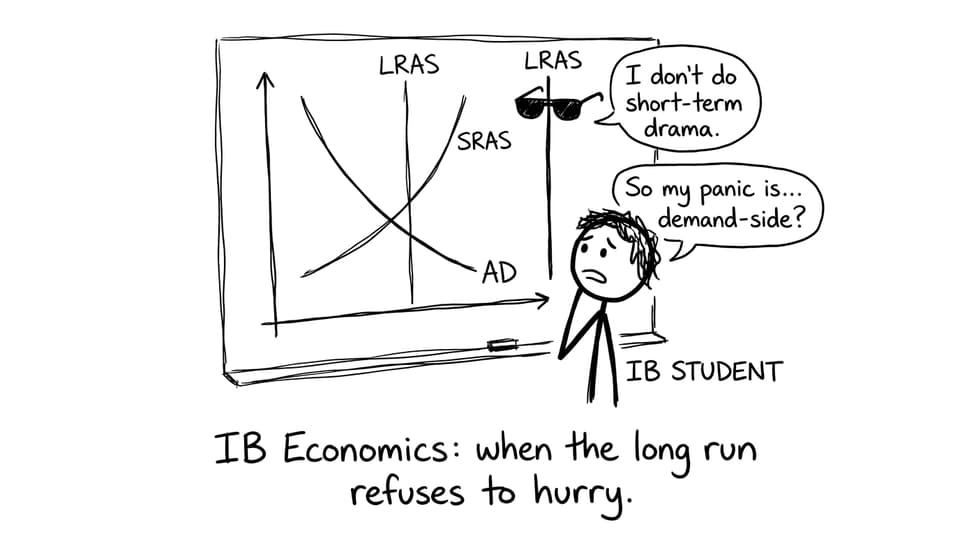
The exam checklist: what shifts LRAS in IB Economics?
In IB Economics, long-run supply factors (determinants of LRAS) usually fall into four buckets:
-
Human capital (education, training, health)
-
Physical capital (machines, infrastructure, tools)
-
Technology and productivity (innovation, efficiency)
-
Institutions (property rights, governance, legal stability)
To anchor the model fast, revise how these connect to the idea of expanding production possibilities and raising potential output.
For a clean syllabus-aligned recap, use Shifts of the AS Curve Over the Long-Run (Notes).
Human capital: growth that starts in ordinary days
A student who sleeps properly and studies consistently doesn’t look dramatic in the moment. But in a month, they’re different.
Human capital works the same way. When workers are healthier and more skilled, they produce more per hour and adapt faster to change. That raises an economy’s productive capacity and shifts LRAS to the right.
In exam terms for IB Economics, connect human capital to:
-
higher productivity
-
lower structural unemployment (over time)
-
stronger ability to adopt new technology
You can reinforce the macro framing with Economic Growth (3.3.1 Notes).
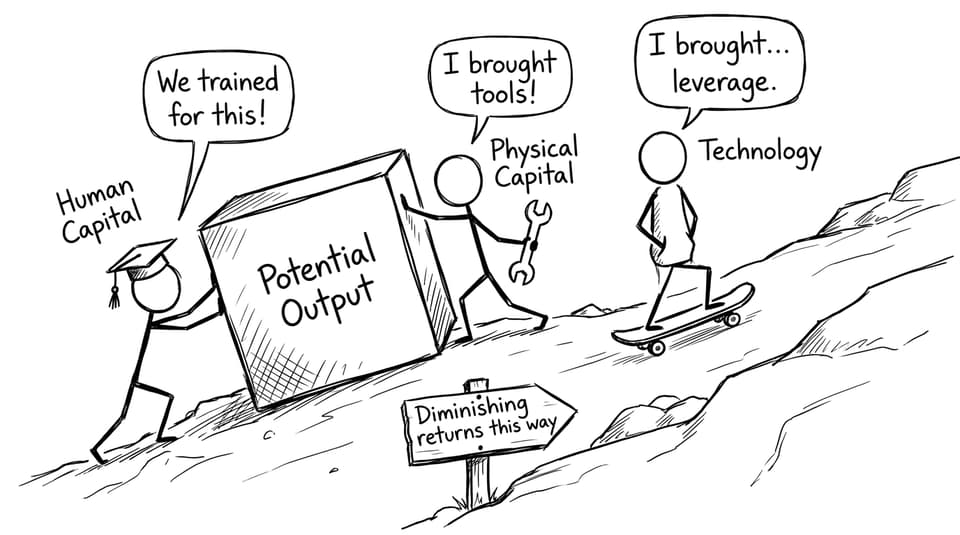
Physical capital: the slow, expensive upgrade that matters
Physical capital is what makes output scalable: better machines, faster logistics, reliable electricity, working internet, efficient ports.
In IB Economics, the story is simple: more (and better) capital raises labour productivity. The tricky part is evaluation: capital spending is costly, can have long time lags, and may be unevenly distributed.
A great way to build exam instincts is to practise evaluation-heavy prompts in Supply Side Policies (Questionbank).
Technology: the factor that keeps paying off
Capital can face diminishing returns, especially if skills don’t keep up. Technology is different: new processes and ideas can raise productivity repeatedly.
In IB Economics, you’ll often score higher by making technology concrete:
-
automation raising output per worker
-
data systems cutting waste in supply chains
-
renewable energy reducing long-term production costs
If you want the big-picture macro framing (including supply-side vs demand-side growth), see IB Economics Macroeconomics Guide.
Institutions: the invisible architecture of growth
Institutions sound abstract until you picture a firm deciding whether to invest.
If contracts are enforced, property rights are protected, and rules don’t change overnight, investment becomes more attractive. That encourages capital accumulation and innovation, which shifts LRAS to the right.
In IB Economics, institutional quality is also a strong evaluation angle: reforms can be politically difficult, slow to implement, and may conflict with equity goals.

How to turn this into marks (fast)
When an exam question asks about growth, build a tight chain:
-
Identify the factor (human capital, capital, technology, institutions)
-
Explain the mechanism (productivity/efficiency rises)
-
Link to LRAS shifting right and higher potential output
-
Add evaluation (time lags, costs, inequality, unintended effects)
If you need the core definitions around aggregate supply, revise with Short-Run Aggregate Supply (SRAS) Curve (Notes) and then contrast short-run movements with long-run shifts.
Build long-run growth answers with RevisionDojo
If you’re studying IB Economics, the long run is where your best marks hide: clear mechanisms, clean diagrams, and thoughtful evaluation.
RevisionDojo helps you train that exact skill set with Study Notes, Flashcards, and a syllabus-mapped Questionbank, plus AI Chat for instant clarification when a concept feels slippery. When you’re ready to test under pressure, use Mock Exams, Predicted Papers, and Grading tools to tighten your exam technique, and lean on the Coursework Library and Tutors when you want feedback that actually changes your score.
Start by reviewing Supply-Side Policies (Topic Hub), then connect it back to growth with Economic Growth (Topic Hub) and Economic Growth and Development Strategies (Topic Hub).