
When you study IB Economics, it’s easy to assume long-term growth is just “more investment = more GDP.” Then you look at real countries over decades and the story gets uncomfortable. Some economies climb steadily, almost quietly. Others sprint for a few years, then stall. A few seem trapped, no matter how hard they try.
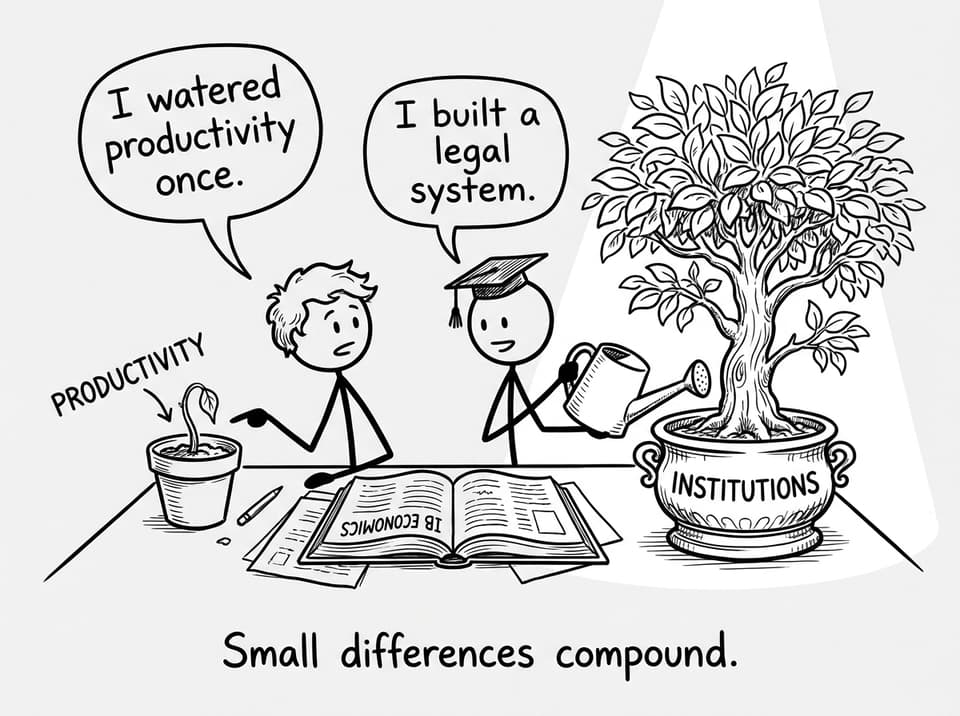
The difference isn’t motivation. It’s compounding. Tiny, persistent gaps in productivity growth stack up the way small daily habits do, until until one country is building high-speed rail while another is still losing hours to power cuts.
The IB Economics long-run growth checklist
Use this quick structure in IB Economics essays and 10-mark explain questions:
-
Productivity: output per worker/hour rises
-
Physical capital: machines, infrastructure, reliable energy
-
Human capital: education, skills, health
-
Technology diffusion: adopting existing best-practice tech
-
Institutions: rules that reward investment and innovation
For definitions and syllabus framing, anchor yourself with Economic Growth Notes (3.3.1).
IB Economics: Productivity is the quiet engine
In IB Economics, long-run growth is essentially the story of productivity. If workers and firms can produce more with the same inputs, the economy’s productive capacity expands. In models, this shows up as a rightward shift of LRAS and an outward shift of the PPC.
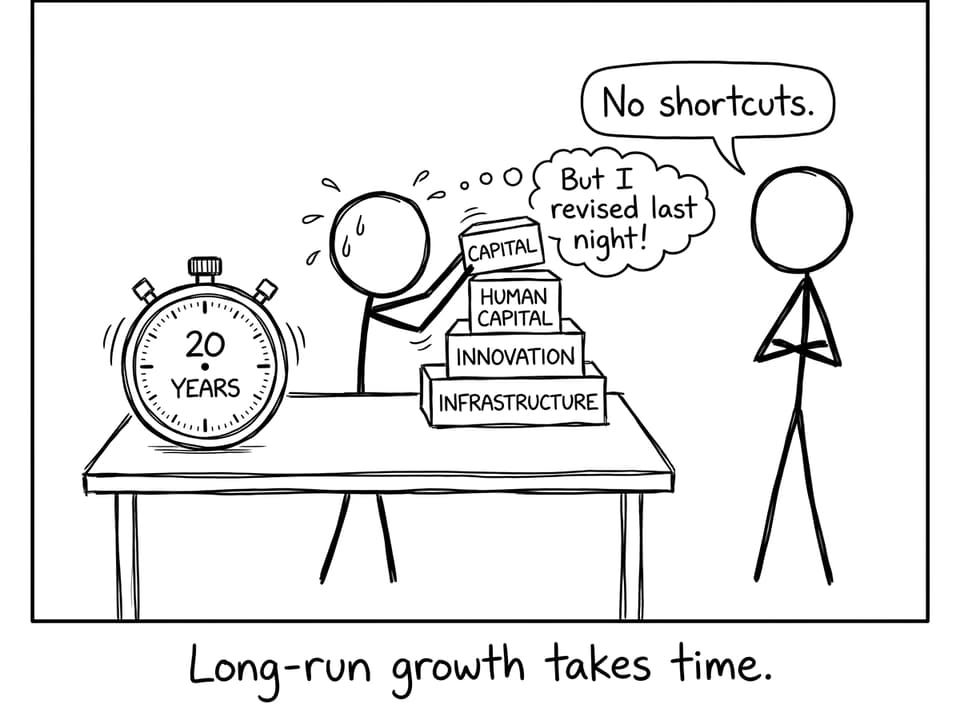
The trap is that productivity doesn’t rise automatically. It rises when an economy repeatedly makes decisions that look boring in the short run: maintaining roads, training teachers, protecting contracts, funding research, keeping rules predictable.
A clean syllabus-aligned way to revise this is How Long-Run Supply Factors Shape Economic Growth.
IB Economics: Institutions decide whether investment “sticks”
Two countries can spend the same share of GDP on investment and get wildly different results. Why? Because institutions determine whether capital is used efficiently and whether people trust the future.
Strong property rights, transparent courts, low corruption, and political stability reduce uncertainty. Firms invest for the long term. Skilled workers stay. Entrepreneurs try new ideas.
Weak institutions do the opposite: projects leak money, contracts aren’t enforced, and talent leaves. Over time, that becomes a growth rate gap you can’t easily close.
For development-policy obstacles you can evaluate in essays, see Challenges That Limit Development Policies.
IB Economics: Technology diffusion isn’t a free download
A common misunderstanding in IB Economics is thinking developing countries can “catch up” just by importing modern technology. In reality, tech adoption requires complementary conditions: skills, infrastructure, functioning markets, and rules that encourage competition and upgrading.
A country can buy advanced machinery, but without reliable electricity, trained technicians, and supply chains, it sits idle. The frontier economies innovate; fast growers adopt and adapt; slow growers fail to integrate.

To link adoption to policy strategies, revise Strategies to Promote Economic Growth and Economic Development (4.10.1) and the 4.10 Topic Hub.
IB Economics: Human capital makes growth resilient
Human capital is where long-term growth stops being abstract. Better health raises attendance and energy. Better education increases adaptability. Better training lets workers use complex capital and improve processes.
In IB Economics, you can treat human capital as both a growth driver and an evaluation point: it has strong benefits, but also long time lags and opportunity costs.
For a focused recap, use Investment in Human Capital (Supply-Side Policy) Notes.
Quick exam moves for IB Economics responses
-
Use LRAS/PPC language to signal long-run growth.
-
Add time lags for education, institutions, and infrastructure.
-
Evaluate with effectiveness: does the policy target the binding constraint?
-
Bring in a tool for practice: Economic Growth and Development Strategies Questionbank.
Bringing it back to RevisionDojo
If you want to turn this topic into marks, treat IB Economics growth as a repeatable framework: productivity first, then the drivers underneath it. RevisionDojo helps you do that fast: revise with Study Notes, drill exam technique in the Questionbank, lock in definitions with Flashcards, stress-test explanations with AI Chat, and sharpen evaluation using Grading tools, Predicted Papers, and Mock Exams. When you’re ready to go deeper, the Coursework Library and Tutors help you connect growth theory to real-world examples without getting lost.
For more targeted growth revision, start with What Drives Long-Term Economic Growth? and keep your IB Economics structure consistent under pressure.