



The moment “action at a distance” stops feeling like magic
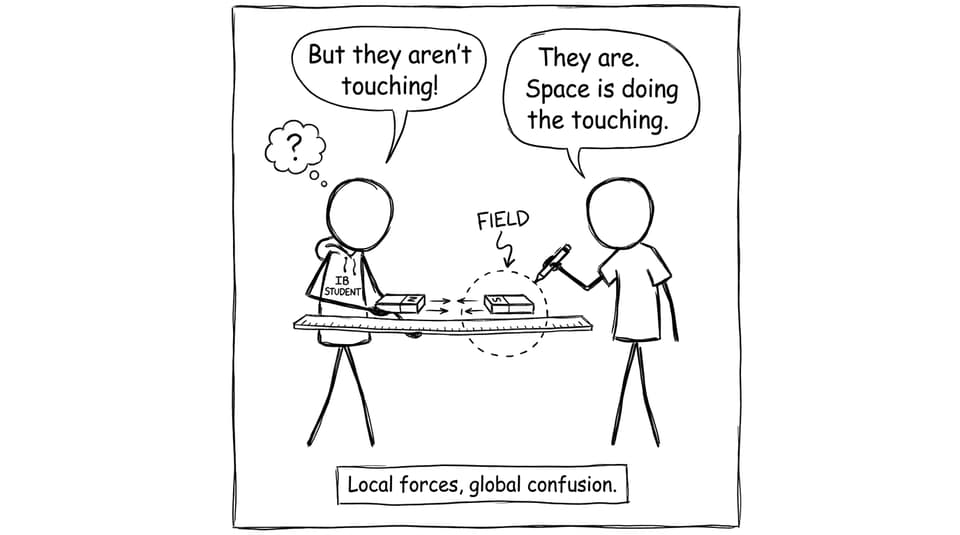
Two magnets sit on your desk. You slide one closer, and the other twitches. No strings. No contact. Just that unsettling feeling that something reached across space.
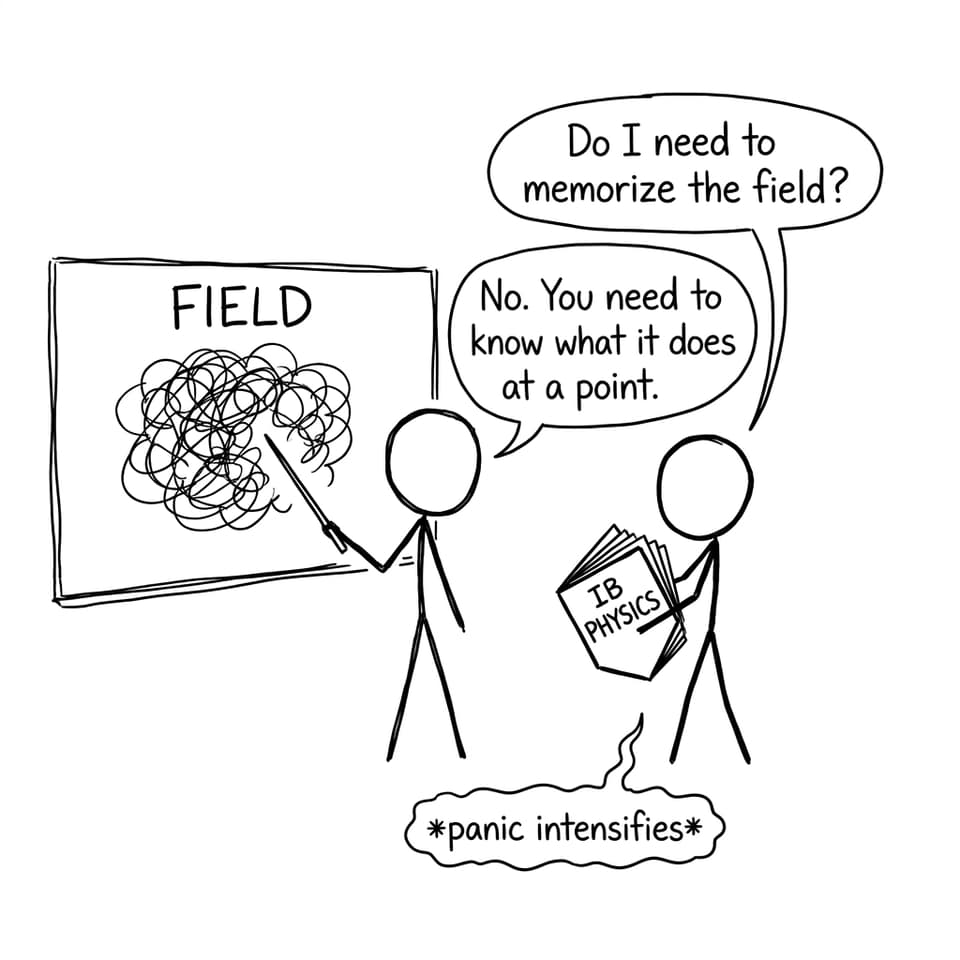
That discomfort is exactly why IB Physics leans so hard on the concept of a field. A field is the idea that space around a mass or charge is not empty in the relevant sense. It has a property at every point, and that local property determines the force an object feels right there. Action at a distance becomes action through space, not a mysterious long-range handshake.
Quick exam checklist for IB Physics fields
-
Define a field as a quantity with a value at every point in space.
-
Emphasize the word local: the object responds to the field where it is.
-
Use the correct “per unit” definitions:
-
Gravitational field strength: (g = F/m)
-
Electric field strength: (E = F/q)
-
-
Mention inverse-square weakening as geometry, not “because it just does.”
-
If asked about energy, say it can be stored in the field configuration.
If you want the syllabus-aligned structure for this whole area, start from IB Physics Topic D - Fields Notes & Questions (SL/HL).
What the concept of a field really changes
In older, intuition-based language, you might say “the Earth pulls the apple.” But the field model in IB Physics rewrites the sentence in a way that removes the spooky part:
-
The Earth creates a gravitational field in the space around it.
-
At the apple’s location, the field has a value (g).
-
The apple experiences force because it is in a region of space where the field is nonzero.
This is more than wording. It’s a shift in what you treat as the immediate cause. The apple is not reacting to the Earth across a void; it’s reacting to the condition of space at its own position.
For gravitational questions, the cleanest supporting detail is the definition of (g) and its point-mass form (g = GM/r^2). RevisionDojo’s D.1 Gravitational Fields hub is a strong reference, and the companion D.1 Gravitational Fields Notes is ideal when you want wording you can reuse under exam pressure.
Why fields make forces “local” (and why examiners like that)
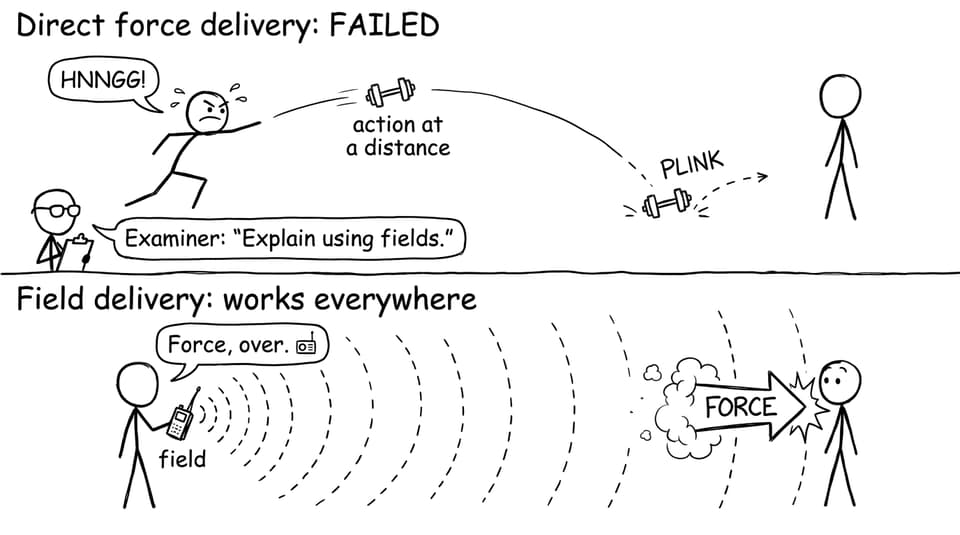
A common IB Physics prompt is essentially: “Explain how a field helps us understand action at a distance.” The highest-value phrase is:
A field makes the interaction local because the force depends on the field at the object’s position.
That local framing helps with three exam habits:
You can define the cause at a point
Instead of saying “two charges attract,” you can say: a test charge experiences (F = qE) because the electric field at that point is (E). That’s the reason markschemes like fields: it turns a vague story into a point-by-point rule.
To tighten your electric field language, use Notes for D.2.1 Electric field properties and laws and then reinforce with D.2 Electric and magnetic fields - IB Questionbank.
You can explain the inverse-square law without shrugging
When a source spreads its influence uniformly in 3D, the “same amount of influence” is shared over the surface area of a sphere, (4\pi r^2). Larger area means less intensity per unit area, so field strength falls like (1/r^2). In IB Physics, that’s the story: geometry drives the weakening.
You can talk about energy as something the field can carry
Gravitational and electric potential energy aren’t just “inside” one object. They’re connected to the configuration of the system, which the field model describes smoothly. That’s why work, potential, and potential difference fit so naturally with fields.
Fields also explain how forces act through a vacuum
One subtle benefit of the field concept in IB Physics is that it removes the need for a material “in between.” Gravity works through space. Electric forces work through space. Even when there’s nothing you’d call a medium, the field still exists and still has measurable effects.
This becomes especially helpful when you transition from static fields to changing ones. A changing magnetic field creating an electric field is much easier to accept when “space can have properties.” For that bridge, read Why Does A Changing Magnetic Field Create An Electric Field?.
How to revise this fast with RevisionDojo
If you’re preparing for exams, the fastest loop is:
-
Read the core explanations in IB Physics Topic D - Fields Notes.
-
Drill exam-style application using the Topic D - Fields - IB Questionbank.
-
Keep formulas close with the Physics Data Booklet - IB Formula Reference.
This is where RevisionDojo’s ecosystem clicks: Study Notes to learn the language, Flashcards to keep definitions sharp, AI Chat to debug misunderstandings, Grading tools to see what your explanation is missing, and Mock Exams plus Predicted Papers to practice timing. If you’re stuck, Tutors can walk you from “I sort of get fields” to “I can explain fields in six lines.”
Closing: turn “spooky” into “solvable”
Action at a distance feels strange only when you imagine forces leaping across emptiness. The field concept in IB Physics replaces that leap with something calmer: a local rule at every point in space. Once you can say “the object responds to the field where it is,” you stop arguing with the universe and start answering questions.
For exam-ready practice, go straight to RevisionDojo’s IB Physics Resources and use Topic D tools to lock the wording, the diagrams, and the calculations together.