A moment every IB Physics student knows
You push a magnet into a coil. The meter jumps. You pull it out. It jumps the other way. Nothing touched anything, yet energy moved.
That little jump is one of the most testable ideas in IB Physics: a changing magnetic field creates an electric field. Not “sometimes.” Not “if charges are nearby.” It is built into how electromagnetism behaves.
The exam checklist (what to write fast)
When you see this in IB Physics, hit these points:
-
Use Faraday’s law: changing magnetic flux induces an emf.
-
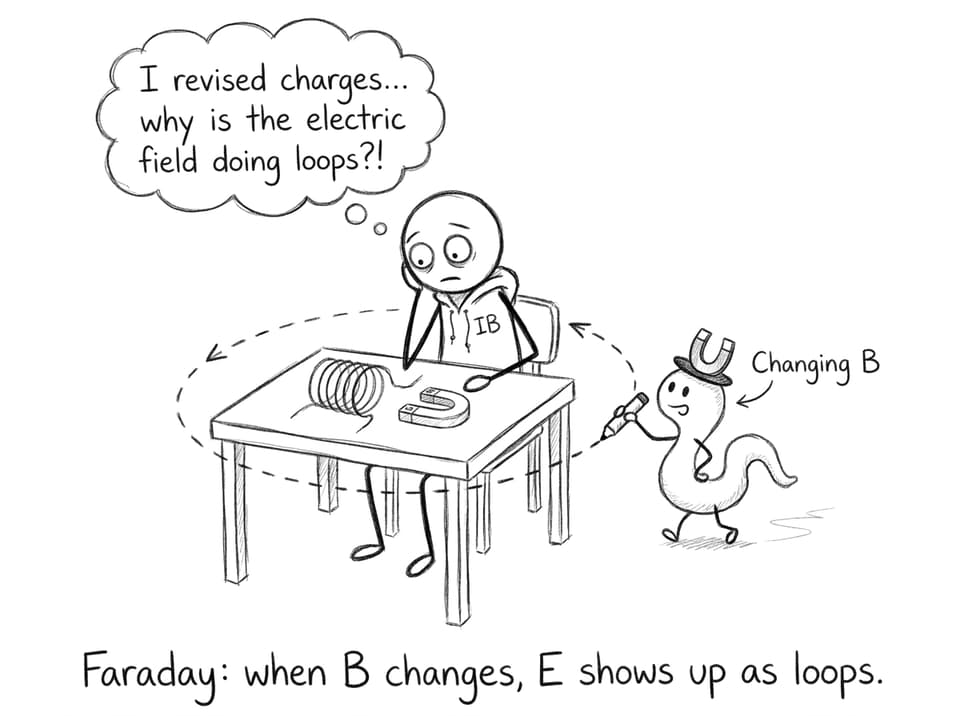
Say the induced electric field forms closed loops (not starting/ending on charges).
-
Mention Lenz’s law: the induced effect opposes the change (energy conservation).
-
Link to applications: generators, transformers, eddy currents.
For syllabus-aligned support, keep these tabs open while you practise:
Why a changing magnetic field creates an electric field
In IB Physics, the clean statement is Faraday’s law: a changing magnetic flux through a loop induces an emf.
Flux is basically “how much magnetic field threads an area,” often written as:
- (\Phi = BA\cos\theta)
If (\Phi) changes, the induced emf appears:
- (\varepsilon = -N,\frac{\Delta\Phi}{\Delta t})
The key conceptual step: that emf can be understood as coming from an induced electric field in space. It’s not created by piled-up charges like in electrostatics. It’s created because a changing (\vec{B}) implies a circulating (\vec{E}).
If you want to tighten your definitions around fields, flux, and induction, use:
The detail examiners love: induced E makes loops
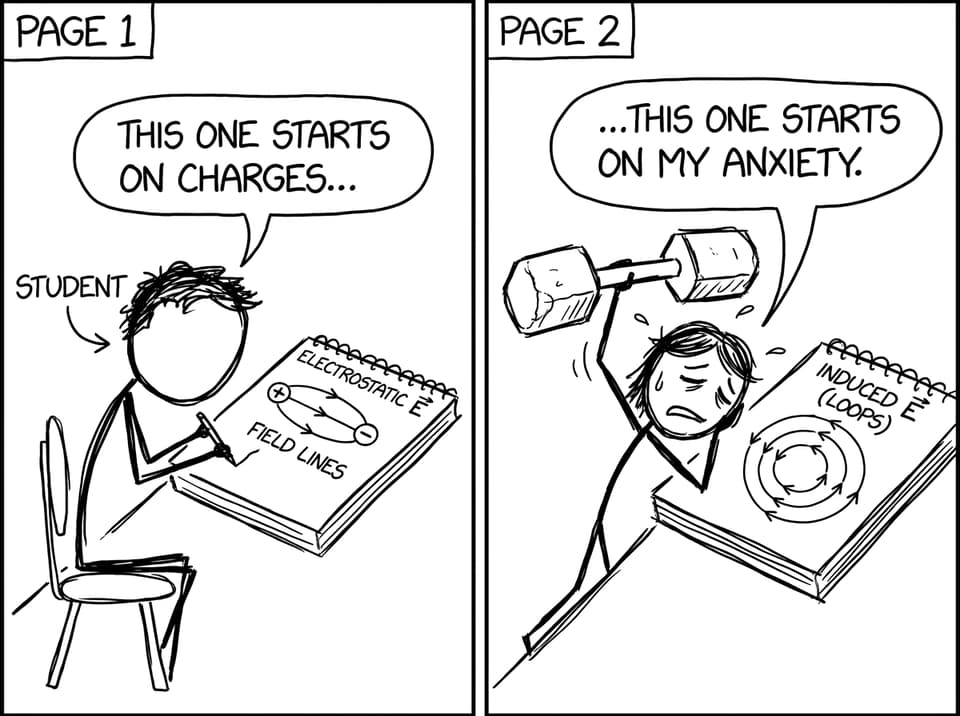
Electrostatic electric fields (from charges) have field lines that begin on + and end on -.
Induced electric fields (from changing (\vec{B})) are different: they form closed loops. That loop shape is why induction can drive currents around a conductor even when there is no obvious “battery-like” pair of terminals.
This is also why students get confused: they expect every electric field to “point from + to -.” In induction questions, the geometry is circular first, and only then do you infer what charges do in a wire.
To practise the loop logic with real exam-style prompts, use the D.4 Induction questionbank (HL) and the broader Induction, alternating currents, and capacitance questionbank.
Lenz’s law: the “no free energy” guardrail
The minus sign in Faraday’s law is not decoration. In IB Physics, it’s your energy story.
If changing flux induces an emf, Lenz’s law says the induced current creates a magnetic field that opposes the change in flux. That opposition is why pushing a magnet into a coil can feel harder when the circuit is closed: you’re doing mechanical work that becomes electrical energy (and often thermal energy too).
A helpful deep-dive is Lenz’s Law explained for IB Physics students, plus this energy-focused explanation: How induction embodies energy conservation.
How to study this efficiently with RevisionDojo
A lot of IB Physics stress comes from mixing up words: emf vs voltage, flux vs field, induced E vs electrostatic E. The fix is structured practice.
RevisionDojo helps you tighten the loop between understanding and marks:
-
Use Study Notes to lock definitions (flux, emf, Lenz’s law).
-
Drill with the Questionbank, then check mistakes with AI Chat.
-
Convert the hardest lines into Flashcards.
-
When you’re close to exams, use Predicted Papers, Mock Exams, and Grading tools to simulate timing and markscheme thinking.
-
If you need a human explanation, the Tutors feature can debug your reasoning fast.
Closing: turn the mystery into marks
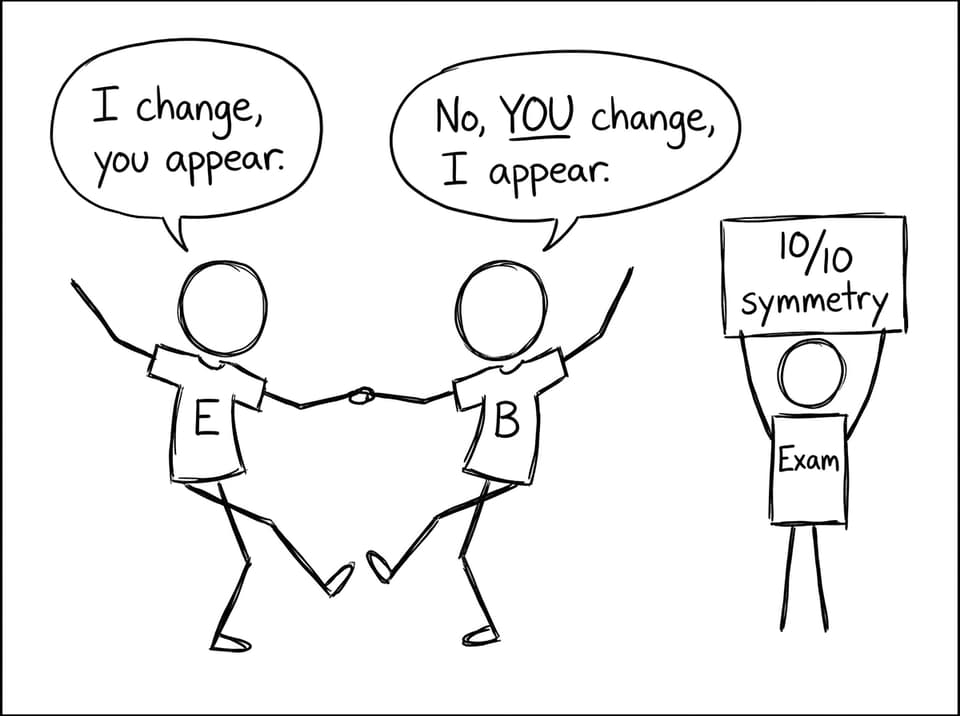
A changing magnetic field creates an electric field because electromagnetism doesn’t allow one field to change in isolation. In IB Physics, that idea shows up as Faraday’s law, loop-shaped induced (\vec{E}), and Lenz’s law protecting energy conservation.
If you want this topic to feel automatic under timed conditions, build the habit on RevisionDojo: review the notes, practise in the Questionbank, and let AI Chat and flashcards clean up the gaps until induction becomes a predictable set of marks.


