


If you study IB Digital Society long enough, you notice a strange pattern: the busiest students aren’t always the most productive. They write more notes, open more tabs, collect more “useful” links. And somehow they still feel behind.
The turning point usually isn’t a new app or a prettier planner. It’s a quieter shift: treating time like a resource you budget, not a mood you follow. With IB Digital Society, that matters even more because the course rewards judgment, structure, and sharp examples, not sheer volume.
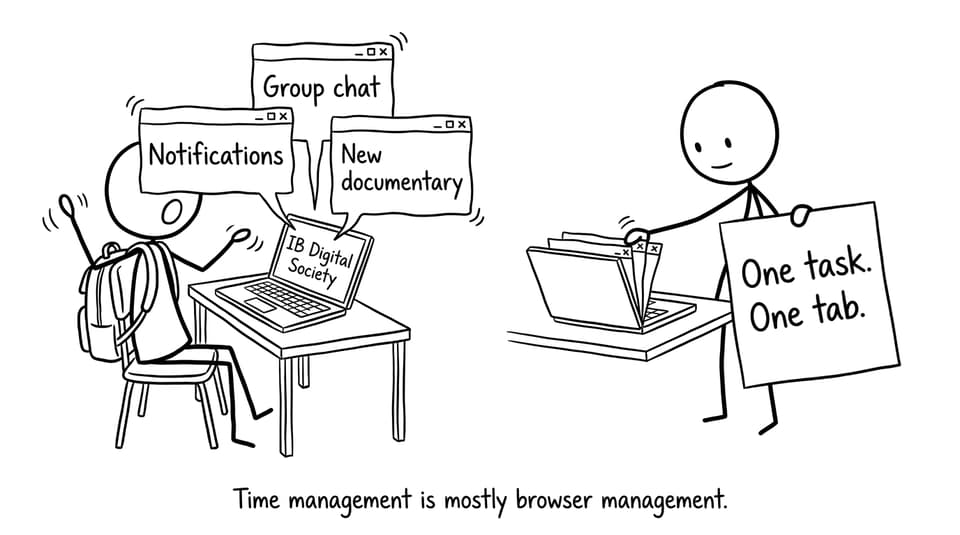
Quick checklist for IB Digital Society time management
Use this as your “minimum viable routine” for IB Digital Society exam prep:
-
Put every Digital Society deadline in one calendar (essays, IA milestones, mocks).
-
Schedule 3-5 hours/week for IB Digital Society outside class (more near deadlines).
-
Break essays and IA tasks into small deliverables (outline, evidence, draft, edit).
-
Study with active recall: questions, flashcards, timed writing, not rereading.
-
Keep a simple research log so your examples stay usable and easy to cite.
-
Protect sleep and one real break so your plan survives the week.
If you want a broader system that works across the diploma, pair this with Best Time Management Hacks for IB Students.
Plan around assessments (without letting them ambush you)
The stress in IB Digital Society usually spikes for predictable reasons: essays stack up, your IA feels “almost started,” and other subjects suddenly demand the same week.
A calmer approach is to build milestones that are so small they’re hard to avoid:
Set IA milestones that create momentum
Instead of “work on the IA,” set milestones like:
-
Choose and refine a focus question
-
Build a case-study shortlist (3 strong, 2 backup)
-
Write the argument skeleton (claims + counterclaims)
-
Draft one section only
-
Edit with rubric language
When you treat IB Digital Society like a sequence of tiny finishes, you stop depending on last-minute adrenaline.
For cross-IB planning ideas, use Time Management in IB: Tools and Techniques That Actually Work.
Use command terms to stop wasting writing time
In IB Digital Society, the fastest way to lose time is to answer the wrong question well. That usually happens when you ignore command terms.
Command terms are basically the exam’s steering wheel. “Discuss” isn’t “describe.” “Evaluate” isn’t “explain.” If you match the command term, your paragraph structure becomes obvious, and you draft faster because you’re not guessing what the examiner wants.
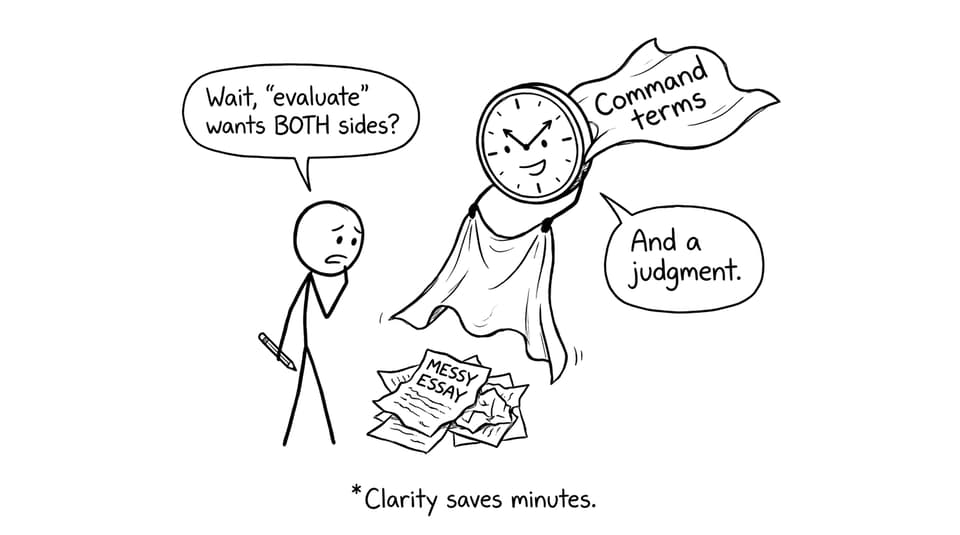
A practical habit: before you write, spend 20 seconds to circle the command term, underline the topic, check the marks, and jot a one-line plan.
For a clear walkthrough, see IB Command Terms: How to Use Them to Score More.
Manage research like a minimalist (your future self will thank you)
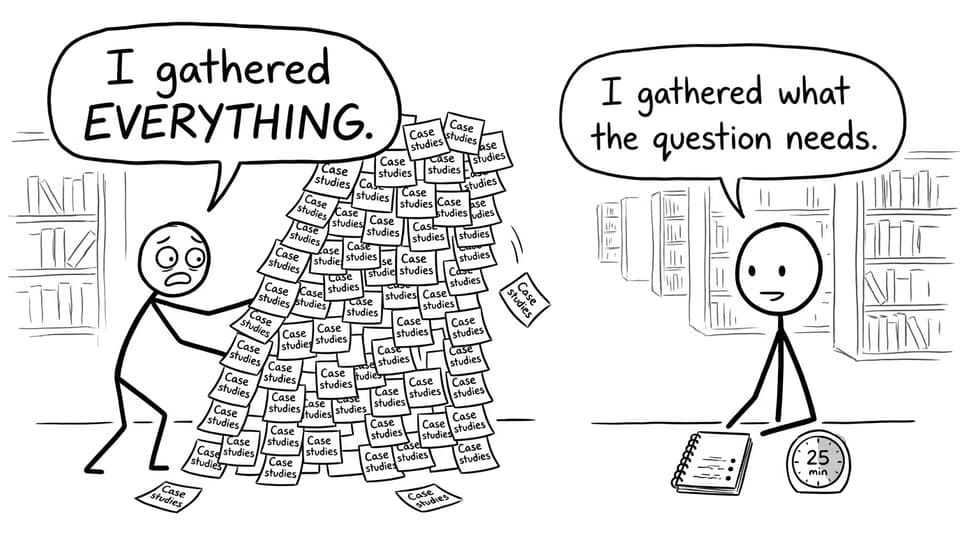
Research can quietly eat your whole week in IB Digital Society because it feels productive. It’s not, unless it becomes usable evidence.
So make your research boring on purpose:
-
Keep a research log with 3 lines per source: claim, relevance, limitation.
-
Limit each case study to what you can actually deploy in an argument.
-
Reuse case studies across subjects when it’s ethical and relevant (Group 3 overlap is real).
This also supports skills that matter beyond IB Digital Society, like being reflective and principled with sources. If you want the bigger picture, read The 10 IB Learner Profile Traits Explained.
Build a weekly routine that protects predicted grades
Predicted grades often reward consistency more than heroics. In IB Digital Society, that usually means submitting on time, showing progress in thinking, and improving drafts using feedback.
A simple weekly structure that works:
-
2 blocks (45-60 min): timed paragraph practice using a prompt
-
1 block (45 min): research log + case study refinement
-
2 mini-sessions (10 min): flashcards for key concepts, definitions, and examples
-
10 minutes Sunday: plan next week’s Digital Society deliverables
If predicted grades are on your mind, keep context with Do IB Predicted Grades Matter for Conditional Offers?.
How RevisionDojo makes IB Digital Society revision easier
Time management gets easier when your tools reduce friction. RevisionDojo is built to keep IB Digital Society revision focused on outputs:
-
Study Notes to patch weak concepts quickly
-
Flashcards for active recall (not passive familiarity)
-
Questionbank to practise exam-style thinking at the right difficulty
-
AI Chat to clarify misconceptions and generate targeted follow-ups
-
Grading tools to tighten structure and evidence
-
Mock Exams and Predicted Papers to rehearse timing and decision-making
-
Coursework Library and Tutors when you need examples, guidance, or feedback
Start from the subject hub: Digital Society (DS) - IB Resources. For more topic-specific posts, browse All IB Digital Society articles.
Conclusion: make IB Digital Society feel lighter by making it smaller
The best time management tip for IB Digital Society is surprisingly unglamorous: shrink the work until it moves every week. Milestones. Command terms. A simple research log. Timed practice that creates proof.
If you want a system that keeps those habits consistent, RevisionDojo gives you the full workflow: Questionbank, Study Notes, Flashcards, AI Chat, Grading tools, Mock Exams, Predicted Papers, and support through the Coursework Library and Tutors. Build your next week of IB Digital Society around measurable outputs, and the stress curve starts to flatten.