


The moment politics moved into your pocket
You can feel it without studying a single textbook.
One minute you are scrolling memes, the next you are watching an election unfold in real time, arguing about a war in a comment thread, or seeing a protest trend across five continents before lunch.
That quiet shift from politics as something that happens in parliaments to politics as something that happens on platforms is the heart of IB Digital Society. In exams, you are not rewarded for panic or hype. You are rewarded for showing how digital systems change power: who gets heard, who gets watched, and who gets to define “truth.”
Quick exam checklist: Digital Society meets global politics
Use this as a fast mental menu in IB Digital Society when a question mentions politics, governance, or international relations:
-
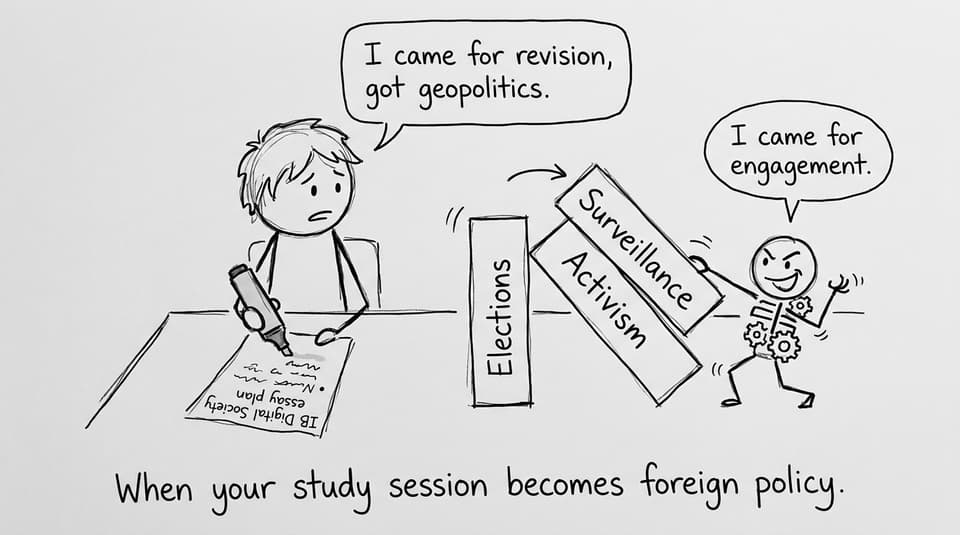
Elections and democracy: persuasion, microtargeting, misinformation, trust
-
Activism and movements: coordination, visibility, censorship, narrative control
-
Surveillance and security: privacy, human rights, policing, “national interest”
-
Platform power: algorithms, moderation, lobbying, corporate governance
-
Global power dynamics: cyber conflict, AI competition, digital inequality
For a clear syllabus home base, keep the IB Digital Society hub open while you revise: IB Digital Society Resources.
Elections, misinformation, and the politics of attention
In IB Digital Society, elections are not just about votes. They are about attention.
Digital campaigning turns persuasion into an optimized system: data signals, segmented audiences, rapid testing, and emotional content that travels faster than careful explanations. This is where you can score well by linking a political outcome to a digital mechanism: recommendation systems, ad delivery, bots, or coordination through private groups.
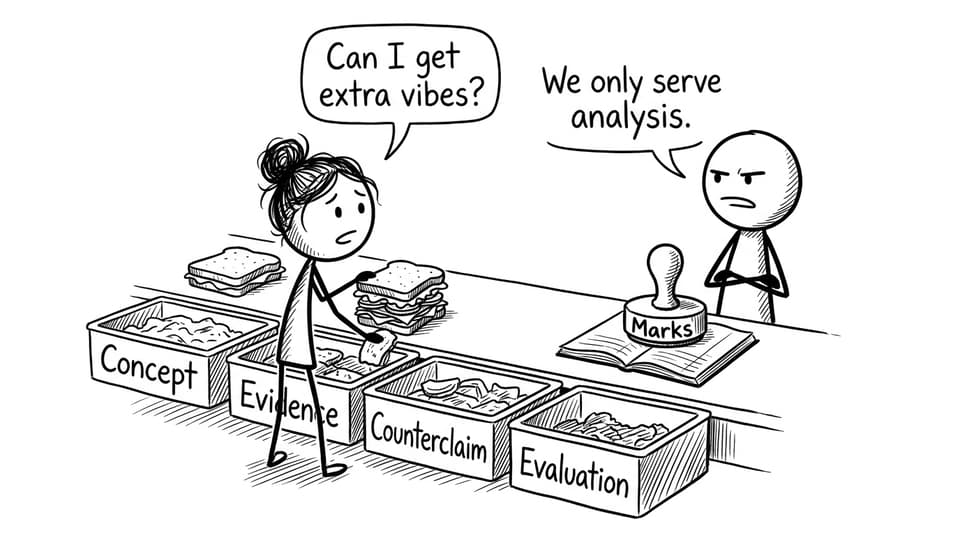
A strong exam paragraph often follows this rhythm:
-
Define the digital system (platform + feature + incentive).
-
Explain how it shapes behavior (what it amplifies, what it hides).
-
Evaluate implications (trust, legitimacy, polarization, fairness).
If algorithms show up in your stimulus, build your explanation with an exam-ready framework: IB Digital Society: Algorithms Explained for Exams. Then drill the skill under time pressure using RevisionDojo’s Questionbank, plus AI Chat when you get stuck mid-answer.
Digital activism: global coordination, local consequences
Digital activism is one of the most hopeful parts of global politics, and also one of the most complicated.
Hashtags and short videos can make distant problems feel immediate. They can also flatten context. In IB Digital Society, your job is to show both sides: platforms can amplify marginalized voices, but they can also encourage performative engagement, spread risky misinformation, or make movements easier to surveil.
A smart way to revise is to collect a small set of versatile examples and reuse them across prompts. RevisionDojo explains how to do this without turning your notes into a messy archive: Using Case Studies for Better Learning in Digital Society.
Surveillance, security, and human rights tensions
Many global politics debates sound philosophical until you see the tool.
Surveillance technologies (mass data collection, facial recognition, location tracking) let states prevent harm and respond quickly to threats. They also create new risks: chilling effects on speech, discrimination through biased systems, and weak accountability when monitoring becomes normal.
In IB Digital Society, this is where the concept of power becomes concrete: power to observe, power to predict, power to punish, and power to define what counts as “safe.” If you are also taking Global Politics, you can cross-revise the overlap and tighten your conceptual language using the RevisionDojo hub: IB Global Politics Resources.
Platforms as political actors, not neutral stages
It is tempting to write, “social media influenced politics.” That is too vague for top marks.
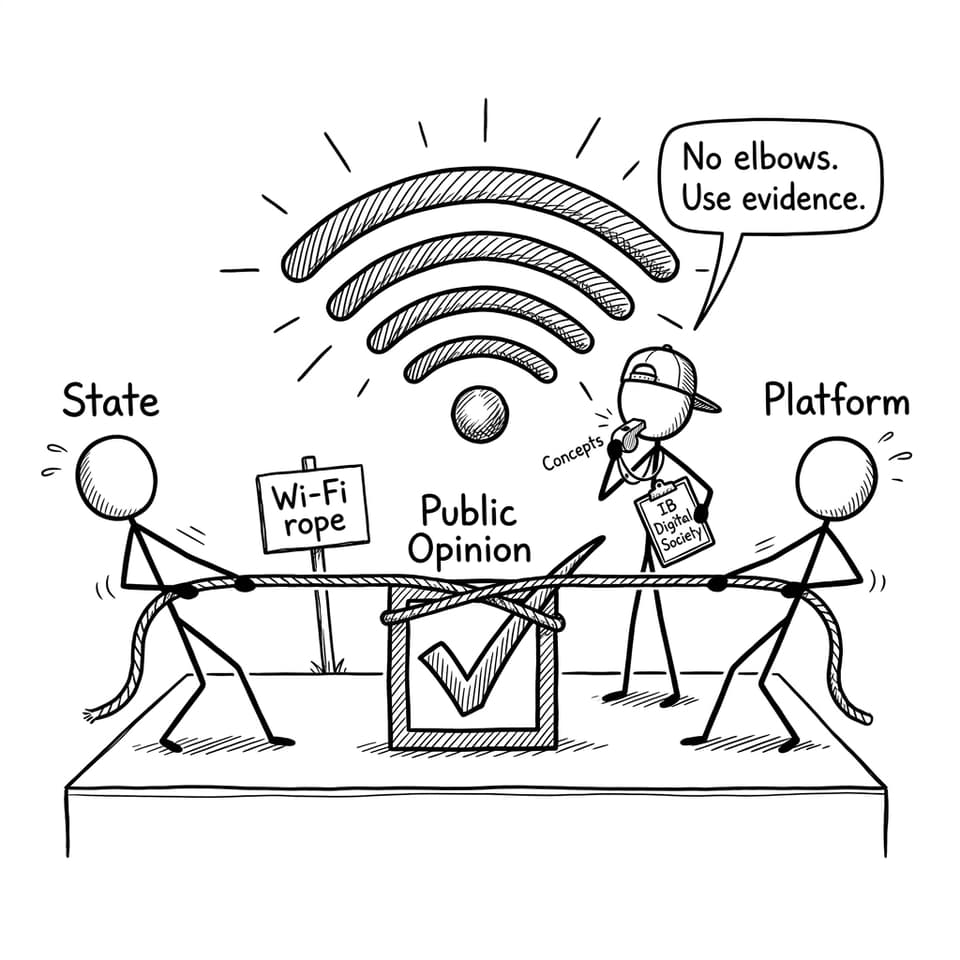
In IB Digital Society, platforms behave like political actors because they:
-
set rules (terms of service, moderation)
-
shape visibility (ranking, recommendation, demonetization)
-
influence agendas (what becomes discussable)
-
negotiate with states (data access, compliance, bans)
Your evaluation can focus on trade-offs: moderation can protect users but also enable censorship; encryption can protect privacy but complicate law enforcement; open networks can empower civil society but invite interference.
If you want a clear lens system for these arguments, revise the course themes directly: IB Digital Society: Key Themes Explained.
A RevisionDojo mini-plan for exam prep
To turn understanding into marks in IB Digital Society, use a simple loop:
-
Study Notes to clarify the concept fast: What is Digital Society (Notes)
-
Flashcards to keep definitions and key tensions active
-
Questionbank to practise exam-style writing with feedback: Questionbank
-
Mock Exams and Predicted Papers to build stamina and timing (RevisionDojo includes both)
-
Grading tools to learn what examiners reward in evaluation
-
Coursework Library and Tutors when you need examples, structure, or a second set of eyes
If you are new to the subject and want expectations that match how it is assessed, this guide helps: Is IB Digital Society Hard? Honest Expectations Explained.
Closing: the exam skill is seeing power in systems
Global politics did not leave the real world. It moved into systems you use every day.
If you can explain that shift with clarity, how platforms allocate attention, how data enables surveillance, how algorithms shape public opinion, you are doing IB Digital Society the way the course was designed. Build your case study bank, practise the same structures repeatedly, and let feedback do the heavy lifting.
When you are ready to train that skill properly, RevisionDojo gives you the full toolkit: Study Notes, Flashcards, Questionbank, AI Chat, Grading tools, Predicted Papers, Mock Exams, a Coursework Library, and Tutors, all aligned to what the exam is actually asking you to do in IB Digital Society.