


Pressure is one of those IB Chemistry ideas that feels obvious right after you understand it, and annoyingly slippery right before. Imagine you are inside a container wall (dramatic, but effective). You do not “feel” temperature or volume directly. You only feel impacts. Every time a gas particle hits you and bounces away, it delivers a tiny shove. Add up billions of shoves per second, and that average shove-per-area becomes pressure.
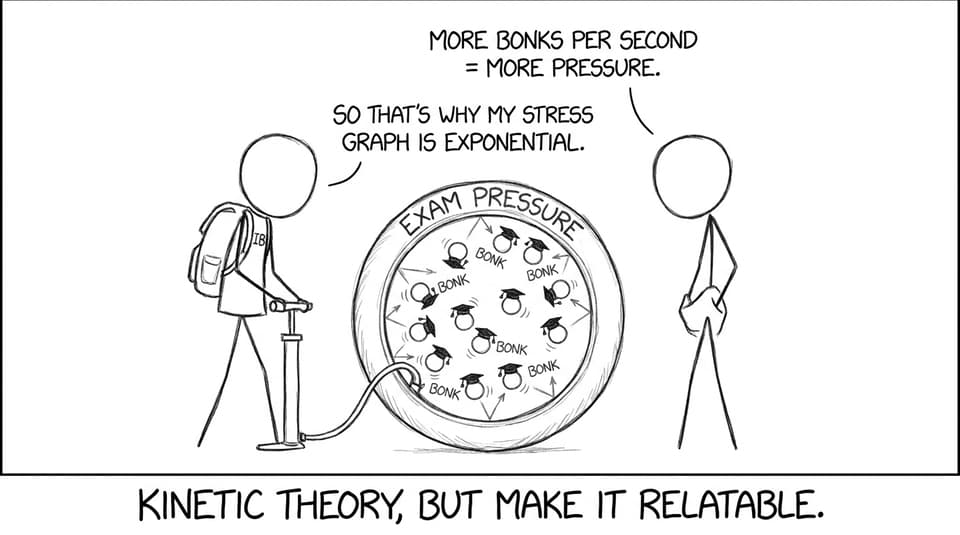
So when gas particles collide more frequently, pressure increases because the wall experiences more momentum changes per second, meaning a larger total force spread over the same area.
The 10-second checklist (exam-ready)
For IB Chemistry, keep this mental checklist:
-
Pressure is caused by particle-wall collisions.
-
More collisions per second (higher frequency) means higher force.
-
Stronger collisions (higher speed) also means higher force.
-
If V is constant and T rises, P rises.
-
If T is constant and V falls, P rises.
-
If T and V are constant and n rises, P rises.
If you want the formula anchor, connect it back to PV = nRT using The Ideal Gas Equation Explained | RevisionDojo.
IB Chemistry particle model: pressure is momentum bookkeeping
In kinetic molecular theory, gas particles move randomly and collide elastically with the container walls. Each wall collision changes the particle’s momentum (it reverses direction), and Newton’s laws tell you that changing momentum requires a force.
In other words, pressure is what you get when you average an enormous number of tiny “momentum swaps.” That’s why IB markschemes love phrases like “more frequent and more energetic collisions with the container walls”.
For a quick refresh on the assumptions behind this model, revise IB Chemistry S1.1.2 the Kinetic Molecular Theory Notes.
Three ways collision frequency increases (and what examiners want)
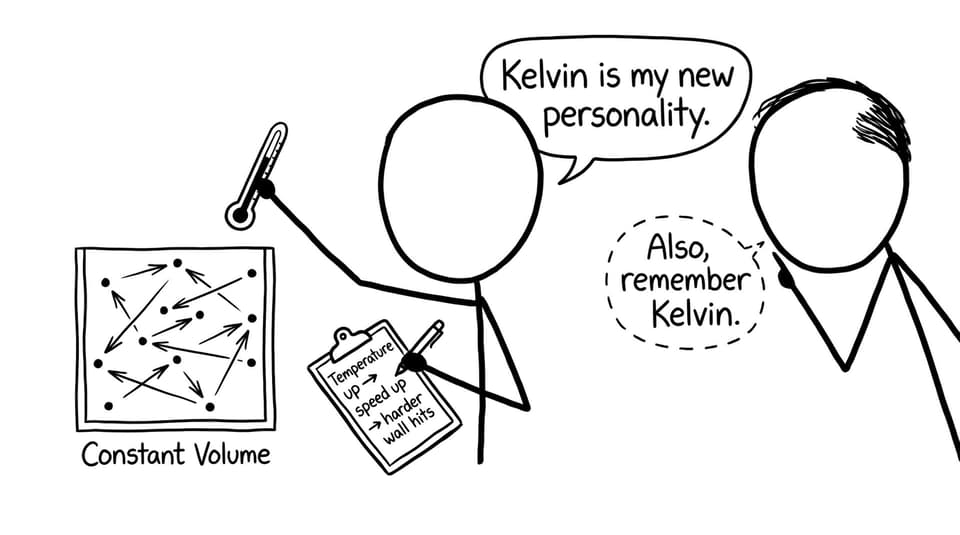
Temperature increases (at constant volume)
Heating a gas increases average kinetic energy, so particles move faster. Faster particles:
-
hit the walls more often (frequency increases), and
-
hit the walls harder (momentum change per collision increases).
So pressure rises quickly when T rises and V is fixed (Gay-Lussac style thinking, even if you mainly cite PV = nRT).
If you want a clean temperature story for IB Chemistry wording, see IB Chemistry: How Temperature Changes Gas Volume.
Volume decreases (compression)
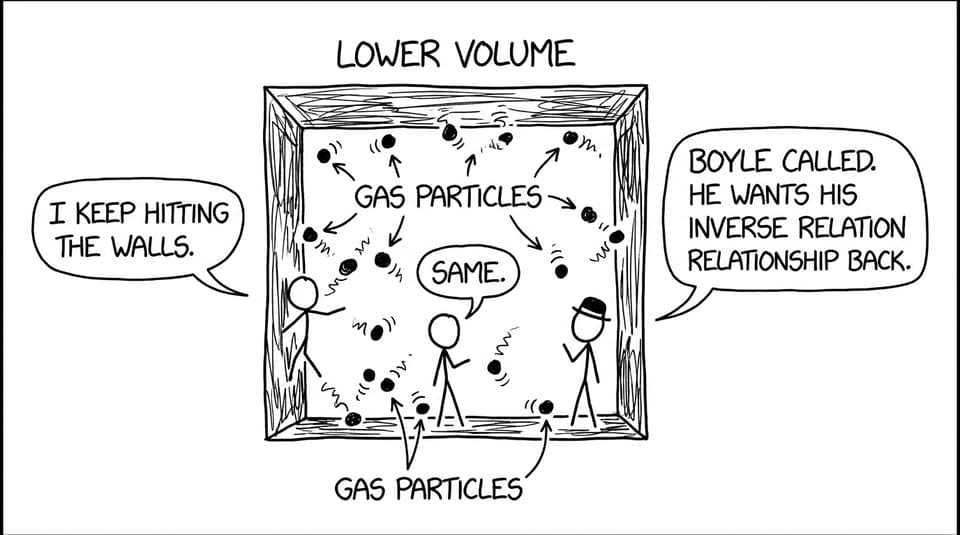
When you compress the same amount of gas into a smaller space, particles have less distance to travel before reaching a wall. That raises collision frequency even if temperature stays constant.
This is the intuition behind Boyle’s law: smaller V means larger P because the wall gets “pinged” more often.
More moles of gas are added (crowding)
Add more particles to the same volume at the same temperature, and you simply have more “bouncers” available to hit the walls. Collision frequency rises because there are more particles moving around.
This links neatly to Avogadro-style reasoning and the n term in PV = nRT. Reinforce that link with What Is Avogadro's Law? IB Chemistry Explained or the syllabus-aligned Notes for S1.4.6 Avogadro's law - IB.
How to turn this into marks (not just vibes)
In IB Chemistry, the highest-scoring explanations usually include:
-
a definition: pressure = force per unit area from collisions
-
a mechanism: collisions transfer momentum to walls
-
a cause: higher frequency and/or higher speed
-
a condition: “if volume remains constant” or “at constant temperature”
Then practice it until it becomes automatic with the S1.5 Ideal gases hub and the IB Chemistry Topic S1.5 Ideal Gases Questionbank (SL/HL). RevisionDojo’s Questionbank plus AI Chat is especially useful here: you can paste your own explanation and ask, “Does this hit the markscheme points?”
Wrap-up: make collisions your mental model
When you’re under exam pressure, it helps to remember that pressure itself is just counting wall-hits: more frequent (or more forceful) collisions mean more force per area, so pressure increases. That single picture connects kinetic theory, Boyle’s law intuition, and the ideal gas equation in one move, perfect for IB Chemistry.
If you want this to feel effortless, build a quick routine on RevisionDojo: read the IB Chemistry Topic S1.5 Ideal Gases Revision Notes (SL/HL), test yourself in the Questionbank, and use AI Chat to tighten your explanations to markscheme language. Then finish with Predicted Papers and Mock Exams to make the reasoning stick when it counts.


