


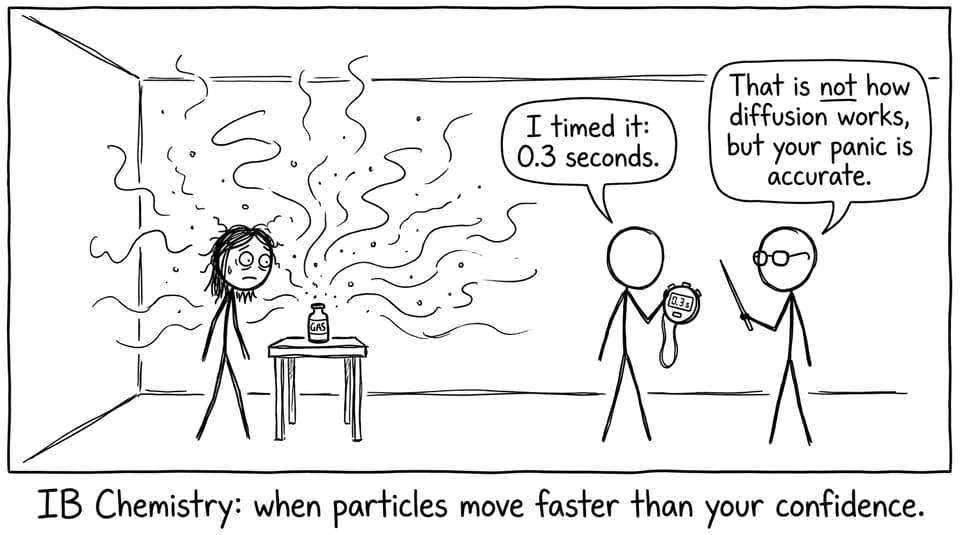
Gases have a talent that feels almost personal: the moment you stop paying attention, they are everywhere.
Open a bottle for one second, and the smell seems to “claim” the room. Leave a syringe unsealed, and the plunger drifts. In IB Chemistry, this isn’t a cute mystery. It’s a predictable consequence of how gas particles move, collide, and spread out.
Quick exam checklist (IB Chemistry)
If you can say these five lines clearly, you can explain most “why do gases expand?” questions in IB Chemistry:
-
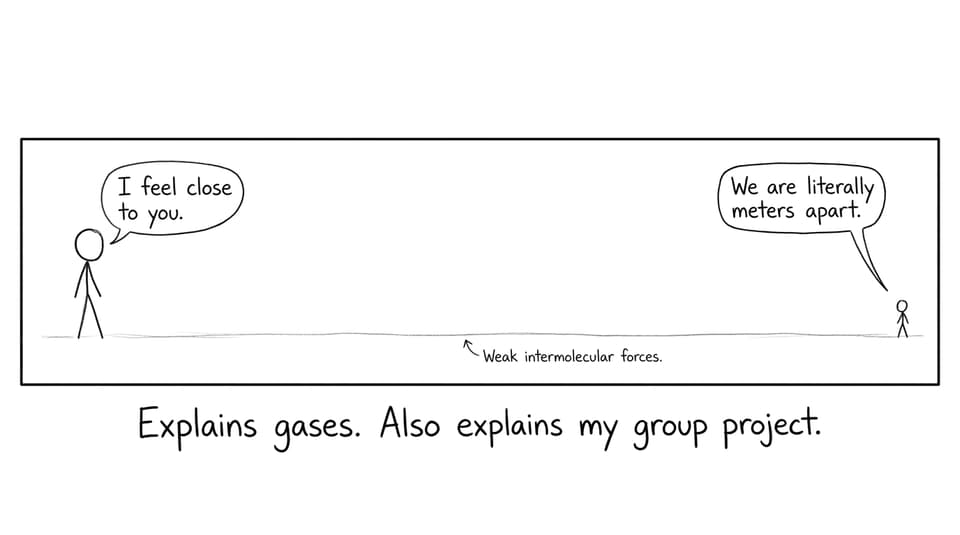
Gas particles are far apart (lots of empty space).
-
Intermolecular forces are negligible compared to kinetic energy.
-
Particles move in constant, random motion.
-
They travel in straight lines between collisions.
-
Collisions with container walls create pressure.
For syllabus-aligned support, keep the kinetic molecular theory page open while you revise: S1.1.2 The Kinetic Molecular Theory Notes.
The core idea: motion with almost no “tether”
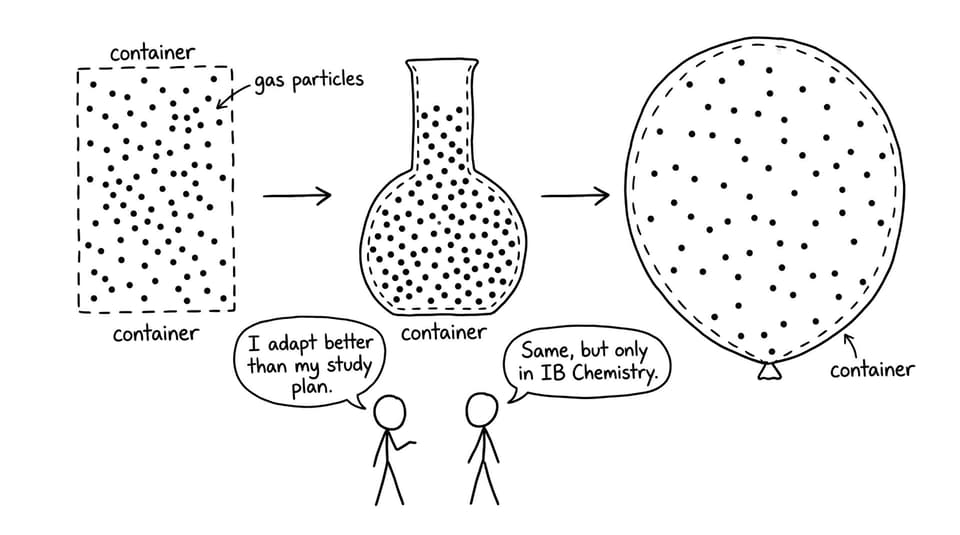
In solids and liquids, particles are close enough that attractions matter all the time. In gases, particles are so widely spaced that attractions barely get a say. So each particle behaves like an independent explorer.
That independence is the real reason gases expand to fill any container: there is no strong “pull” gathering particles back into one region. Random motion does the opposite. It spreads them out.
If you want the IB wording, anchor your explanation in the model assumptions from the gases unit: S1.5 Ideal gases.
Diffusion is not magic, it’s statistics
Students sometimes imagine particles “deciding” to spread out. A better IB Chemistry explanation is statistical:
-
In a container, there are vastly more microstates (arrangements) where particles are spread out than clumped in one corner.
-
Random motion makes the system drift toward the most probable distribution.
-
That most probable state looks like “evenly filled.”
This is why two gases mix without stirring: each particle keeps moving randomly, and mixing is simply the overwhelmingly likely outcome.
Pressure connects the particle story to the macroscopic story
Examiners love when you link microscopic collisions to macroscopic pressure.
Gas pressure comes from particles colliding with container walls. If the container volume increases, collisions per second temporarily drop, so pressure drops. Then particles move into the newly available space, restoring a more uniform collision pattern across the walls. The gas ends up occupying the entire container.
For a focused pressure explanation you can quote and adapt in your own words, see: Why does pressure increase when gas particles collide more frequently.
How this shows up in IB Chemistry questions
The “expand to fill the container” idea is often a hidden first step in gas-law problems:
-
Using proportional reasoning from Boyle’s Law and Charles’s Law.
-
Explaining why a balloon changes size with temperature.
-
Justifying why gases mix uniformly.
To connect this directly to calculations, revise: The Ideal Gas Equation Explained and How Temperature Affects Gas Volume for IB Chemistry.
And when you want the fastest way to turn understanding into marks, use targeted practice: S1.5 Ideal gases - IB Questionbank or browse by topic here: IB Chemistry Questionbank.
Bring it home to marks with RevisionDojo
If you can explain why gases expand to fill any container, you’re not just memorizing IB Chemistry facts. You’re translating the particle model into exam language: spacing, random motion, weak attractions, wall collisions, and pressure.
To lock it in, pair concepts with practice on RevisionDojo: use the Study Notes and Flashcards for quick recall, then attack the Questionbank with AI Chat and Grading tools for feedback that matches examiner logic. When exams get close, Predicted Papers and Mock Exams make the ideas feel automatic, and the Tutors and Coursework Library help if gaps show up late.
Your container can be any shape. Your explanation should be, too: flexible, clear, and built for full marks in IB Chemistry.