
Choosing the IB Diploma can feel like deciding what the next two years of your child’s life will look like in a single conversation. It is natural to worry about workload, stress, university options, and whether encouragement might quietly become pressure.
The most helpful approach is simpler: explain what the programme actually requires, ask how your child feels about that kind of learning, and investigate whether the school can provide the support they would need. The decision should reflect their interests, working habits, wellbeing, and future plans, not the reputation of the qualification alone.
When talking to your child about IB choice, your role is not to persuade them toward a predetermined answer. It is to help them replace a vague fear of “the IB” with specific, answerable questions.
A quick checklist for the IB conversation
Before making the decision, try to establish five things together:
- Does your child understand the structure of the Diploma Programme?
- Are the available subjects compatible with their interests and possible university plans?
- How do they respond to sustained coursework, independent research, and deadlines?
- What academic and wellbeing support does the school provide?
- Does your child feel involved in the decision rather than judged by it?
You do not need to settle everything in one evening. In fact, several shorter conversations are usually more revealing than one formal family summit.
Begin with what the IB Diploma actually involves
A useful discussion starts with shared facts. The IB Diploma Programme is a two-year programme primarily intended for students aged 16 to 19. Students study six subjects across a broad curriculum and complete three core elements: Theory of Knowledge, the Extended Essay, and Creativity, Activity, Service.
Most Diploma students take three subjects at Higher Level and three at Standard Level, although the precise combination can vary within IB rules and school offerings. Subjects are graded from 1 to 7, while Theory of Knowledge and the Extended Essay can contribute up to three additional points. The maximum Diploma score is 45. Receiving the Diploma normally requires at least 24 points as well as satisfying the IB’s other passing conditions, including completing CAS.
If those terms are new to your family, read this clear explanation of how the IB Diploma works together. Understanding the structure prevents the conversation from being dominated by second-hand stories about whether IB is impossibly hard or automatically impressive.
IB is broad, research-oriented, and assessed through more than final examinations. Depending on the subject, students may complete internal assessments, oral tasks, practical work, essays, and externally assessed examinations. That variety suits some learners better than others. RevisionDojo’s guide to IB facts and common misconceptions can help separate genuine demands from hallway mythology.
Ask questions that reveal fit, not status
Parents can unintentionally frame the choice as a test of ambition: “Are you capable of doing IB?” That question is emotionally heavy and practically weak. Many capable students could complete the programme, but that does not mean it is the best route for every student.
More useful questions include:
- Which subjects do you enjoy enough to study in depth for two years?
- Do you like making connections across different areas, or would you prefer greater specialization?
- How do you feel about writing, research, oral work, and long-term projects?
- What worries you most: difficulty, time, grades, or losing space for other interests?
- What kind of help would make the programme feel manageable?
Listen for specifics. “It sounds stressful” may mean your child has heard alarming stories. It may also mean they already struggle with sleep, organization, or competing commitments. Those situations require different responses.
Avoid answering every concern immediately. A sentence such as “Let’s work out whether that fear is based on the programme itself, the way your school runs it, or something we can plan for” keeps the conversation open.
Be honest about workload without turning it into a warning
The IB Diploma is demanding. Its difficulty comes not only from complex content, but from coordinating six subjects, core requirements, internal deadlines, and examination preparation over two years.
Research into Diploma student wellbeing has found that workload can be challenging to manage and that parents, teachers, and peers can either reduce stress through support or intensify it through pressure. More recent research has also highlighted variation: some students report being overwhelmed, while others thrive within the programme. “IB is stressful” is therefore incomplete. The better question is whether this student, in this school, with this support system, can manage its demands sustainably.
Talk about current habits without treating them as permanent character traits. A child who procrastinates now is not destined to procrastinate forever. But choosing IB on the assumption that organization will somehow appear is equally unhelpful.
Discuss practical systems:
- How are school deadlines coordinated across subjects?
- Who notices when a student begins falling behind?
- Is there access to the IB coordinator, counsellors, learning support, or subject teachers?
- Can extracurricular commitments be adjusted during intense periods?
- What routines currently protect sleep, exercise, and downtime?
For a realistic picture, explore healthy habits for balancing IB and life. If your child is already in the programme and examinations are approaching, the guide to managing IB exam stress offers a more immediate framework.
Connect subject choices to future plans carefully
The IB Diploma is recognized by universities internationally, but recognition does not mean that every subject combination satisfies every course requirement. Universities and national admissions systems set their own conditions, which can change.
If your child has possible destinations or degree areas in mind, investigate them before selecting Higher Level subjects. Look at official university admissions pages, note required subjects and grades, and ask the school’s university adviser to confirm your interpretation. If your child is undecided, focus on preserving plausible options rather than forcing a career decision at 15 or 16.
The conversation might sound like this: “You do not need to know your whole future. We should still check whether this combination keeps the routes you currently care about open.”
RevisionDojo’s guide to discussing IB subjects and careers provides a useful starting point. Families should then verify current entry requirements directly with each institution.
Treat the school environment as part of the decision
IB is a common framework, but the day-to-day experience is shaped by the school. Subject availability, timetable design, teacher experience, deadline coordination, class size, and student support can materially affect the experience.
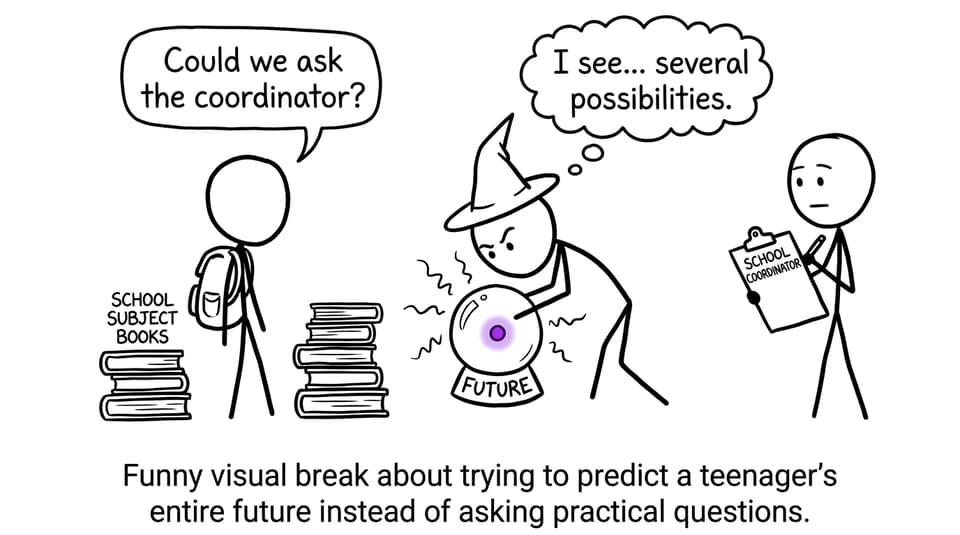
Arrange a conversation with the IB coordinator and let your child ask some of the questions. Useful topics include:
- Which subjects and levels will actually run?
- How does the school schedule major internal deadlines?
- What happens when a student is struggling academically or emotionally?
- Can students change levels or pathways, and by what deadline?
- What do current students wish they had understood before starting?
Also clarify the available routes. In some schools, the choice is not simply full Diploma or no IB. Students may be able to take individual Diploma Programme courses or pursue another qualification entirely. The differences matter for workload, credential outcomes, and university applications. This comparison of the full IB Diploma and individual IB courses can help your family formulate better questions, but the school must confirm its own options.
Watch for pressure hiding inside supportive language
Parents rarely intend to make their child feel that affection depends on academic performance. Pressure often arrives more quietly through repeated comparisons, constant grade questions, or statements about “wasting potential.”
Try to distinguish three messages:
- Confidence: “I believe you could learn how to manage this.”
- Permission: “Choosing another suitable route would not disappoint me.”
- Responsibility: “Whichever route you choose, we should understand its commitments.”
All three matter. Confidence without permission can feel like an order. Permission without honest discussion can leave a teenager making a major decision with too little guidance.
If your child is strongly opposed to IB, do not dismiss that response. Ask for the reasons and investigate them. Equally, if they want IB mainly because friends are choosing it or because it sounds prestigious, help them examine what the ordinary Tuesday afternoon version of that decision will involve.
Create a decision rather than demanding an answer
A calm decision process can take place over a week or two:
| Step | What to do |
|---|---|
| Understand | Review the Diploma structure, assessment, and available school subjects. |
| Explore | Ask your child what attracts or worries them. |
| Verify | Check school support and current university requirements. |
| Compare | Consider IB alongside the realistic alternatives. |
| Decide | Let your child explain their preferred route and reasoning. |
| Review | Agree on what support and warning signs will matter after starting. |
This process gives the student meaningful ownership without asking them to make the decision alone. It also turns disagreement into research. Instead of arguing about whether IB is “worth it,” you can investigate the particular issue underneath: subject access, workload, learning style, or admissions requirements.
Frame IB as doable with the right support
The healthiest final message is neither “IB will be easy” nor “IB will consume your life.” It is this: IB is demanding, but it can be doable with the right subjects, realistic routines, school support, and timely help.
That last part matters because students often imagine the programme as two years of handling every difficulty alone. Show them what support would look like before they need it. Teachers and coordinators provide school-specific guidance. Family can protect routines and notice changes in wellbeing. Structured resources can make studying less chaotic.
RevisionDojo’s all-in-one IB resources help remove some of the fear factor by making the work more concrete. Students can clarify content with Study Notes and AI Chat, practise recall with Flashcards, and apply concepts through the Questionbank. As assessments approach, Grading tools, Predicted Papers, and Mock Exams can support feedback and timed preparation. The Coursework Library provides models for understanding expectations, while Tutors offer human guidance when independent study is not enough.
The point is not that one platform makes the decision automatically right. It is that “Can I cope?” becomes less frightening when your child can see the systems, people, and tools available to help.
The best conversation leaves room to think
A good IB discussion does not end with a triumphant yes or a relieved no. It ends with your child feeling heard, better informed, and able to explain what matters to them.
Start with facts. Explore fit. Verify the school and university details. Be candid about workload while making it clear that asking for help is part of responsible learning, not evidence of failure.
If your child chooses the Diploma Programme, the next step is to build support before pressure rises. Explore RevisionDojo’s smarter approach to IB exam preparation together and agree on a sustainable routine. The aim is not to remove every challenge. It is to ensure that challenge never has to become confusion faced alone.