



A child asking to change an IB subject halfway through the year can make a parent wonder whether something has gone seriously wrong. Often, it has not. The request may reflect a genuine mismatch, a newly discovered university requirement, or simply the first difficult stretch of a demanding course.
The clear answer is yes, switching IB subjects mid year may be possible, especially in IB Year 1, but it is not automatic. The school must approve the change, the replacement subject must fit the timetable, and the student needs a realistic plan for catching up. The later the request comes, the more difficult the switch becomes.
Parents should contact the school's Diploma Programme coordinator promptly. Only the school can confirm its internal policy, determine whether the proposed combination satisfies Diploma requirements, and amend the student's official assessment registration when necessary.
The short checklist for parents
Before supporting or rejecting the request, establish five things:
- Why does your child want to switch? Separate temporary difficulty from a lasting mismatch.
- Will the school permit it? Policies, class capacity, timetables, and internal deadlines vary.
- How much content has the new class completed? Ask for a topic-by-topic catch-up estimate.
- Will the change preserve the Diploma structure? The subject groups and HL/SL balance must remain valid.
- Could it affect university options? Check current entry requirements for likely courses and institutions.
A useful first step is understanding how the IB Diploma works. The decision becomes clearer when everyone can see the structure surrounding one individual subject.
Why the school makes the final decision
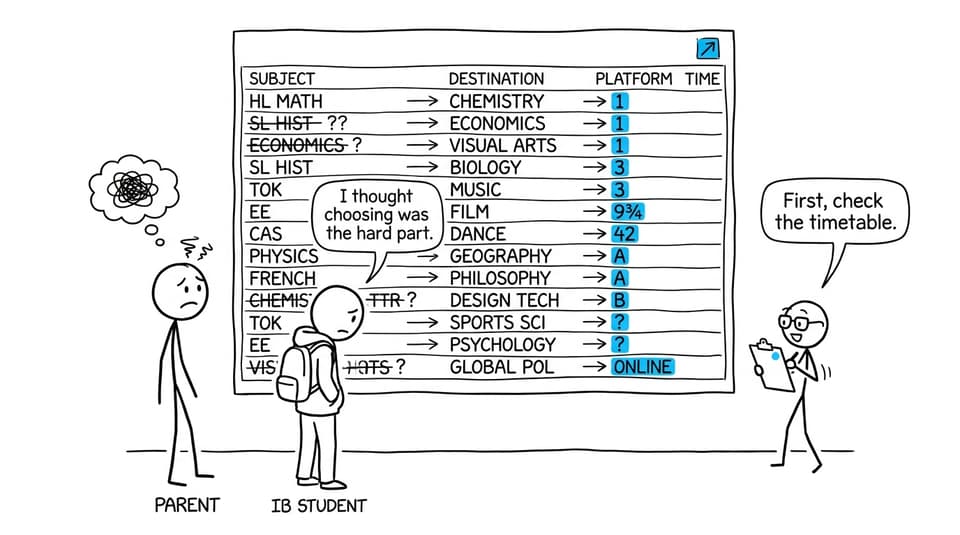
The IB Diploma Programme is not six unrelated courses collected on one transcript. It is a coordinated two-year programme with subject-group rules, different teaching-hour expectations at Higher Level and Standard Level, internal assessments, and the core components of Theory of Knowledge, the Extended Essay, and Creativity, Activity, Service.
Under the current IB curriculum structure, Diploma students normally study six subjects. They take at least three and no more than four at Higher Level, with the remainder at Standard Level. Students generally select across six subject groups, although an arts subject can be replaced by an additional subject from Groups 1 to 4. The IB recommends 240 teaching hours for an HL course and 150 for an SL course.
That structure explains why a seemingly simple request can have several consequences. Moving from one Group 3 subject to another may preserve the overall combination, for example, while replacing a required language or mathematics course could create a structural problem. Parents who need a refresher can review how many IB subjects students take.
There is also an administrative boundary. Students and parents cannot independently change an official IB assessment registration. The DP coordinator handles registration through the IB's system, and amendments made after applicable registration deadlines can incur additional fees. Because session dates and school procedures may change, ask the coordinator for the deadlines that apply to your child's examination session rather than relying on a general date found online.
When a mid-year subject change is realistic
A switch is most realistic during IB Year 1, often called DP1. At that stage, the student has missed months rather than an entire year, and major assessment work may still be manageable. Even then, approval depends on the school.
Schools commonly examine:
- whether the new class has space;
- whether both subjects occupy compatible timetable blocks;
- whether the student has the required prior knowledge;
- how much syllabus content must be recovered;
- whether internal assessment deadlines remain achievable;
- whether teachers can produce credible progress evidence or predicted grades;
- whether the revised combination supports the student's intended university pathway.
Changing from HL to SL within the same subject can sometimes be more manageable than replacing the subject entirely, because much of the underlying course content overlaps. However, an HL-to-SL move may require another subject to move up to HL so that the overall Diploma combination remains valid.
By DP2, a full subject replacement becomes substantially harder. The student may have missed a large share of the recommended teaching time, while coursework and university applications are already advancing. RevisionDojo's guides to changing subjects during DP1 or at the start of DP2 and changing an IB subject after Year 1 explain those later-stage risks in more detail.
Diagnose the reason before changing the timetable
The most important question is not simply, “Can the subject be changed?” It is, “What problem are we trying to solve?”
A switch may be sensible when the course conflicts with a verified university prerequisite, the student entered at an unsuitable language level, or the subject is a persistent mismatch despite appropriate effort and support. It may also be necessary when health or wellbeing concerns make the present workload unsustainable, although those conversations should involve the relevant school support staff.
The case is less clear when the request follows one disappointing result, a difficult unit, friendship changes, or frustration with a teaching style. Those concerns still matter. But changing subjects may replace a visible problem with a larger, less visible one: months of unfamiliar content and compressed assessment work.
Ask your child to describe the difficulty precisely:
- Is the content not understood?
- Is knowledge understood but not converted into marks?
- Is the workload concentrated in one HL course?
- Is the concern about the subject or one current topic?
- Has the student consistently used feedback and sought help?
- Would changing the level solve the problem without changing the subject?
This is a better conversation than asking whether the subject is simply “too hard.” The parent guide to IB subject struggles can help families distinguish a recoverable learning gap from a deeper mismatch.
Check university requirements before approving a switch
Subject choice can affect eligibility for particular university courses. Requirements vary by institution, country, programme, subject, and level. A university may accept the IB Diploma generally while still requiring a specific HL subject for a particular degree.
Do not base this decision on broad statements such as “engineering needs mathematics” or “medicine needs science.” Check the official admissions page for each realistic programme and entry year. Record whether a subject is required, recommended, or merely useful. If the wording is unclear, contact the institution directly and retain the response.
This works in both directions. A child may discover that switching protects an important option. Alternatively, the family may learn that the proposed change would close a pathway the student still values. RevisionDojo's discussion of IB subject choices and future careers offers a useful framework for that conversation.
Build a catch-up plan before signing the form
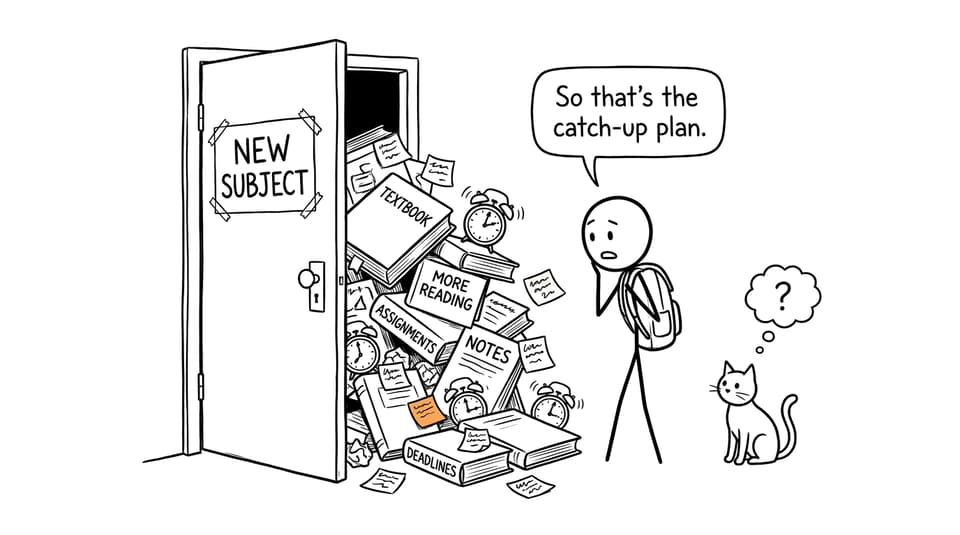
If the school is open to the change, ask the receiving teacher to define the missing work before the family commits. “I will catch up” is an intention. A plan identifies topics, assessments, resources, deadlines, and support.
| Question to settle | Evidence of a workable answer |
|---|---|
| What content has been missed? | A syllabus-based list from the receiving teacher |
| What must be completed first? | Priorities based on prerequisite knowledge and upcoming assessments |
| When will catch-up happen? | Protected weekly sessions with dated milestones |
| How will progress be checked? | Topic tests, submitted work, or teacher conferences |
| What support is available? | Teacher help, structured resources, or tutoring |
| What happens if progress stalls? | A review date and an agreed fallback option |
Use the RevisionDojo IB syllabus hub to compare the student's current knowledge with the new course's topics and assessment structure. The first weeks should focus on foundations and imminent classwork, not on trying to read every missed page in order.
Try a short academic rescue plan first when struggling is the cause
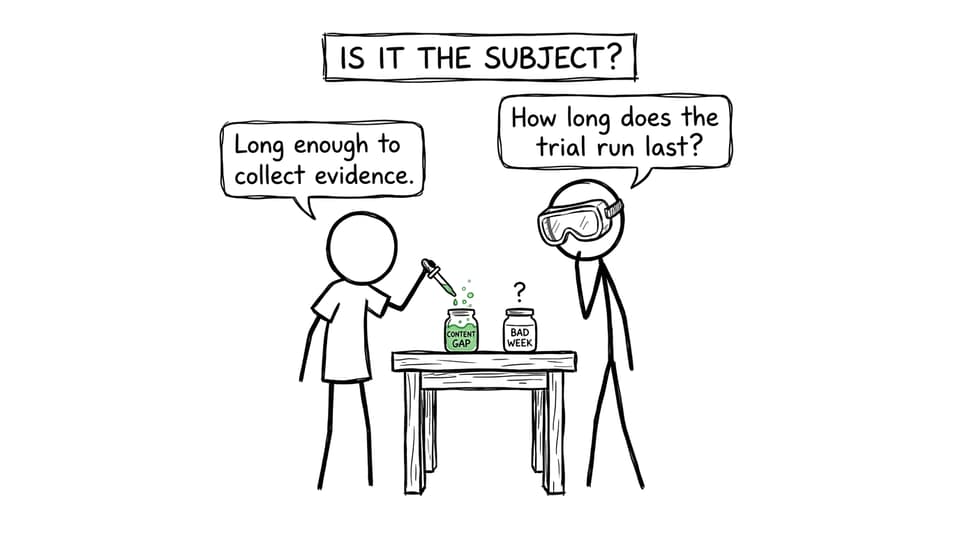
A subject change is expensive in time, even when there is no financial charge. Before making it irreversible, a student who is switching mainly because of poor performance may benefit from a short, structured trial of better support.
For two or three weeks, identify one or two weak topics. Use clear Study Notes to rebuild understanding, Flashcards for active recall, and the RevisionDojo Questionbank to test whether that understanding survives contact with exam-style questions. AI Chat can clarify a specific misconception, while Grading tools can reveal whether the real issue is knowledge, command terms, or answer structure.
The goal is evidence, not endless perseverance. Mock Exams and Predicted Papers can test performance under time pressure, while the Coursework Library can clarify expectations for assessed work. If the gap remains severe, a RevisionDojo Tutor can help the family judge whether the problem is technique, missing foundations, or genuine subject fit. The guide for students who feel behind provides a practical starting routine.
Sometimes this trial shows that the subject is recoverable. Sometimes it confirms that changing is the healthier choice. Both outcomes are useful because the final decision is based on patterns rather than panic.
A calm next step for IB diploma parents
Contact the DP coordinator and request one meeting involving your child, the current teacher, and, where possible, the proposed teacher. Bring the university checks and ask for the school's policy, timetable constraints, registration implications, missed content, assessment deadlines, and approval process in writing.
Then compare two honest plans: a recovery plan for staying and a catch-up plan for switching. The better option is not the one that promises immediate relief. It is the one your child can realistically sustain while preserving wellbeing, Diploma eligibility, and future choices.
RevisionDojo can support either path. It can help a struggling student test whether the current subject is salvageable, or give an approved switcher a structured way to close specific gaps. In an IB programme full of consequential decisions, clarity is often more valuable than speed.