
If you’ve ever stared at an IB question and felt the strange mix of “I know this topic” and “I have no idea what they want,” you’re not alone. The IB doesn’t just test knowledge. It tests interpretation: command terms, examiner logic, and the small details that quietly cost marks.
That’s where IB question explanations by AI become genuinely useful, not as shortcuts, but as clarity tools. On RevisionDojo, Jojo AI helps you understand what a question is really asking, why an answer earns marks, and how to fix misunderstandings before they calcify into habits.
What “good” IB AI question explanations should do
Use this quick checklist when you’re choosing how to revise for IB exams:
-
Translate command terms (analyse, evaluate, compare) into an actionable plan
-
Connect your attempt to markscheme logic (what earns marks, what doesn’t)
-
Teach the concept behind the mistake, not just the final answer
-
Adapt practice so you see the same weakness again (on purpose), until it improves
RevisionDojo is built around that loop: Study Notes, Flashcards, Questionbank, AI Chat, Grading tools, Predicted Papers, Mock Exams, a Coursework Library, and Tutors working together.
Break down IB command terms without guessing
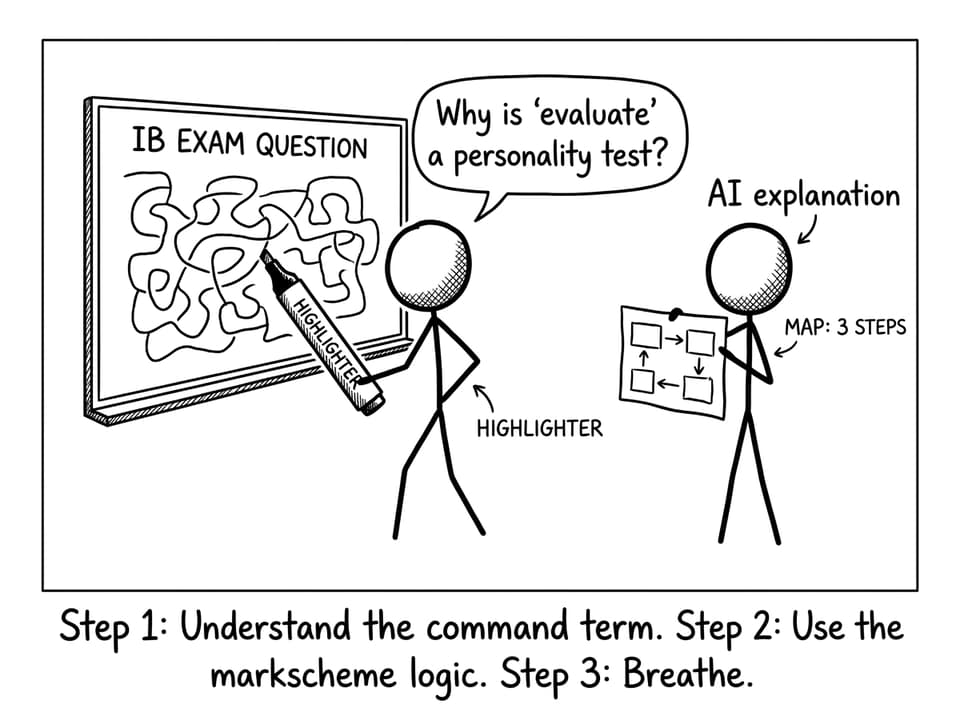
Most IB stress comes from ambiguity. “Evaluate” feels like a trap. “Discuss” feels endless. AI explanations help most when they convert vague wording into steps.
With Jojo AI, you can ask for a word-by-word breakdown of the prompt, then follow up with “What would a top-band response focus on first?” That’s a different experience from generic chatbots, because it’s designed for IB style and assessment.
To explore the tool itself, start here: Jojo AI feature page.
Learn markscheme thinking with model answers you can compare
In IB, you can be “basically right” and still lose marks. Usually it’s structure, precision, or missing a key point.
AI question explanations help when they show:
-
A model response that mirrors examiner expectations
-
Where marks were earned (and where they leaked)
-
Better phrasing that matches IB command terms
RevisionDojo’s ecosystem makes this practical: do targeted practice in the IB Question Bank guide, then upgrade your approach with a bigger picture of what quality practice looks like in IB Question Bank: Thousands of Practice Questions.
Turn mistakes into fast, repeatable improvement loops
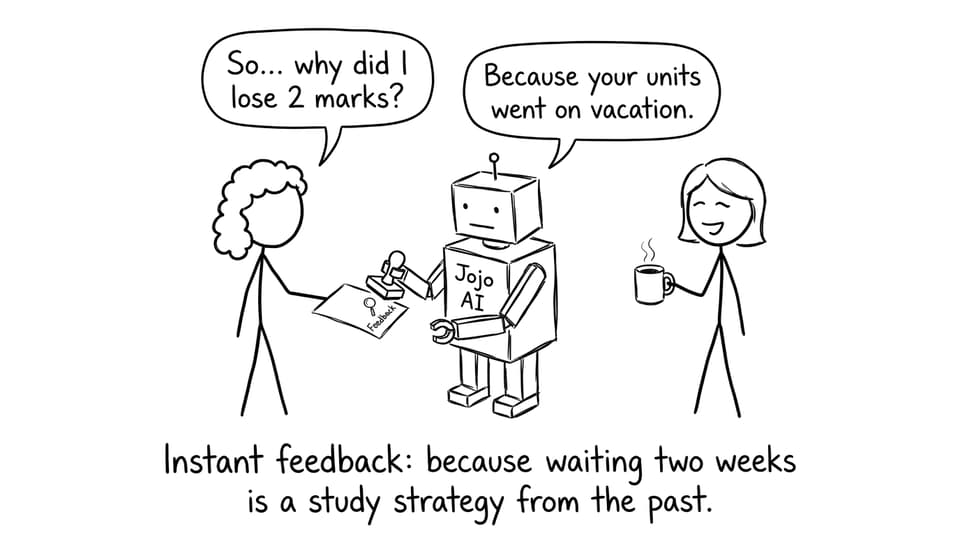
A quiet advantage of IB AI explanations is speed. Not rushing, just shortening the gap between confusion and correction.
Here’s a simple loop many students use:
-
Do a short set in the Questionbank (one topic)
-
Read the AI explanation until you can re-explain it yourself
-
Convert the missed idea into Flashcards for spaced repetition
-
Re-try a similar question within 48 hours
If you want a broader strategy for staying consistent, this pairs well with How to Study for IB Exams Without Burning Out.
Use IB-style rehearsal to make explanations “stick” under pressure
Understanding in calm conditions is one thing. Performing under time pressure is another.
That’s why RevisionDojo connects explanations to rehearsal: mock-style runs with immediate feedback. If you want to build that exam-day stamina, read IB Mock Exam Feedback: Get Instant Results and Explanations and, for the bigger structure behind realistic practice, IB Predicted vs Specimen Papers: What They Mean.
FAQ
Is using AI for IB question explanations actually helpful, or just comforting?
It’s helpful when it changes what you do next. The best IB AI question explanations don’t just reassure you that you “get it”, they show why a response earns marks and what specific gap held you back. Comfort fades fast if you keep repeating the same mistake under timed conditions. A good AI explanation should push you toward a clearer method, better structure, and tighter evidence. It should also help you practice the same skill again, soon, so learning becomes measurable. On RevisionDojo, that’s the point: explanations are connected to Questionbank practice, Flashcards, and Mock Exams so the insight turns into a score change.
How do I use IB AI explanations without becoming dependent?
Use explanations as a mirror, not a crutch. First, attempt the IB question on your own, even if it’s messy. Then compare your response to the AI breakdown and ask, “Which mark did I fail to earn, and why?” Next, rewrite only the weak part: the definition, the justification, the evaluation, the conclusion. Finally, do one more similar question to prove the fix worked. This pattern keeps your thinking active, and it’s exactly why RevisionDojo combines AI Chat with practice tools instead of separating them.
What if I need help beyond exam questions (like IA, TOK, or EE)?
That’s normal in the IB, because coursework stress leaks into exam prep time. The goal is to reduce that background noise so you can revise consistently. RevisionDojo supports that with Grading tools and a Coursework Library, so you can check rubric alignment earlier instead of guessing for weeks. If you’re choosing what to prioritize, Which IA Should You Start First? A Calm IB Strategy is a practical starting point. And when you want human guidance, Tutors can turn feedback into a plan rather than a pile of comments. The best system is the one that keeps you moving, one clear step at a time.
A calmer way to do IB revision
The IB gets easier when questions stop feeling like riddles. With IB question explanations by AI, you’re not just collecting answers; you’re learning the examiner’s logic, one prompt at a time.
If you want that clarity in a full study loop, open RevisionDojo’s Jojo AI feature page, then pair it with Questionbank practice, Flashcards, and timed Mock Exams. Your next IB breakthrough is usually one explanation away, the kind that finally makes the concept click.