
In IB History, the Internal Assessment can feel like a quiet deadline that keeps growing teeth.
One day it’s “just pick a topic.”
The next day you’re staring at a document with three half-written introductions, eight tabs of sources, and the uneasy thought that you might be spending hours to earn marks you’re not sure how to win.
Here’s the calming truth: the IB History HL IA is not won by genius. It’s won by sequencing. When you follow the right steps, you stop improvising and start building.
This step-by-step guide to writing your IB History HL IA walks you through the process from topic selection to final polish, with a structure that matches what examiners actually reward.

A quick IB History HL IA checklist (save this)
Before we go deep, here’s the simple route map for an IB History HL IA:
-
Pick a topic you can stay curious about for weeks
-
Shrink it until it fits a 2,200-word investigation
-
Draft a focused, arguable research question
-
Collect a small set of high-quality sources (not a mountain)
-
Plan Section A (source evaluation), Section B (investigation), Section C (reflection)
-
Write with analysis first, narrative second
-
Cite as you go, then run a final “trace test”
-
Get feedback, revise, and proofread like it’s a submission, not a draft
If you want the official-feeling overview in one place, start with IB History Resources and keep it open while you plan.
Step 1: Choose an IB topic you can actually live with
The best IB History HL IA topics have an underrated quality: they keep you awake.
Not because they’re stressful, but because you genuinely want to know the answer.
If you pick a topic you don’t care about, every step after this becomes a negotiation with your own attention.
A strong starting point is to pick a unit you’ve already studied (Cold War, authoritarian states, civil rights, 20th-century wars) and then ask: where do historians disagree, even slightly? That disagreement is oxygen for an IB investigation.
If you’re stuck, browse models for what “IA-sized” looks like: IB History Examples gives you real samples so you can see the scale, tone, and level of specificity that earns marks.
Topic filters that make your life easier
Use one of these “shrink tools” to make your topic manageable:
-
Time frame: 3-10 years, not 50
-
Place: one country, city, or region
-
Actor: one leader, party, institution, or movement
-
Policy/decision: one treaty, reform, intervention, or election
-
Turning point: one event that changed outcomes
This is how an IB History HL IA stops being “about everything” and starts being about something you can prove.
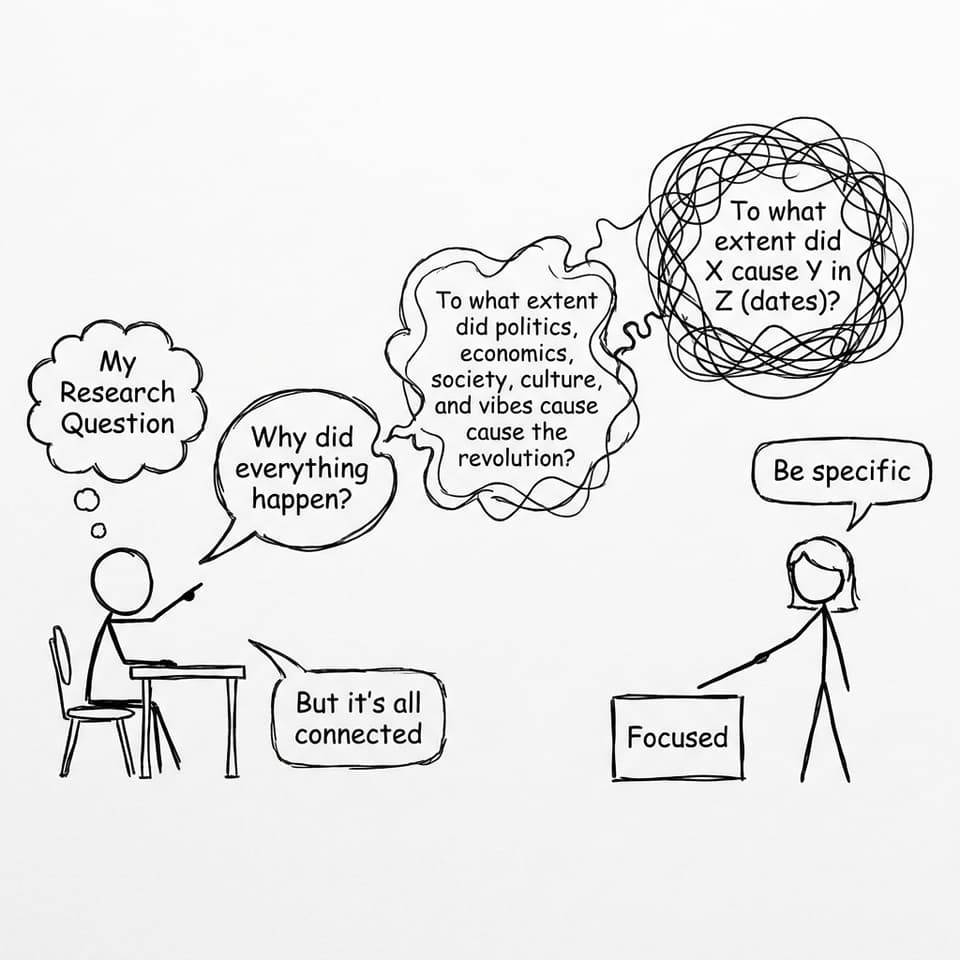
Step 2: Turn your interest into a focused research question
Your research question is the steering wheel. If it’s loose, your whole IB draft swerves.
The goal is clarity + argument + evidence.
A good question doesn’t just invite storytelling. It forces judgement.
Common IB History HL IA research question stems:
-
To what extent did X contribute to Y between (dates)?
-
How significant was X in shaping Y in (place) during (dates)?
-
Did X primarily cause Y, or were other factors more important?
Notice what these do: they push you toward weighing factors, not listing them.
If you want a quick reality check on whether your question is narrow enough, compare it to the criteria language and planning guidance inside RevisionDojo’s IA hub: IB Internal Assessment Guides.
Step 3: Research like an IB historian (small, strong, deliberate)
Research is where many IB students accidentally waste time.
They collect too many sources, too early, without knowing what each one is supposed to do.
Instead, research in two passes:
First pass: build your foundation
Aim for 3-5 solid secondary works (books, academic articles, reputable history sites) that give you:
-
background context
-
key debates
-
useful evidence (dates, statistics, quotations)
-
historiographical angles you can mention briefly
Tools like JSTOR and Google Scholar are still useful, but your main rule is simple: in IB History, quality beats quantity.
Second pass: choose your “two key sources” for evaluation
Your IB History HL IA requires clear evaluation, so pick two sources you can discuss in depth.
Choose sources that give you something to evaluate: bias, perspective, method, purpose, proximity to events.
When you’re ready to check whether your evaluation actually matches the rubric, use IB History IA Grader. It breaks the expectations into plain English and helps you see which criteria your draft is underfeeding.
Step 4: Plan the structure before you write (Section A, B, C)
A calm IB History HL IA is planned, not “written and fixed later.”
The standard structure is three parts:
Section A: Identification and evaluation of sources
This is where you present your research question and evaluate two key sources.
A reliable method is OPVL (Origin, Purpose, Value, Limitation), but keep it practical:
-
Origin: who made it, when, in what context?
-
Purpose: why does it exist?
-
Value: what does it uniquely offer for your investigation?
-
Limitation: what does it miss, distort, or fail to prove?
If citations make you nervous, read this before drafting Section A: IB History IA Referencing: Cite Sources Properly. It will save you hours at the end.
Section B: Investigation
This is the heart of the IB History HL IA. The winning move is to write like this:
-
claim (one sentence)
-
evidence (specific and sourced)
-
analysis (why this evidence supports the claim)
-
mini-judgement (how important is this compared to other factors?)
If you want a practical model for how analysis earns marks, keep this open while you draft: 10 Proven Tips for a Strong IB History IA Analysis.
Section C: Reflection
Reflection is not apologizing for what you didn’t do.
In IB terms, it’s showing you understand what historians struggle with:
-
reliability and bias
-
gaps in evidence
-
how method shapes conclusions
-
what you would do differently with more time
This is where a thoughtful voice helps. Be honest, but specific.
Step 5: Draft with “analysis first” energy
A common IB trap is writing a beautiful narrative that answers nothing.
A good test: highlight every sentence that directly answers your research question.
If you don’t see enough highlights, your draft is drifting.
Two drafting habits that raise your score fast:
-
Start each paragraph with a judgement (not background)
-
End each paragraph by ranking importance (even briefly)
If you need a rubric-aligned guide to keep your structure tight, RevisionDojo’s deep dive is worth reading alongside this post: IB History: Write an Outstanding History IA.
Step 6: Cite as you go (then run the “trace test”)
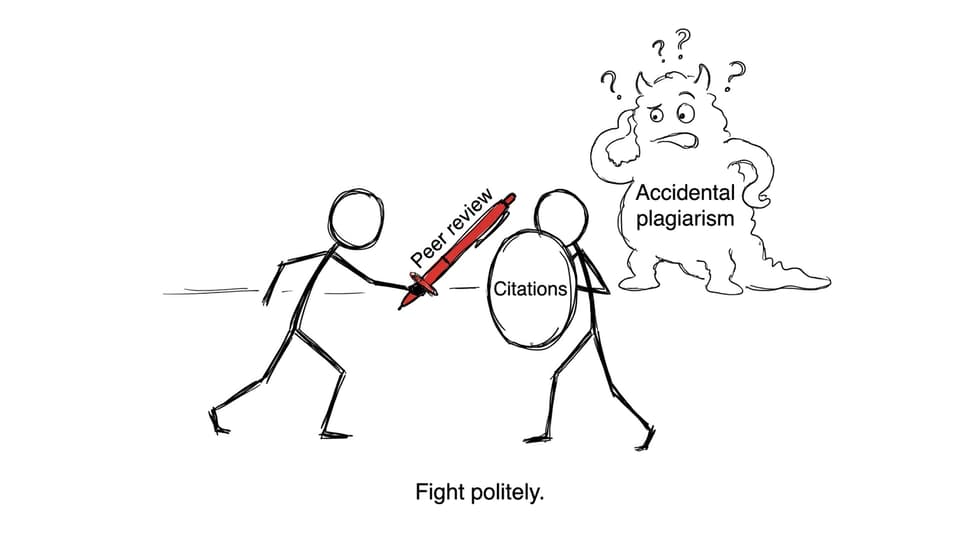
The fastest way to make an IB History HL IA feel scary is to leave citations until the end.
Instead:
-
cite while drafting
-
keep one consistent style (Chicago and MLA are common)
-
include page numbers for quotes and close paraphrases
Then do a “trace test”: pick 5 claims in your investigation and confirm each one points to the correct source and page. This one habit prevents the messy, last-night panic.
Step 7: Get feedback and revise like it’s a system
Your teacher’s time is limited, so treat feedback like a sequence:
-
peer review for clarity (does it make sense?)
-
peer review for logic (does it prove the question?)
-
rubric review (does it hit the criteria?)
-
final proofread (grammar, formatting, citations)
RevisionDojo can support this loop in a way that feels steady:
-
AI Chat to test whether your argument is actually answering the question
-
Grading tools (like the IA grader) to self-check criteria alignment
-
Coursework Library to compare structure against high-scoring samples
-
Study Notes and Flashcards to strengthen content knowledge while drafting
-
Tutors when you need human guidance on focus, argument, or planning
Closing: make your IB History HL IA feel smaller
Most IB stress comes from vagueness.
The IB History HL IA gets easier the moment it becomes a series of small, finishable steps: a focused question, two key sources, a planned investigation, and writing that keeps returning to judgement.
If you want this process to feel even steadier, build your workflow inside RevisionDojo: use the IB History Resources hub for content, the Questionbank and Mock Exams to stay sharp for exams, Study Notes and Flashcards to tighten evidence recall, and the IA grading tools plus AI Chat to pressure-test your draft against the rubric.
Your IB IA doesn’t need to be perfect.
It needs to be focused, honest, and built like an investigation.
When you treat it that way, it stops being a looming task and starts becoming one of the most controllable wins in IB.