
The phrase salvation and liberation in world religions asks how human beings reach their ultimate religious goal. Yet religions do not always agree about the destination, the problem that must be overcome, or even what it means to be a person who can be saved.
Christianity commonly speaks of salvation from sin and reconciliation with God. Buddhism teaches a path beyond craving, ignorance, and dukkha. Hindu traditions describe liberation from samsara, although they offer several paths and different accounts of the liberated self. Jainism understands liberation as the soul's release from karmic bondage.
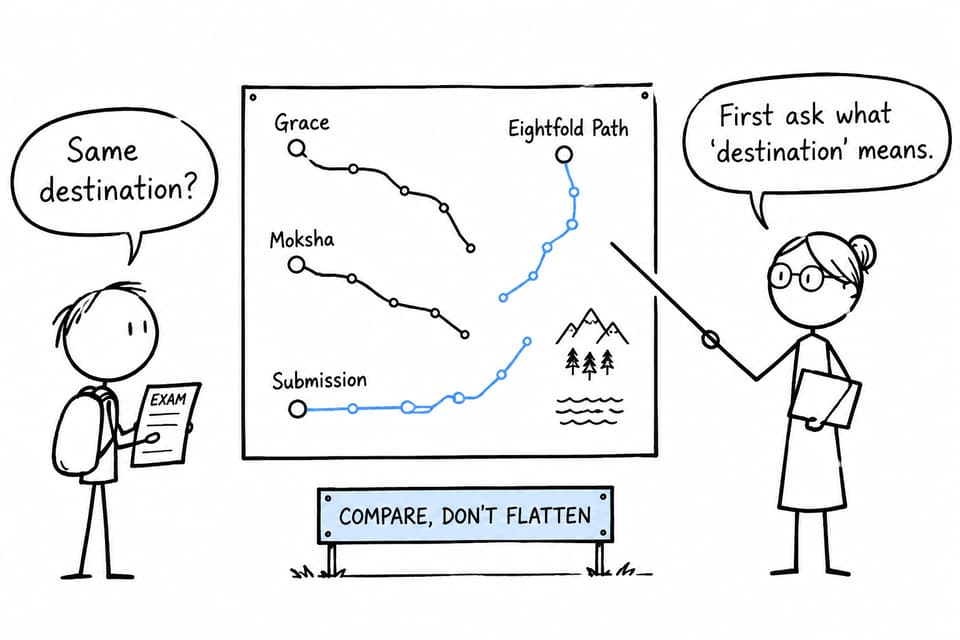
For IB World Religions SL, begin with the human condition. Then explain the destination, the path towards it, and the relationship between personal effort and transcendent assistance. This produces a more accurate comparison than assuming every religion describes the same journey.
A quick comparison checklist
When studying the Part 1 theme often expressed as “How do we get there?”, ask five questions:
- Problem: What prevents human beings from reaching fulfilment?
- Goal: Is the destination salvation, liberation, enlightenment, paradise, union, or purification?
- Path: Which beliefs, practices, virtues, or disciplines lead there?
- Agency: Does progress depend on effort, divine grace, or both?
- Transformation: How should the path change present life?
These questions provide a repeatable structure for revision and timed answers. They also prevent a misleading conclusion: sometimes religious paths differ because their destinations differ too.
What salvation and liberation mean
Salvation usually describes rescue from a condition that people cannot simply ignore. In Christianity, this condition is understood through sin, estrangement from God, mortality, and the need for reconciliation. In Islam, divine mercy, faithful submission, righteous action, and final accountability shape discussions of salvation.
Liberation often means freedom from bondage. Hindu moksha is release from samsara, while Buddhist nirvana ends the causes of suffering and rebirth. Jain liberation frees the soul from accumulated karma.
The terms overlap, but they are not interchangeable. Nirvana is not simply a Buddhist version of heaven. Heaven usually suggests continued personal existence in relation to God, while Buddhism challenges belief in a permanent, independent self through anatta. Accurate comparison preserves that distinction.
Hinduism: several paths towards moksha
Hindu traditions connect the human predicament with karma, ignorance, and samsara. The broad goal is moksha, liberation from rebirth, although Hindu schools explain its nature differently.
The Bhagavad Gita presents several influential paths:
- Karma marga: performing duty without attachment to personal reward.
- Jnana marga: gaining insight into self and ultimate reality.
- Bhakti marga: expressing loving devotion to a personal deity.
It is therefore inadequate to say that Hindus escape rebirth by doing good deeds. Detached action, knowledge, and devotion may all function as paths. Some Vedanta perspectives emphasize realization of the relationship between atman and Brahman. Devotional traditions may place greater weight on loving relationship and divine grace.
In an exam, name the path, connect it to the problem it addresses, and acknowledge diversity where it changes the explanation.
Buddhism: diagnosing and ending dukkha
The Four Noble Truths identify dukkha, trace its arising to craving and ignorance, affirm its cessation, and prescribe the Noble Eightfold Path.
The path is commonly organized into:
- Wisdom: right view and right intention.
- Ethical conduct: right speech, right action, and right livelihood.
- Mental discipline: right effort, right mindfulness, and right concentration.
These are not eight unrelated rules. Ethical conduct supports concentration, meditation supports insight, and insight weakens the ignorance and craving sustaining dukkha.
Unlike Christianity, this path is not normally centred on forgiveness from a creator God. It concerns awakening to reality and extinguishing the causes of suffering. Even “self-liberation” requires qualification because Buddhists rely on teachings, communities, and teachers. Traditions also understand the assistance of Buddhas and bodhisattvas differently.
Christianity: salvation through Christ and grace
Christian accounts of salvation begin with the relationship between humanity and God. Sin damages that relationship, while the life, death, and resurrection of Jesus Christ make reconciliation and eternal life possible. Salvation is not merely moral self-improvement; it is rooted in divine initiative.
Grace is central, but Christians differ over how grace, faith, works, sacraments, and human cooperation relate. Many Protestant traditions emphasize justification by grace through faith, understanding good works as the fruit rather than the cause of salvation. Catholic teaching also treats initial grace as an undeserved gift while emphasizing a grace-enabled response through faith, charity, and sacramental life.
“Christians are saved by being good” is therefore inadequate. A stronger answer connects salvation with Christ, grace, faith, repentance, and transformed conduct. Love, forgiveness, worship, and charity matter because the path reshapes present life as well as the believer's final destiny.
Jainism: liberation through purification
Jainism understands karma as binding the soul to embodied rebirth. Liberation requires stopping new karmic influx and removing accumulated karma.
The Three Jewels provide the path:
- Right faith
- Right knowledge
- Right conduct
These elements belong together. Knowledge without conduct is insufficient, while conduct must rest on right understanding. Ahimsa, or nonviolence, is especially important because harmful actions create further bondage. Ascetics observe demanding disciplines, while lay Jains follow obligations suited to lay life.
Unlike Christianity, Jainism does not centre liberation on a divine saviour. Unlike Buddhism, it affirms an enduring individual soul. Jainism and Buddhism may both discuss karma, rebirth, discipline, and liberation, but those shared terms belong to different understandings of the person.
A comparison that preserves difference
| Religion | Central problem | Ultimate goal | Important elements of the path | Role of agency |
|---|---|---|---|---|
| Hinduism | Karma, ignorance, and samsara | Moksha | Action, knowledge, devotion, and discipline | Human practice, sometimes with divine grace |
| Buddhism | Craving, ignorance, and dukkha | Nirvana | Four Noble Truths and Noble Eightfold Path | Practice, insight, and guidance |
| Christianity | Sin and separation from God | Reconciliation, eternal life, and salvation | Grace, faith, repentance, and life in Christ | Divine initiative with human response |
| Jainism | Karma binding the soul | Liberation and purification | Three Jewels, nonviolence, and restraint | Sustained knowledge and conduct |
The comparison should go beyond saying that every religion teaches goodness. Buddhist ethics helps weaken craving and ignorance. Jain ethics prevents karmic bondage. Christian works express a response to grace and restored relationship with God. Hindu duty may purify action by reducing attachment to its rewards. Similar conduct can therefore serve different religious purposes.
Using the concept in IB World Religions Part 1
Part 1 covers nine religions in three groups: Hinduism, Buddhism, and Sikhism; Judaism, Christianity, and Islam; Taoism, Jainism, and the Baha'i Faith. Official 2026 examiner instructions retain this three-section organization for Paper 1.
Organize notes around recurring questions rather than nine disconnected fact files. For each religion, create a route map containing the human problem, ultimate goal, path, central practices, key terminology, internal diversity, and one concrete example. The RevisionDojo IB World Religions resource hub offers syllabus-aligned Study Notes, Flashcards, and Questionbank practice for building this structure.
Comparison remains useful when a task addresses one religion. Knowing why Buddhist nirvana differs from Christian salvation forces you to define both precisely. Comparing Jain and Buddhist views of self similarly prevents vague claims about liberation.
Turning knowledge into a Paper 1 answer
Paper 1 contains nine questions, one for each Part 1 religion. Students choose three, including one from each syllabus section. Questions begin with a short extract and use structured tasks, so success depends on selecting relevant knowledge rather than reproducing everything remembered.
Identify the command term
“Outline,” “explain,” and “compare” require different responses. The IB exam command terms guide helps distinguish recall from developed explanation. If asked to explain, show why a practice leads towards the religious goal instead of merely naming it.
Establish the religious logic
Name the problem and destination early. For Buddhism, identify dukkha, craving, and nirvana. For Christianity, identify sin, reconciliation, and salvation through Christ. Then connect belief with practice. Buddhist mindfulness, for example, supports insight by helping practitioners observe experience without attachment. Christian repentance responds to sin and seeks restored relationship with God.
Add a precise qualification
You might note that Hindu traditions emphasize different margas, or that Christian denominations explain faith, works, grace, and sacraments differently. Qualification demonstrates accuracy, but it should not reduce the answer to “everyone believes something different.”
Practise under realistic conditions
Use the World Religions mock exam preparation plan to combine recall with timed writing. Flashcards and practice questions for IB revision serve complementary purposes. Flashcards secure terms such as moksha, grace, anatta, and ahimsa. The Questionbank tests whether you can apply them, while Grading tools provide focused feedback. Predicted Papers and Mock Exams then reveal whether your knowledge remains usable under time pressure.
The destination determines the path
A religious path makes sense only in relation to its diagnosis of the human condition. Grace answers a different problem from ignorance. Nirvana is not another word for heaven. Moksha and Jain liberation both address rebirth, yet they depend on different understandings of self, karma, and reality.
RevisionDojo turns these distinctions into usable exam knowledge. Study Notes and Flashcards establish foundations; AI Chat and Tutors clarify difficult comparisons; the Questionbank and Grading tools strengthen written responses. For extended investigation, the World Religions Coursework Library and World Religions IA examples demonstrate how careful comparison develops into sustained analysis.
Good revision does not flatten religions into one answer. It shows why each path begins where it does, where it claims to lead, and what transformation it asks of those who follow it.