

The question every IB student asks (quietly)
The week your IA is submitted, time changes shape.
A day can feel like a month. A harmless notification can feel like a verdict. And somewhere between revising for finals and pretending you sleep, the same thought keeps returning: Can you see your IA marks before results day?
If you are asking, you are not being dramatic. You are being human.
An IA is strange because it is both yours and not yours. You write it, record it, defend it, polish it. Then it leaves your hands and travels through systems you cannot see: teacher marking, internal standardization, IB moderation, final grade boundaries. So the honest answer is rarely a clean yes or no.
This guide explains what usually happens, what your school may tell you, and what you can do instead of refreshing your inbox for an answer that might not come.
Quick overview checklist: what you can know (and what you can't)
Use this as your reality anchor.
- You can usually receive feedback on your IA before final submission (within IB rules).
- Your teacher may tell you an indicative mark or markband for your IA, depending on school policy.
- Even if your teacher shares a number, it may not match the final IB outcome after moderation.
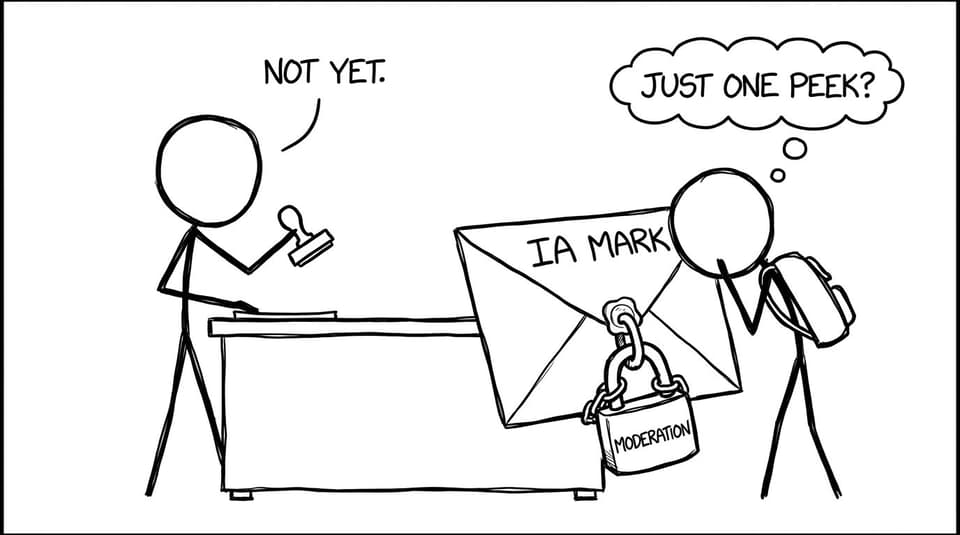
- You typically do not get official, confirmed IA marks through the candidate portal before results day.
- After results day, schools can often access component marks, and you can discuss next steps with your coordinator.
If that already calms you a little, good. Now let's make the uncertainty useful.
Why your IA mark feels "hidden" in the first place
The IB has a reason for the fog, even if it annoys you.
Your IA is internally assessed by teachers, then moderated by external IB examiners. Moderation exists because teachers are human and schools are different. A top-mark IA in one classroom should mean roughly the same thing as a top-mark IA in another.
That process creates two realities at once:
- Your teacher gives an IA mark based on the rubric.
- The IB may adjust (moderate) marks up or down for the cohort.
So even if you know your teacher's mark, you still don't fully know your final IA outcome. That is why many schools choose not to share exact numbers. It reduces false certainty and, frankly, reduces arguments.
If you want a bigger-picture refresher on what an IA is across subjects, this guide is a helpful baseline: IB Internal Assessment: A Complete Guide.
Can you see your IA marks before results day?
In most cases: not officially.
What "official" really means
Official IA marks are the marks that count after moderation, combined with your exam components, then converted into a grade (1–7). The IB candidate portal generally does not show you your component marks early. Results day is results day.
What schools sometimes do instead
Schools vary. Some teachers will share:
- a rough markband (for example, "mid-6 territory"),
- a criterion breakdown, or
- an estimate framed clearly as provisional.
Other schools have strict policies: no numbers shared, only qualitative feedback.
Neither approach is automatically "more fair." But you should treat any pre-results IA number as informational, not contractual.
The two marks that matter: teacher mark vs moderated mark
A useful way to think about your IA is to imagine two labels on the same folder.
The teacher's IA mark
This is the mark your teacher awards using the rubric and the evidence in your work. A strong department will also standardize -- teachers compare samples to align harsh and lenient marking. RevisionDojo has a good discussion of how schools try to make this consistent: Using RevisionDojo to Standardize Internal Assessments.
The moderated IA mark
This is the mark that emerges after the IB checks how a school's marking compares to global standards. If the IB thinks a cohort has been consistently marked too high or too low, it can shift marks.
That gap is the emotional source code of the question: If my teacher told me my IA mark, would it even be real?
Real enough to guide your expectations, not real enough to bet your peace on it.
What you can ask your teacher (without making it awkward)
You can ask, and you should. Just ask cleanly.
Here are three scripts that work because they respect the process:
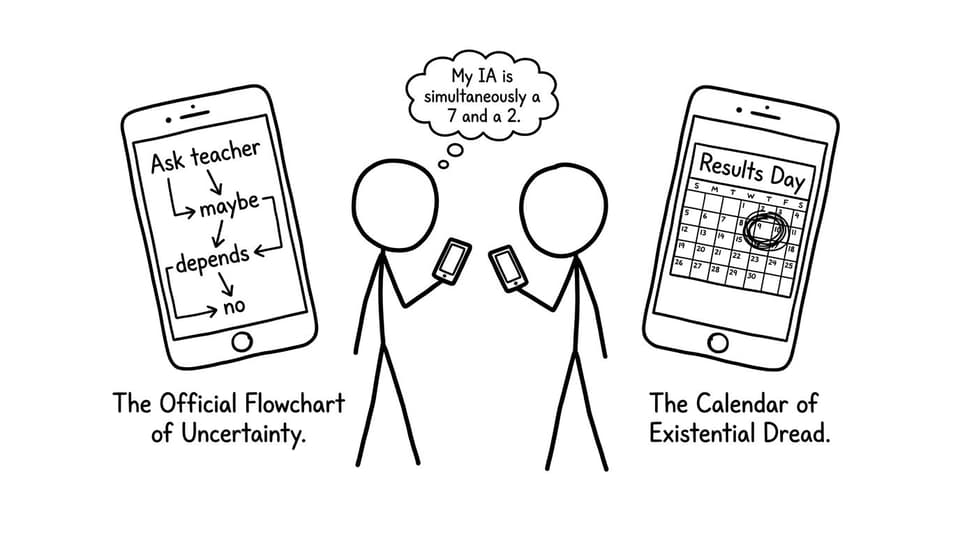
- "Are we allowed to know our IA mark or markband before results day, or is it school policy not to share?"
- "Could you tell me which IA criteria were strongest and which were weakest, so I can learn from it?"
- "If you can't share a number, could you confirm whether my IA is broadly meeting the top-band descriptors?"
Notice what's missing: pressure, bargaining, and the hint that their answer controls your identity.
If you want to understand rubrics more concretely, exploring criterion language helps in almost every subject. For example, RevisionDojo breaks down an IA rubric clearly here: Language A IA Rubric.
The healthier move: estimate your IA mark using evidence, not vibes
When students spiral about IA marks, it is often because their mental model is built on rumors.
A better model is built on artifacts.
Use rubric-aligned grading tools for a reality check
RevisionDojo's rubric graders let you self-assess your IA with criterion-by-criterion clarity. You are not trying to replace your teacher or the IB. You are trying to reduce uncertainty with structured feedback.
Try one relevant to your subject:
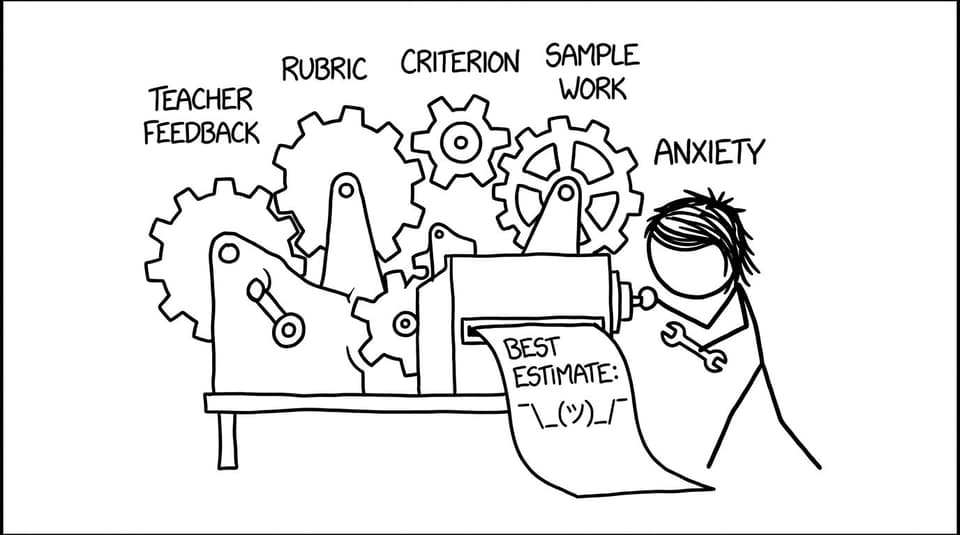
What this gives you is not a prophecy. It gives you a diagnosis: where your IA is strong, where it is thin, and which criteria are costing you marks.
Use exemplars to calibrate your intuition
Most students do not struggle because they are lazy. They struggle because they have not seen enough good work.
That is why exemplars matter. They teach your brain what "top-band" looks like in real life.
Start here: IB Coursework Exemplars Index (IA, EE, TOK), then browse your subject collection (for example, IB Computer Science IA Exemplars). When you compare your IA to a verified high-scoring model, you stop guessing and start noticing.
If you are a maths student, this piece also shows how to use exemplars strategically: Using IA/EE Exemplars to Improve Your IB Math IA.
Ask AI Chat one precise question
When anxiety is high, students ask huge questions: "Is my IA good?"
Better: ask one surgical question in AI Chat.
Examples:
- "Which sentences in my evaluation are descriptive instead of analytical?"
- "Does my conclusion explicitly answer my research question, or does it summarize?"
- "Which criterion is most limited by my method, and what revision would most improve it?"
That is the quiet advantage of RevisionDojo's AI Chat: it turns vague panic into a specific next step.
If your IA is already submitted, what can you do now?
You cannot rewrite the IA you already handed in. But you can reclaim control in two ways.
Build an exam plan that assumes uncertainty
If you knew your exact IA mark, you might slack off or overcorrect. Uncertainty can be annoying, but it can also keep you honest.
A simple approach:
- Treat your IA as "fine until proven otherwise."
- Put your energy into exam components you can still influence.
- Use a tight loop: Study Notes -- Questionbank -- Mock Exams.
If you want a concrete short-term plan, RevisionDojo's exam content is built for it:
- How 45-Point IB Students Prepare for Exams
- IB Exam Day Checklist
- IB: How to Study in the Last 24 Hours
Use Predicted Papers and Mock Exams to reduce surprises
Your IA is one piece of your final grade. Your exams are usually the larger piece. So the most rational stress-management strategy is to become fluent in exam conditions.
RevisionDojo supports that with Predicted Papers, Mock Exams, and timed practice flows. If you want the platform-wide workflow view, this is a solid overview: RevisionDojo App: The Smarter Way to Prep for IB Exams.
Closing: make the IA uncertainty work for you
Waiting to know your IA mark can feel like waiting for permission to breathe.
But there is a quieter truth: the students who do best are not the ones who get certainty earliest. They are the ones who build a system that works even when certainty never arrives.
Use your IA as data, not destiny. Calibrate using rubrics, graders, and exemplars. Then put your attention where it compounds: Questionbank practice, Study Notes clarity, daily Flashcards, targeted AI Chat, timed Mock Exams, and strategic Predicted Papers.
That is what RevisionDojo is built for: a full-loop IB toolkit that turns anxiety into action, and action into results.
If you want one next step today, pick one subject and run one focused block: 20 minutes of notes, 20 minutes of questions, 10 minutes of review. You do not need to know your IA mark to start building certainty.