The final weeks before IB papers create a strange temptation. Because time feels scarce, students often return to what feels safe: rereading notes, highlighting definitions, and reviewing familiar chapters. Yet knowing the content is only half the task. You must also respond in the form the question requests.
If you need to revise command terms one last time, do not try to memorise a long glossary in isolation. Learn the small differences between easily confused terms, attach each term to an answer structure, and practise choosing that structure under time pressure.
This matters particularly for the November session. The final IB November 2026 schedule starts on 23 October and ends on 13 November, so your preparation should be anchored to your own first paper, not simply the word “November.” Confirm every subject, paper, and local start time with your coordinator, then use the IB November 2026 exam schedule and study plan to map the weeks ahead.
Your final command-term checklist
Before papers begin, aim to complete these five tasks:
- Confirm command-term definitions using the current guide for each subject.
- Create one answer pattern for every recurring term.
- Complete short drills that isolate similar terms, such as describe and explain.
- Practise mixed questions so you must identify the required response yourself.
- Use timed sections to make the routine automatic under pressure.
Command terms indicate the kind and depth of response expected. The rest of the question identifies the content, while the mark allocation helps indicate scope. That distinction is the foundation of effective exam technique.
Reduce the glossary to answer shapes
A glossary becomes useful only when each definition changes what you write. These compact answer shapes are a starting point, but you should check the terminology and conventions in your current subject guide.
| Command term | Practical answer shape |
|---|---|
| State or identify | Give the required fact, feature, value, or conclusion directly. |
| Outline | Present the main points briefly, without unnecessary development. |
| Describe | Give a detailed account of what happens or what is present. |
| Explain | Connect the result to reasons, causes, or a mechanism. |
| Compare | Refer to both items throughout and establish relevant similarities. |
| Contrast | Refer to both items while making their differences clear. |
| Analyse | Break the issue into important parts and show relationships between them. |
| Justify | Support an answer or conclusion with valid reasons or evidence. |
| Evaluate | Weigh strengths and limitations, then reach a supported judgment. |
| Discuss | Present a considered, balanced review supported by evidence and a conclusion. |
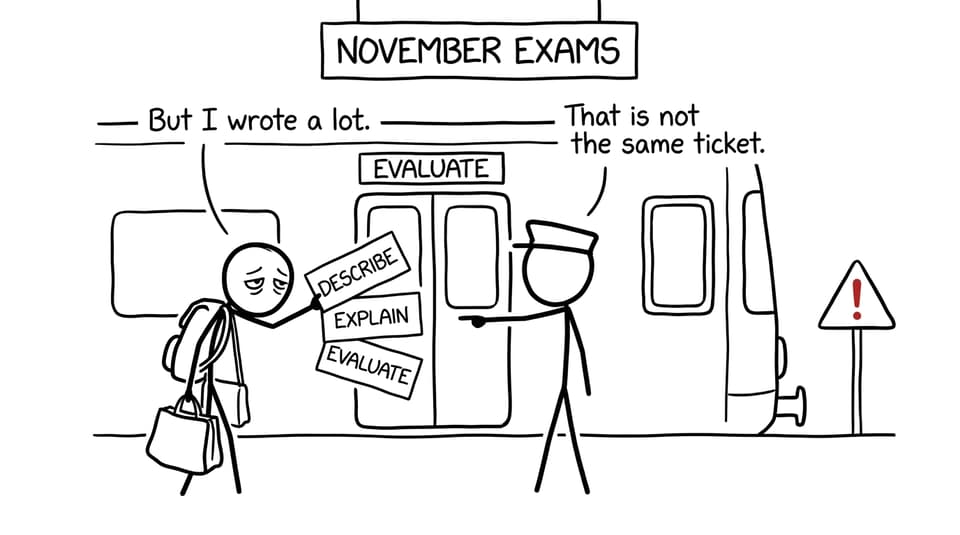
The most dangerous mistakes usually occur between neighbouring terms. A student may describe a trend when asked to explain it, or present two separate summaries when asked to compare. The writing can be accurate and still fail to complete the requested intellectual action.
For a deeper explanation of these distinctions, review how IB command terms shape examiner expectations. Then close the page and reproduce the answer shapes from memory.
September: diagnose the terms you actually confuse
Early in the September-to-November window, avoid treating all command terms equally. Begin with a diagnostic exercise across your subjects.
Select 12-18 representative questions. Do not answer them fully. Instead, spend 20-30 seconds on each question and write:
- the command term;
- the content focus;
- the likely answer structure;
- the evidence, calculation, or example required;
- the depth suggested by the marks.
Then compare your plans with reliable guidance and worked responses. Record mistakes under three labels: term confusion, subject convention, or scope error. This shows whether you misunderstood the verb, overlooked how your subject uses it, or planned too much or too little for the marks available.
RevisionDojo’s IB resources by subject let you move from concise Study Notes into relevant Questionbank practice without turning diagnosis into another afternoon of searching. If your wider schedule is still unclear, build it around specific papers using this practical IB exam timetable method.
October: replace recognition with production
Recognising that “evaluate” involves strengths and limitations is not the same as producing a balanced evaluation when the clock is moving. By October, most command-term revision should therefore happen through written responses.
Use a four-part drill:
- Choose one commonly confused pair, such as outline and explain.
- Answer two questions on the same topic, one for each term.
- Compare the structures rather than merely checking the content.
- Write a correction rule that you can reuse.
A useful correction rule is specific: “For explain, I will connect each claim to a cause, mechanism, or consequence.” A weak rule says only, “Add more detail.”
The RevisionDojo active recall practice-question method supports this attempt, diagnose, correct, and reattempt cycle. Use the Questionbank to isolate a term or question type, then use AI Chat and Grading tools to ask why the response did or did not fulfil the instruction.
Whatever label students use online, including “IB novexam,” the useful principle is the same: the fall term or final pre-exam period should move from learning definitions toward rehearsing decisions. You are training yourself to see a verb and immediately know what kind of answer must follow.
The final 7 days: stabilise instead of expanding
In the final week, adding more command terms can create confusion. Narrow your list to the terms that appear regularly in your subjects and the pairs you still mix up.
Build a small Flashcard deck with the term on the front and three items on the back:
- its precise meaning;
- the structure it requires;
- one mistake you personally make.
Keep these sessions short. The RevisionDojo flashcard system for active recall explains how focused prompts and repeated retrieval can keep essential distinctions available without consuming an entire revision block.
Complete one or two timed sections using Mock Exams or Predicted Papers, but review them selectively. Look for command-term errors, weak conclusions, missing comparisons, incomplete working, and answers whose length does not match their marks. Do not attempt to rebuild every topic at once.
Use the same 20-second routine on every paper
When the paper opens, command-term knowledge must become a physical routine:
- Circle the command term.
- Underline the precise topic or issue.
- Check the marks.
- Translate the instruction into an answer shape.
- Write a one-line plan before beginning an extended response.
For “evaluate,” your plan might be: criteria, supported strength, supported limitation, condition, judgment. For “explain,” it might be: claim, reason, mechanism, result. For “compare,” pair the subjects in each point rather than discussing them in separate blocks.
The guide to using command terms effectively in IB responses offers more subject-aware structures. The goal is not to make every response formulaic. It is to prevent stress from pulling you into the wrong kind of answer.
Keep content errors separate from command-term errors
After practice, ask two different questions:
- Did I know enough relevant content?
- Did I perform the action requested by the command term?
A factual gap requires Study Notes, Flashcards, or help from AI Chat. A response-shape problem requires another question using the same term. If the distinction remains unclear, a Tutor can examine your reasoning and show where description should become explanation, or where analysis needs to become evaluation.
This separation saves time. Revision becomes smaller and more honest. The Coursework Library can also reduce uncertainty around remaining written work, while Mock Exams and Predicted Papers let you test command-term decisions within realistic sequences rather than isolated exercises.
Make the final revision count
Command terms are not an extra chapter to learn after the syllabus. They are the instructions that turn knowledge into a markable response.
Use RevisionDojo as the complete IB revision loop: clarify weak content with Study Notes, retrieve definitions through Flashcards, practise response shapes in the Questionbank, use AI Chat and Grading tools for feedback, and test the habit through Predicted Papers and Mock Exams. The final weeks are not about knowing every possible sentence. They are about making the right first decision when each question appears.


