


A wrong answer can feel like the end of a question. In reality, it is the beginning of the most valuable part of practice.
Reviewing mistakes in MYP Physics practice means identifying why an answer failed, correcting the reasoning, and testing whether you can apply the lesson independently. Do not simply read the solution and move on. Classify the error, rebuild the weak step, write a reusable rule, and retry the question without support.
MYP Physics tests remembered knowledge alongside explanation, investigation, evidence processing, evaluation, and scientific impacts. Productive review must therefore examine both physics content and communication.
The mistake-review checklist
Use this loop after every short practice set:
- Attempt the questions without notes.
- Mark each answer as correct, uncertain, or incorrect.
- Find the first point where your reasoning went wrong.
- Classify the mistake.
- Write the corrected solution in full.
- Create one short “next time” rule.
- Complete a similar question.
- Retry the original question after two or three days.
Begin with five questions from the MYP Physics Questionbank. Careful review usually teaches more than rushing through a larger set.
A step-by-step method for reviewing mistakes
Attempt first and record your confidence
Answer a small set under realistic conditions. Avoid notes, hints, and solutions during the attempt. Beside each response, record your confidence as high, medium, or low.
A correct answer with low confidence may indicate fragile understanding. A confidently wrong answer often exposes a misconception. Review incorrect and low-confidence answers, plus calculations with incomplete working or unclear scientific language.
Locate the first wrong step
Do not write “I got the question wrong.” That description is too broad to change your behaviour.
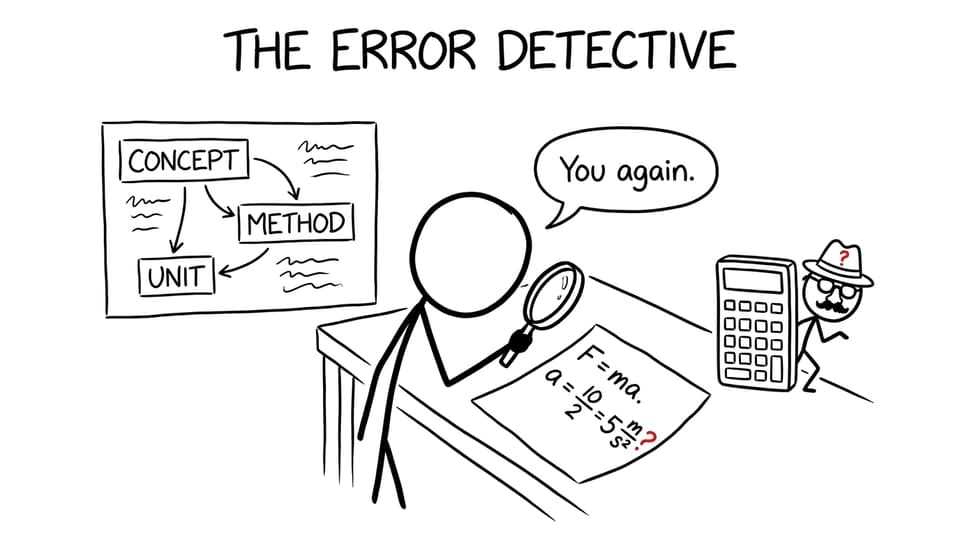
Compare your response with the explanation and locate the earliest faulty step. Perhaps you interpreted a distance-time graph as a speed-time graph, converted centimetres to metres incorrectly, or calculated correctly without explaining the physical reason.
Later errors may simply be consequences. If you chose an unsuitable model, repairing the final arithmetic will not fix the underlying problem.
Classify the mistake
Place each error into a category that points toward the next action.
| Error type | What it may look like | Best response |
|---|---|---|
| Concept | Confusing mass with weight | Relearn the distinction and explain it aloud |
| Equation choice | Using speed when acceleration is required | Identify known and unknown quantities first |
| Algebra | Rearranging an equation incorrectly | Redo the manipulation symbolically |
| Units | Leaving time in minutes when SI units are needed | Convert quantities before substitution |
| Graph or data | Misreading a gradient or anomaly | Describe axes and trends before calculating |
| Command term | Describing when asked to explain | Translate the command term into an answer plan |
| Investigation | Giving vague variables or improvements | Make each variable and improvement specific |
| Communication | Missing working, labels, evidence, or reasoning | Rewrite the response as a complete solution |
Patterns soon become visible. If six errors involve units, you probably do not need to reread the entire energy chapter. You need a deliberate unit-checking habit.
Rebuild the solution without copying
Read the explanation once, close it, and solve the problem on a blank page. A copied solution can look familiar without becoming retrievable.
For a calculation, use this sequence:
- State the relevant physical relationship.
- Rearrange it if necessary.
- Convert units.
- Substitute values with units.
- Calculate with sensible precision.
- Check whether the result is physically reasonable.
If a question gives a change in velocity and a time interval, begin with
Then identify what represents in that situation. This pause can prevent sign errors, inappropriate substitutions, and physically unreasonable answers.
If the concept remains unclear, return to the relevant MYP Physics lessons and study guides. The Forces and Motion resources, for example, let you repair a narrow mechanics weakness without rereading everything.
Write one reusable error rule
Turn the correction into a sentence beginning with “Next time I will...”
Weak rule: “Be more careful.”
Useful rule: “Next time I calculate acceleration, I will find final velocity minus initial velocity before dividing by time.”
Other useful rules include:
- “When asked to explain, I will give the result and the scientific reason.”
- “Before reading a graph, I will identify both axes and their units.”
- “For an investigation improvement, I will state what should change and how it improves the evidence.”
Keep these rules in a notebook or digital error log. Review them before your next question set.
Test the correction immediately
Understanding a worked answer is not proof that you can solve a new problem. Select one similar but unseen question and attempt it independently.
Use the topic filters in the MYP Physics resource hub to practise the same skill in a different context. If the second attempt fails for the same reason, revisit the concept, ask RevisionDojo’s AI Chat for another explanation, or seek guidance from a teacher or Tutor. If it succeeds, schedule a delayed retry.
Match the correction to the MYP skill
The best MYP Physics revision techniques account for the four Sciences criteria. A calculation mistake may relate mainly to knowing and understanding, but other errors require different remedies.
For inquiring and designing, check whether your hypothesis is testable, variables are explicit, and method can produce relevant data. For processing and evaluating, inspect graph conventions, calculations, conclusions, limitations, and evidence-based improvements. When reflecting on scientific impacts, evaluate implications rather than giving a one-sided description.
Command terms determine the expected response. “State” calls for a direct answer. “Explain” requires reasons or causes. “Evaluate” requires strengths, limitations, and a supported judgment. The MYP Sciences curriculum breakdown explains how these skills fit together.
Build a simple error log
An error log should be short enough to maintain. Use five fields:
| Question and topic | First wrong step | Error type | Correct principle | Next action |
|---|---|---|---|---|
| Motion graph question | Treated gradient as acceleration | Graph interpretation | Distance-time gradient represents speed | Answer two new gradient questions tomorrow |
Do not copy entire solutions. Record the insight that can change a future answer.
Once a week, count your error types and build the following week’s practice around the most frequent category. RevisionDojo’s MYP Physics Flashcards reinforce definitions, units, and relationships, while the Questionbank tests application.
A same-day 30-minute review routine
Use this routine immediately:
- Minutes 0-10: Complete three targeted questions without help.
- Minutes 10-15: Mark them and label confidence levels.
- Minutes 15-20: Diagnose the first wrong step and classify each error.
- Minutes 20-25: Rewrite the weakest answer from memory.
- Minutes 25-30: Complete one similar question and schedule a delayed retry.
As your confidence grows, add timed mixed sets. RevisionDojo’s Grading tools and AI feedback can identify weaknesses in longer responses. The MYP eAssessment preparation guide connects this habit with timing, command terms, and on-screen performance.
Mistakes should change your next session
The purpose of review is not to create a beautiful notebook of corrections. It is to make the next answer better.
A strong correction changes what you practise, check, or explain. The most useful MYP Physics study tips are small and repeatable: diagnose one error, repair one idea, test it again, and return later.
RevisionDojo brings that cycle together. Study Notes and Lessons rebuild understanding; Flashcards strengthen retrieval; the Questionbank supplies targeted application; and AI Chat, Grading tools, Mock Exams, Predicted Papers where available, the Coursework Library, and Tutors provide deeper support. For a broader routine, use the MYP Revision Guide.
A wrong answer is only wasted when it disappears without changing anything. Keep the evidence, find the cause, and let each mistake decide what you do next.