

Geophysical hazards don’t wait for you to finish your paragraph. One minute you’re revising plate boundaries; the next, the question asks you to evaluate how a country responds across time. In IB Geography, that time dimension is the difference between a vague answer and an examiner-friendly one.
Responses to geophysical hazards (earthquakes, volcanic eruptions, tsunamis, landslides) are best understood as a timeline: what happens immediately to keep people alive, and what happens afterwards to rebuild and reduce risk next time. If you can explain both clearly, you can usually secure the evaluation marks.
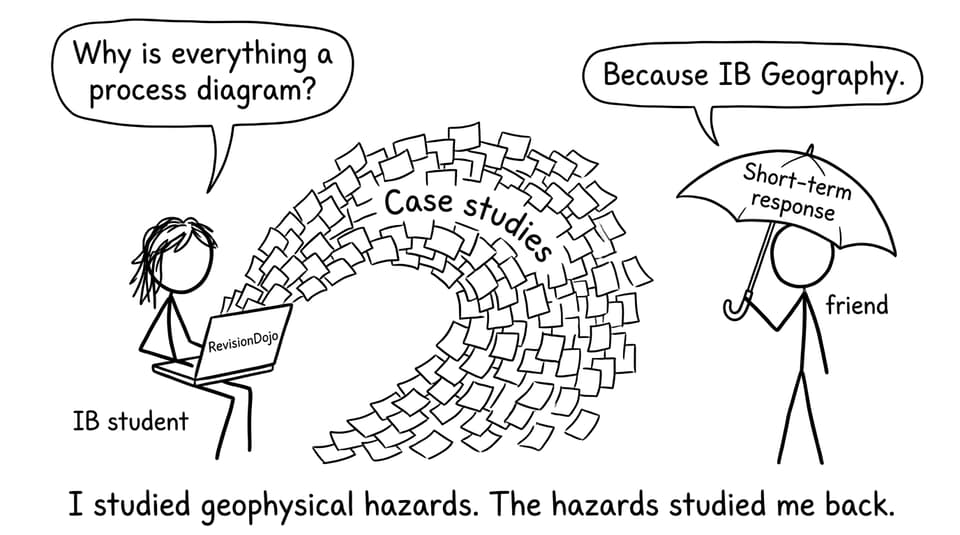
IB Geography quick checklist: what to include
-
Name the hazard and the context (exposure + vulnerability)
-
Separate short-term and long-term responses
-
Link responses to capacity to cope, governance, and development
-
Add evaluation: what worked, what failed, and why
-
Finish with resilience (risk reduction, adaptation, “build back better”)
For a full syllabus map, start with IB Geography Option D: Geophysical Hazards.
Short-term responses to geophysical hazards
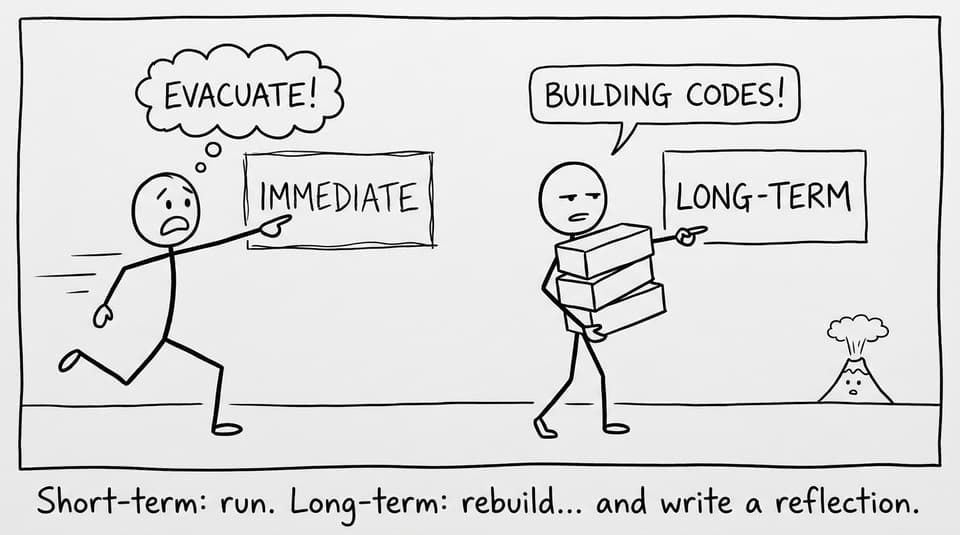
Short-term responses are the urgent actions taken during and right after the event. In IB Geography, the purpose is simple: reduce deaths and prevent secondary crises.
Typical short-term responses include:
-
Search and rescue to locate survivors trapped under rubble
-
Emergency medical care and triage
-
Temporary shelter for displaced people
-
Food, clean water, and sanitation to prevent disease
-
Rapid communication: warnings, evacuation orders, safety guidance
The highest-scoring answers explain that short-term responses are often reactive. They depend on how prepared the place was before the hazard, which links directly to vulnerability. If you need a strong conceptual link, revise vulnerability using Why Are Some Areas More Vulnerable to Geophysical Hazards?.
Long-term responses in IB Geography: recovery and risk reduction
Long-term responses stretch from months into years. They aim to restore daily life, but also to reduce future risk. In IB Geography, this is where you earn evaluation marks because long-term plans reveal priorities, inequalities, and political capacity.
Common long-term responses include:
-
Rebuilding infrastructure (homes, schools, hospitals, roads, utilities)
-
Stricter building codes and enforcement (especially in earthquake zones)
-
Land-use planning (zoning, relocation from high-risk areas)
-
Economic recovery: jobs, grants, business support, investment
-
Education and preparedness: drills, public risk awareness
-
Improved monitoring and early warning systems
To connect responses to the wider course, you can link long-term recovery to development pathways in Geophysical Hazards and Development.
How to turn “responses” into a top-mark exam paragraph
Examiners reward specificity. A strong IB Geography paragraph often follows this pattern:
-
Short-term: identify immediate needs and who delivers them (state, NGOs, international aid).
-
Limitations: explain constraints (access, funding, damaged transport, governance).
-
Long-term: show how rebuilding reduces vulnerability (codes, planning, warnings).
-
Judgement: argue which matters most for resilience, and why.
If you want to revise the hazard setting quickly, use How Do Tectonic Plate Boundaries Create Hazards? and then consolidate with Option D Notes.

Conclusion: build your answer like a timeline
The most reliable way to score on “responses to geophysical hazards” is to write like time is moving: short-term survival first, long-term resilience second. That structure is the heartbeat of IB Geography Option D, and it turns scattered facts into a judgement.
If you want to make this topic feel predictable, revise the core content with IB Geography resources, practise with the Questionbank, and tighten your definitions using the Flashcards. RevisionDojo brings your notes, practice, and feedback into one place so your next hazard-response essay feels calm, clear, and exam-ready.