
Preparing for MYP English Language and Literature eAssessment is less about memorizing every literary term and more about making good decisions under time pressure. You need to interpret unfamiliar texts, identify meaningful choices, organize an argument, produce purposeful writing, and communicate accurately on screen.
The most effective preparation loop is simple: study one skill, apply it to an unseen text, receive criteria-based feedback, rewrite the weakest part, and repeat under tighter timing. This turns revision from passive reading into performance practice.
The IB describes Language and Literature eAssessment as an on-screen examination for eligible MYP Year 5 students. Published IB materials indicate a duration of up to two hours, but confirm the blueprint and arrangements for your session with your school because official guidance can change.
Your preparation checklist
Before creating a schedule, check whether you can:
- Explain Criteria A, B, C, and D in practical language
- Analyse written, visual, and multimedia material
- Explain the effect and purpose of an authorial choice
- Compare texts through shared ideas
- Produce writing suited to a specified audience and purpose
- Plan, type, edit, and navigate sources comfortably on screen
- Complete timed work without notes or external assistance
- Turn feedback into one target for your next attempt
If several items feel uncertain, do not try to study everything at once. Use the list as a map. Start with the weakest skill and build a short practice loop around it.
Understand what the eAssessment rewards
MYP Language and Literature uses four criteria: A: Analysing, B: Organizing, C: Producing text, and D: Using language. RevisionDojo's MYP Language and Literature assessment criteria guide explains what each criterion demands.
The criteria work together. An insightful interpretation loses force if its organization is difficult to follow. A creative response may contain an original idea but still be weakened by an unsuitable register or limited language control.
| Criterion | What to practise |
|---|---|
| A: Analysing | Interpret choices, support ideas, compare, and justify conclusions |
| B: Organizing | Build a logical sequence and connect ideas clearly |
| C: Producing text | Create writing suited to audience, purpose, and form |
| D: Using language | Control vocabulary, grammar, register, and style |
Rereading class texts alone is not enough. The examination asks you to transfer familiar skills to unfamiliar material, so revision should recreate that demand.
Use this 75-minute practice method
You do not need a perfect timetable. Open an unfamiliar article, advertisement, literary extract, image, or video transcript and begin.
Set a five-minute criteria target
Choose one criterion and turn it into an observable target:
- “I will explain the effect of every quotation I use.”
- “Each paragraph will begin with a claim that answers the question.”
- “My creative response will maintain one clear voice and register.”
A narrow target makes improvement measurable. “Get better at English” does not.
Read and annotate for ten minutes
Read once for overall meaning. On the second reading, identify the text type, audience, purpose, tone, and two or three patterns. These might include repeated images, sentence length, contrasts, framing, camera angle, layout, or shifts in perspective.
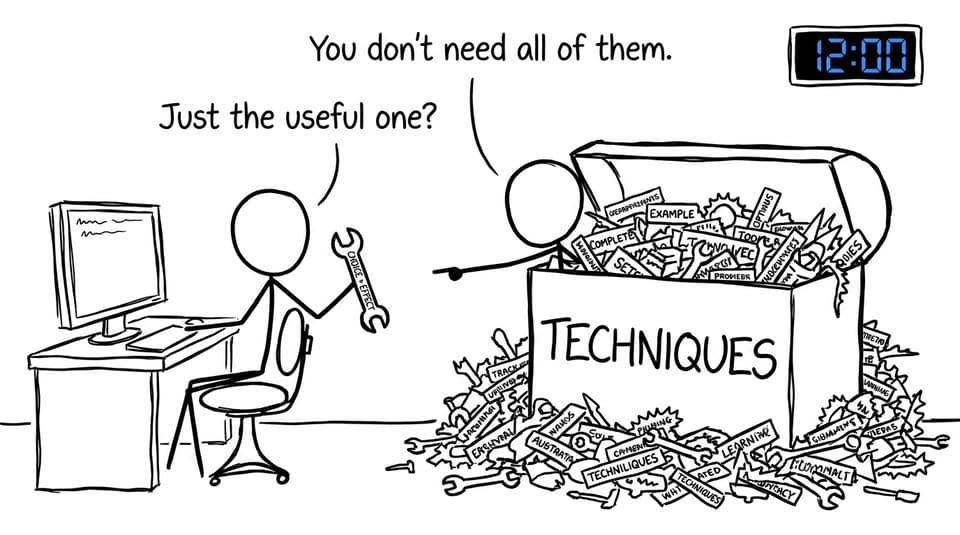
Do not circle every technique. Select choices that help explain meaning. RevisionDojo's visual analysis notes can help when an image or multimedia source feels more difficult than prose.
Build a five-minute argument
Write one thesis and three possible paragraph claims. Use this analytical chain:
choice --> evidence --> effect --> meaning --> purpose
Identifying repetition is only the beginning. Explain what is repeated, how the pattern shapes emphasis or rhythm, what response it encourages, and how that response serves the creator's purpose. The author intention notes for MYP English develop this reasoning further.
Write and produce for forty minutes
Write two analytical paragraphs without consulting notes. Use short, precise evidence and spend more time explaining than quoting. If choosing evidence is difficult, review RevisionDojo's MYP evidence selection notes.
A useful paragraph sequence is:
- Make an arguable point
- Introduce precise evidence
- Identify the relevant choice
- Explain its effect and meaning
- Connect it to audience, purpose, or the question
Then choose an audience, purpose, and text type for a short creative or non-literary response. Spend three minutes planning, twelve minutes writing, and five minutes editing. Decide first what you want the reader to think, feel, or do. A speech may need direct address and a persuasive progression; a narrative may rely on viewpoint, pacing, and controlled revelation.
Review and rewrite for fifteen minutes
Mark your work against the selected criterion. Highlight one successful decision and one weak section. Rewrite only the weak section, then record a rule beginning, “Next time, I will...” For example: “Next time, I will connect visual details to the intended audience instead of merely describing them.”
Practise comparison through relationships
Comparison becomes weak when students discuss Text A completely and then add Text B at the end. Strong comparison begins with a shared idea: both texts represent authority, but one makes it appear protective while the other makes it threatening.
Build paragraphs around the relationship:
- Establish the shared point of comparison
- Analyse one precise choice from Text A
- Connect or contrast a choice from Text B
- Explain what the difference reveals about purpose, perspective, or context
Use connectives such as similarly, whereas, by contrast, and to a greater extent only when the underlying relationship is real. RevisionDojo's guide to the best MYP Language and Literature revision strategies includes further analysis and comparison drills.
Train the digital part of the examination
At least once each week, practise on a computer with a visible timer. Avoid pausing to search for explanations or correcting every sentence while drafting.
Use a consistent process:
- Read the complete task
- Note the command term and assessment focus
- Set a planning limit
- Draft in logical blocks
- Leave an editing buffer
- Check that every response answers the question
During editing, prioritize missing words, unclear sentences, paragraph breaks, agreement, punctuation, and consistency of tense or register. Clarity matters more than vocabulary that sounds impressive but does not express your meaning precisely. The broader RevisionDojo MYP eAssessment success guide explains how to combine subject knowledge with timing and digital fluency.
Build a repeatable weekly routine
Effective MYP English Language and Literature study tips usually look modest. Progress comes from repetition, not one heroic weekend.
- Monday: Review one skill using MYP English Language and Literature Study Notes
- Tuesday: Write one timed analytical paragraph
- Wednesday: Use Flashcards to retrieve terminology and text-type conventions
- Thursday: Plan and begin a creative or non-literary response
- Friday: Rewrite work using criteria-based feedback
- Weekend: Complete a longer on-screen simulation and update your error log
RevisionDojo brings this loop into one place. The Questionbank supplies focused practice, while Study Notes and Flashcards rebuild weak knowledge. AI Chat can question your reasoning, and Grading tools can identify criteria-level weaknesses. Mock Exams and Predicted Papers, where available, support timed rehearsal rather than prediction guarantees. The Coursework Library provides models of purposeful writing, while Tutors can diagnose recurring problems when independent corrections are not enough.
Prepare for calm execution
An unseen text will always contain uncertainty. Your task is not to discover one hidden interpretation but to construct a plausible argument supported by precise evidence.
On the day, begin with purpose and patterns. Choose fewer details and explain them properly. Follow the command term, keep the criteria visible in your decisions, and protect time for editing.
Preparing for MYP English Language and Literature eAssessment becomes manageable when every session produces something observable: a plan, paragraph, comparison, creative opening, or corrected response. Use RevisionDojo as the home for that process. Learn, attempt, review, rewrite, and repeat until unfamiliar material becomes a manageable challenge.